Logical fallacies: 28 you'll hear in real arguments
A logical fallacy is a reasoning mistake that makes an argument feel convincing when it isn't. Textbooks illustrate them with politicians and ads. Here each one is shown where most of us actually meet it: arguing with a partner about chores, with a parent about curfew, with a coworker about a deadline.
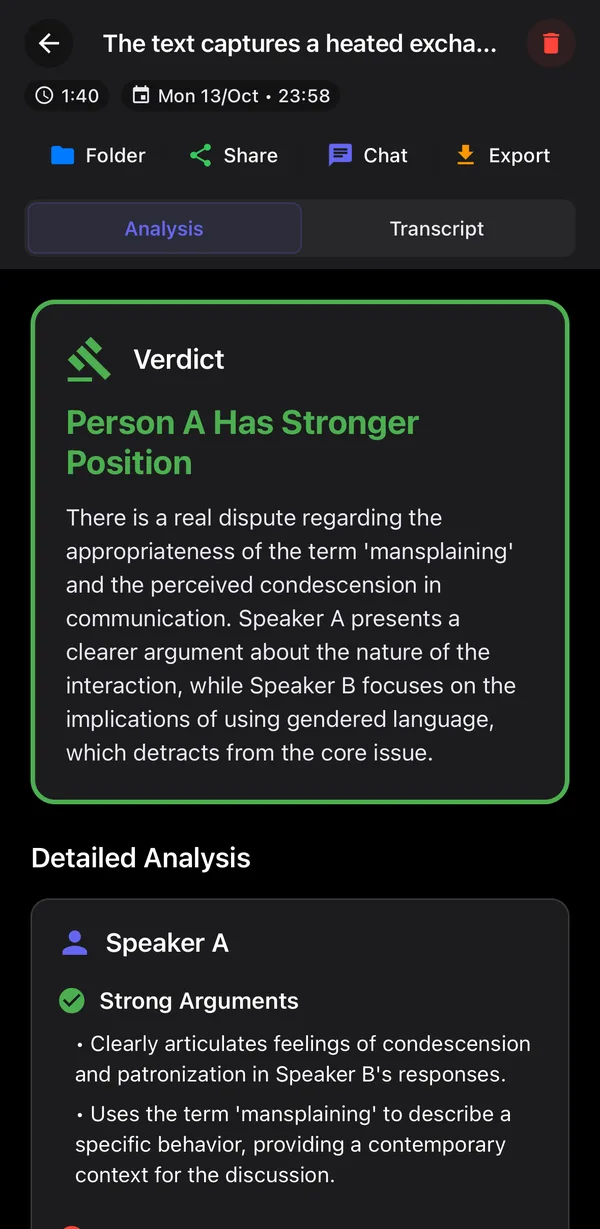
Every page gives a plain definition, real-sounding examples, how to tell it apart from a fair point, and what to say back without making things worse. If you're in the middle of one, paste both sides into the argument judge: it flags the fallacies on each side.
Attacks and distractions
Moves that change the subject or go after the person instead of the point.
- Ad HominemAlso called ad hominem fallacy, argumentum ad hominemAd hominem (Latin for 'to the person') is a fallacy in which someone attacks the person making an argument instead of the argument itself: their character, motives, intelligence or circumstances. The attack may sting, but it doesn't show the point is wrong. 'You're just jealous' and 'What would you know, you're nineteen' are classic ad hominem replies.Read it →
- Genetic FallacyAlso called fallacy of origins, fallacy of virtueThe genetic fallacy is accepting or rejecting a claim because of where it came from rather than because of whether it holds up. "You only think that because your mom told you" dismisses an idea by its origin. Where an idea started can be interesting, but it does not decide whether the idea is right.Read it →
- Guilt by Association FallacyAlso called association fallacy, honor by associationThe guilt by association fallacy is concluding that a person or idea is bad because of who or what it is linked to, instead of on its own merits. "Your friend cheated, so you'd cheat too" judges you by your friend. Association can raise a question; it cannot answer it.Read it →
- Poisoning the WellAlso called poisoning the well fallacy, preemptive ad hominemPoisoning the well is discrediting someone in advance, before they have made their point, so the audience dismisses whatever they say next. "Before Dad tells his side, remember he exaggerates everything" is a classic example. It is a preemptive form of ad hominem: the attack comes first, so the argument never gets a fair hearing.Read it →
- Red Herring FallacyAlso called red herring, irrelevant conclusionA red herring fallacy is a reply that switches to a different topic, one that sounds related but doesn't answer the question, so the original point quietly drops out. The new topic may be important, even true. It still leaves the first issue unresolved. The name comes from a story about using a smelly fish to throw hounds off a trail.Read it →
- Straw Man FallacyAlso called strawman argument, straw personA straw man fallacy is when someone replaces your actual point with a weaker or more extreme version of it, then argues against that version instead. It feels like a win because the distorted claim is easy to knock down, but your real point was never answered. In personal arguments it often starts with 'So what you're saying is...'Read it →
- Tu Quoque FallacyAlso called appeal to hypocrisy, you too fallacyTu quoque (Latin for 'you too') is a fallacy that dismisses a criticism by pointing out that the critic does the same thing: 'You can't tell me to stop vaping, you smoked for ten years.' The critic may well be a hypocrite, but that doesn't make the advice wrong. It's also called the appeal to hypocrisy.Read it →
- WhataboutismAlso called whataboutery, what about youWhataboutism is answering a criticism with a counter-accusation instead of a response: 'What about the time you...' The other person's faults may be real, but they don't make the original criticism wrong. It's a way of changing the subject, and in personal arguments it turns one problem into a contest over who has done worse.Read it →
Weak evidence
Conclusions that lean on too little, the wrong kind, or the loudest kind of proof.
- Anecdotal FallacyAlso called anecdotal evidence fallacy, argument from anecdoteThe anecdotal fallacy is using a personal story or an isolated example in place of solid evidence about a general claim. "My grandpa never wore a seatbelt and lived to ninety" says nothing about whether seatbelts save lives. Stories are vivid and memorable, which is exactly why they can outweigh better evidence in an argument.Read it →
- Appeal to Authority FallacyAlso called appeal to authority fallacy, argument from authorityAn appeal to authority is a fallacy when a claim is treated as settled just because someone with status said it, especially when that person isn't an expert on the topic, is quoted out of context or disagrees with most experts. Citing real expertise on its own subject is a good reason. The fallacy is using a name in place of evidence.Read it →
- Appeal to Emotion FallacyAlso called appeal to emotion fallacy, argumentum ad passionesAn appeal to emotion is a fallacy when feelings are used in place of reasons: guilt, fear, pity or flattery pushes someone to agree instead of evidence that the claim is right. 'After everything I've done for you, you'd really say no?' Feelings matter in personal arguments. The fallacy is treating a feeling as proof about facts or fairness.Read it →
- Bandwagon FallacyAlso called appeal to popularity, ad populumThe bandwagon fallacy treats something as true, good or acceptable because many people believe it or do it: 'Everyone in my class has a phone.' Popularity can be a useful hint, but it isn't evidence that a claim is correct or that a choice is right for you. It's also called the appeal to popularity or argumentum ad populum.Read it →
- Burden of Proof Fallacy and the Appeal to Ignorance, ExplainedAlso called shifting the burden of proof, appeal to ignoranceThe burden of proof fallacy is making a claim and then demanding that others disprove it, instead of supporting it yourself. Its close cousin, the appeal to ignorance, treats a lack of evidence as proof: "you can't prove it didn't happen, so it did." The person making a claim usually carries the burden of backing it up.Read it →
- Cherry Picking FallacyAlso called cherry picking, fallacy of incomplete evidenceThe cherry picking fallacy is selecting only the facts, examples or quotes that support your side while ignoring the ones that don't. Each picked item may be true, but the overall picture is false. Showing a friend three screenshots out of a two-hour text fight is a common everyday version.Read it →
- Hasty GeneralizationAlso called hasty generalization fallacy, overgeneralizationA hasty generalization is a sweeping conclusion drawn from too few examples, or from examples that aren't typical: one unanswered text becomes 'you never answer me', one messy roommate becomes 'people from that school are slobs'. The examples may be real. There just aren't enough of them to support a claim about always, never or everyone.Read it →
- Post Hoc Ergo Propter HocAlso called post hoc fallacy, false cause fallacyPost hoc ergo propter hoc (Latin for 'after this, therefore because of this') is the fallacy of assuming that because one thing happened after another, the first caused the second: 'Ever since your mom visited, you've been distant.' The timing may be a clue, but coincidence, a shared cause or something else entirely could explain it.Read it →
Rigged framing
Arguments that win by how the question is set up, not by what is true.
- Circular Reasoning and Begging the QuestionAlso called begging the question, circular argumentCircular reasoning is an argument whose conclusion is already assumed in its premises, so it ends where it started: 'It was a harmless joke because it didn't hurt anyone.' It's also called begging the question. The argument sounds complete but gives no independent reason to believe the conclusion. In everyday speech, 'begs the question' usually means something else: 'raises the question'.Read it →
- Equivocation FallacyAlso called equivocation, fallacy of ambiguityThe equivocation fallacy is using one word in two different senses within the same argument, so a conclusion seems to follow when it doesn't. "You told me to be more spontaneous, so why are you mad I booked a trip without asking?" slides from spontaneous dates to spontaneous spending. Most equivocation in arguments is accidental.Read it →
- False DilemmaAlso called false dichotomy, either/or fallacyA false dilemma, also called a false dichotomy or either/or fallacy, presents only two options when more exist, so you feel forced to pick one: 'Either you trust me or you check my phone.' Real choices usually include middle paths, combinations or a third option nobody has mentioned yet. The fallacy works by hiding them.Read it →
- Kafka TrapAlso called kafkatrap, kafkatrappingA Kafka trap is an argument where denying an accusation is treated as evidence that the accusation is true. "If you weren't jealous, you wouldn't get so defensive about it" leaves no answer that counts as innocent. The trap is the structure, not the topic, and the label itself is sometimes misused to dodge fair criticism.Read it →
- Loaded Question FallacyAlso called loaded question, complex questionA loaded question fallacy is a question that smuggles in an assumption the other person has not agreed to, so any direct yes or no answer seems to admit it. "Why do you always embarrass me in front of my friends?" assumes you always do. The fair move is to answer the assumption first.Read it →
- Middle Ground FallacyAlso called argument to moderation, false compromiseThe middle ground fallacy is assuming the truth, or the best solution, must lie halfway between two opposing positions. If one person says the bill is due on the 5th and the other says the 15th, the answer is not the 10th. Splitting the difference works for preferences, not for facts.Read it →
- Motte and Bailey FallacyAlso called motte and bailey fallacy, motte and bailey doctrineA motte and bailey is an argument move where someone makes a bold, hard-to-defend claim (the bailey), retreats to a modest, easy-to-defend claim (the motte) when challenged, and then acts as if defending the modest claim also defended the bold one. Two different positions are treated as if they were the same.Read it →
- Slippery Slope FallacyAlso called slippery slope, domino fallacyA slippery slope fallacy claims that one small step will set off a chain of events ending in disaster, without showing why each step would actually lead to the next. 'If we let her stay out until midnight, next she'll be skipping school.' Some chain reactions are real. The fallacy is assuming the whole chain with little or no evidence.Read it →
Debate tactics
Moves that keep an argument going or make it impossible to lose.
- Gish GallopAlso called galloping, kitchen-sinkingA Gish gallop is an argument tactic where someone fires off so many claims, accusations or links, so quickly, that the other person cannot possibly answer them all. Quantity replaces quality: each weak point takes seconds to say and minutes to untangle, so whatever goes unanswered starts to look true.Read it →
- Moving the GoalpostsAlso called moving the goalposts fallacy, shifting the goalpostsMoving the goalposts is changing what counts as proof, or as success, after the other person has already met the original standard. Instead of accepting the result, the person adds a new requirement, so the conclusion they started with can never be lost. It turns a disagreement into a game nobody else can win.Read it →
- No True Scotsman FallacyAlso called no true scotsman, appeal to purityThe no true Scotsman fallacy protects a sweeping claim from a counterexample by redefining the group: 'No real friend would forget your birthday.' 'Mine did.' 'Then she was never a real friend.' Instead of admitting the claim was wrong, the speaker changes the definition so nothing could ever disprove it. The name comes from philosopher Antony Flew.Read it →
- Sunk Cost FallacyAlso called sunk cost effect, Concorde fallacyThe sunk cost fallacy is continuing something mainly because of the time, money or effort already spent on it, even when the future no longer looks worth it. The spent resources are gone whatever you decide next, so on their own they are a poor reason to keep going. Only what lies ahead can change.Read it →
Frequently asked questions
What is a logical fallacy?
A logical fallacy is a flaw in reasoning that makes an argument look stronger than it is. The conclusion might even be true, but the reasons given don't support it. Most fallacies people meet in daily life are informal ones: they misuse evidence, change the subject, or rig the choices.
How many logical fallacies are there?
There is no fixed number. Philosophers have named well over a hundred, and lists online range from a dozen to several hundred depending on how finely they split them. This list covers the ones that actually show up in personal arguments.
What is the difference between formal and informal fallacies?
A formal fallacy is an error in the structure of an argument, so it is invalid whatever it is about. An informal fallacy is an error in the content: weak evidence, irrelevant attacks, loaded wording. Almost every fallacy on this page is informal.
Which fallacies are most common in relationship arguments?
In fights between partners and family members the usual suspects are the straw man (arguing against an exaggerated version of what was said), whataboutism (answering a complaint with a counter-complaint), hasty generalization ("you always", "you never") and the false dilemma.
Does pointing out a fallacy win the argument?
Rarely. Naming a fallacy can sound like scoring a point, and the other person hears an attack. It works better to restate what they actually said, or ask what evidence would change their mind. And spotting a fallacy doesn't prove the conclusion wrong: that mistake has a name too.
The ArgueResolver app · iPhone and Android
Record the argument. Get the verdict.
ArgueResolver listens while you talk it out, works out who said what, and gives an honest verdict on what was actually said, with compromises and steps to fix it.
Free to start · See how it works