Appeal to Emotion Fallacy: Examples, and When Feelings Do Count
Also called: appeal to emotion fallacy, argumentum ad passiones, guilt trip, appeal to pity, appeal to fear
Updated · 5 min read · 4 sources
The short answer
An appeal to emotion is a fallacy when feelings are used in place of reasons: guilt, fear, pity or flattery pushes someone to agree instead of evidence that the claim is right. 'After everything I've done for you, you'd really say no?' Feelings matter in personal arguments. The fallacy is treating a feeling as proof about facts or fairness.
What is an appeal to emotion?
An appeal to emotion tries to win agreement by stirring up a feeling rather than by giving a reason. It works because emotions move us faster than arguments do. But a strong feeling about a claim doesn't make the claim true, and feeling guilty about saying no doesn't make no the wrong answer.
Logic textbooks list several flavors. They often appear together:
- Appeal to fear
- Scare tactics: 'If you don't take this job, you'll regret it for the rest of your life.' A real risk may be in there, but the fear is doing the arguing.
- Appeal to pity
- 'I've had the worst week, so you have to let this go.' Hard circumstances deserve compassion; they don't settle whether something was fair.
- Appeal to guilt
- The guilt trip: 'After all I've sacrificed for this family...' Past generosity becomes leverage on a present decision.
- Flattery
- 'Someone as smart as you can see this is the right call.' Agreement is linked to a compliment instead of a reason.
- Outrage
- Stoking anger so a claim feels obviously true: 'Doesn't it make you furious that they did this?'
When feelings are not a fallacy
In personal arguments, feelings are often the point. 'I felt embarrassed when you corrected me in front of your parents' isn't a fallacy; it's information about the impact of something, and impact is exactly what the two of you are trying to sort out. The Gottman Institute's example of a healthy complaint starts with 'I was scared when you were running late.'
The line is between feelings as information and feelings as proof. 'I'm upset, and here's why' gives the other person something to work with. 'I'm upset, so you're wrong' asks them to concede because of the feeling alone. The first is honest communication, best done with an I statement. The second is the fallacy.
Appeal to Emotion Fallacy examples
Guilt trips and emotional pressure
Families are especially good at appeals to guilt, because there's so much shared history to draw on. 'I guess I just don't matter' or 'Fine, do what you want, I'll manage' can pressure someone into agreeing without anyone stating a reason. When that pressure comes sideways, through sighs and martyrdom instead of a direct request, it overlaps with passive aggressive behavior.
Guilt trips usually come from real feelings: loneliness, fear of being left out, worry. Treating them as manipulation and nothing else tends to escalate things. Treating them as a feeling you can respond to, while still making your own decision, works better.
Appeal to emotion examples
Each of these leans on a feeling to close an argument that hasn't been made:
- 'If you really loved me, you'd move here.'
- 'Think how sad your grandmother will be if you don't come.'
- 'Do you want our kids to grow up in a dangerous neighborhood?' (Without any data about the neighborhood.)
- 'After the year I've had, I can't believe you're bringing this up.'
- 'Everyone on the team will be crushed if we miss Friday.'
How to respond to an appeal to emotion
Take the feeling seriously first. 'I can tell this really hurts' isn't a concession on the decision; it's a signal that you heard them. Skipping straight to 'that's an appeal to emotion' is technically correct and practically disastrous.
Then separate the feeling from the decision, and ask for the reasons: 'I also want to understand why you think staying is the better choice.' If the pressure is high, slow down. Decisions made under a wave of guilt or fear are rarely the best ones, and asking for a day to think is fair.
Watch for appeals to fear dressed as predictions; they often turn into a slippery slope. If you'd like to see how an exchange looks without the emotional heat, our free argument judge weighs the reasons each side actually gave.
What to say
I can tell this really hurts, and I don't want to brush that off. Can we also talk about why I think the trip is okay?
I care about that too. Let's look at the actual numbers before we decide.
I don't want to decide this while we're both upset. Can we come back to it tomorrow?
How you feel about this matters to me. Help me understand your reasons too, so we can weigh both.
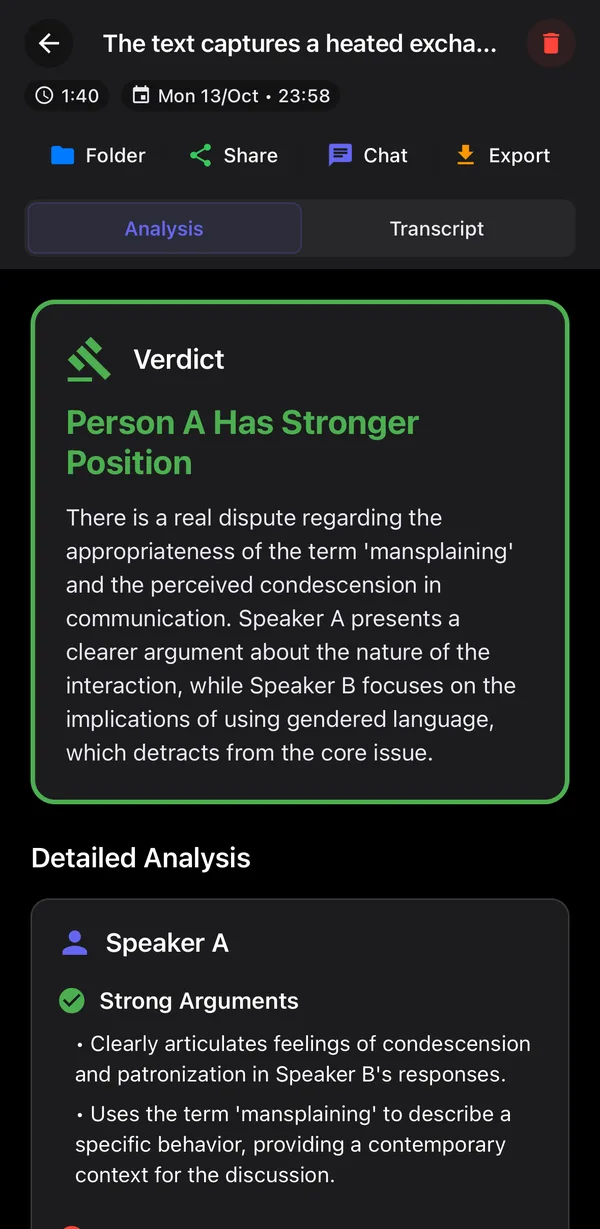
In an argument right now?
Type both sides and get a fair verdict, with the fallacies on each side. Free.
Questions people ask
What is an example of an appeal to emotion?
'If you loved me, you wouldn't go out with your friends this weekend.' It links a decision to proof of love instead of giving a reason why staying home is better.
Is it always a fallacy to appeal to emotions?
No. Saying how something made you feel is legitimate, especially in a relationship. It becomes a fallacy when the feeling is offered as the reason a factual claim is true or a decision is right.
Is a guilt trip an appeal to emotion?
Yes. A guilt trip uses guilt, often about past sacrifices, to push agreement on a present decision without arguing for it directly.
What is the difference between pathos and an appeal to emotion?
Pathos is the classical name for persuading through emotion, and it can be legitimate when the feeling fits the facts. An appeal to emotion fallacy is when the feeling replaces the facts.
Sources
Keep reading
- FallaciesSlippery Slope FallacyA slippery slope fallacy claims that one small step will set off a chain of events ending in disaster, without showing why each step would actually lead to the next. 'If we let her stay out until midnight, next she'll be skipping school.' Some chain reactions are real. The fallacy is assuming the whole chain with little or no evidence.
- FallaciesBandwagon FallacyThe bandwagon fallacy treats something as true, good or acceptable because many people believe it or do it: 'Everyone in my class has a phone.' Popularity can be a useful hint, but it isn't evidence that a claim is correct or that a choice is right for you. It's also called the appeal to popularity or argumentum ad populum.
- GuidesI StatementsI statements are sentences that describe your own feelings and needs instead of judging the other person, for example 'I feel overwhelmed when the dishes pile up, and I need a hand tonight' instead of 'You never help.' They raise a problem without putting the listener on trial, so it can be solved.
- GuidesPassive Aggressive Behavior ExamplesPassive aggressive behavior is showing anger indirectly instead of saying it: a cold "I'm fine", a joke with a sting, a favor done badly on purpose, a loud sigh instead of a request. Common passive aggressive behavior examples include backhanded compliments, convenient forgetting and pointed silence. The fix is saying the feeling directly.
- FallaciesAd HominemAd hominem (Latin for 'to the person') is a fallacy in which someone attacks the person making an argument instead of the argument itself: their character, motives, intelligence or circumstances. The attack may sting, but it doesn't show the point is wrong. 'You're just jealous' and 'What would you know, you're nineteen' are classic ad hominem replies.
The ArgueResolver app · iPhone and Android
Record the argument. Get the verdict.
ArgueResolver listens while you talk it out, works out who said what, and gives an honest verdict on what was actually said, with compromises and steps to fix it.
Free to start · See how it works