Bandwagon Fallacy: Why 'Everyone Does It' Isn't an Argument
Also called: appeal to popularity, ad populum, argumentum ad populum, appeal to the people
Updated · 4 min read · 4 sources
The short answer
The bandwagon fallacy treats something as true, good or acceptable because many people believe it or do it: 'Everyone in my class has a phone.' Popularity can be a useful hint, but it isn't evidence that a claim is correct or that a choice is right for you. It's also called the appeal to popularity or argumentum ad populum.
What is the bandwagon fallacy?
The bandwagon fallacy argues from numbers: lots of people think it, so it's true; lots of people do it, so it's fine. The name comes from the old image of a parade wagon that people jump onto because it's where the crowd is going. Logic textbooks call it ad populum, an appeal to the people.
Crowds can be right, and often are. But what makes a claim true is the evidence, not the headcount. Plenty of things everyone believed have turned out to be wrong, and plenty of things nearly everyone does are bad ideas for a particular family, couple or person.
'Everybody does it': bandwagon arguments at home
Every parent of a teenager knows the opening line: 'Everyone else is allowed to.' It's the bandwagon in its purest form, and it's usually also a hasty generalization, since 'everyone' tends to mean three friends. Adults do it too. 'All our friends are engaged by now.' 'Every couple we know splits the bills fifty-fifty.' 'Nobody irons anymore.'
Social media makes the comparison constant, and highly selective. You see the vacation and the anniversary post, not the argument in the car on the way there. Arguing about what 'everyone' does tends to turn a decision about your life into a contest with an imaginary average.
Bandwagon Fallacy examples
When popularity is a fair reason
Popularity isn't always irrelevant. It counts as evidence in a few situations:
- Questions about norms
- If the argument is whether something is rude, how most people see it is part of the answer. Etiquette is, by definition, about shared expectations.
- Coordination
- Driving on the right, using the app the whole family has, picking the restaurant most of the group can reach. Here going with the crowd is the point.
- A hint worth checking
- If thousands of people rely on a product, that's a reason to look at why. It's a starting point for evidence, not a substitute for it.
- Social cost
- For a teenager, being the only one without something can carry a real social cost. That's a fair reason to weigh, even though 'everyone has one' isn't a reason on its own.
Bandwagon fallacy examples
Listen for 'everyone', 'nobody', 'most people' and 'normal' carrying the argument:
- 'Everyone's kids have phones by eleven.'
- 'Nobody cooks from scratch anymore.'
- 'Most couples our age already own a house.'
- 'Every company uses this software, so it must be the best.'
- 'This video has ten million views, so it's probably true.'
How to respond to a bandwagon argument
Two questions do most of the work. First: is it actually true that everyone does it? Often it isn't, and finding that out gently takes the pressure off. Second: even if it is, does that make it right for us? What other people choose is useful information, not a decision.
Then look for the real reason underneath. A teen who says everyone has a phone may be telling you they feel left out of the group chat. A partner who says all your friends are engaged may be telling you they want to talk about the future. Those are real conversations, and they go better than arguing about the statistics. They come up a lot in arguments with parents.
Bandwagon arguments are close cousins of the appeal to authority: one leans on a crowd, the other on a famous name. If you'd like to check whether a reply leaned on 'everyone' instead of a reason, our free argument judge flags it.
What to say
Is it really everyone? And even if it is, I'd like to hear why it matters to you.
What other people do is worth knowing. What do we actually want?
If lots of people use it, there might be a good reason. Let's find out what it is.
I get not wanting to be the only one. Let's talk about that part.
In an argument right now?
Type both sides and get a fair verdict, with the fallacies on each side. Free.
Questions people ask
What is an example of the bandwagon fallacy?
'Everybody is buying this stock, so it's a smart investment.' Lots of buyers don't show the stock is a good value; crowds can be wrong, especially about prices.
What does ad populum mean?
Argumentum ad populum is Latin for 'argument to the people'. It's the formal name for arguing that something is true or right because it's popular.
Is popularity ever good evidence?
Sometimes. For questions about social norms or coordination, what most people do is relevant. For questions of fact, popularity is at most a hint to check the evidence.
What is the difference between the bandwagon fallacy and the bandwagon effect?
The bandwagon effect is the psychological tendency to adopt beliefs or behaviors because others have. The bandwagon fallacy is the argument that uses that popularity as a reason.
Sources
Keep reading
- FallaciesAppeal to Authority FallacyAn appeal to authority is a fallacy when a claim is treated as settled just because someone with status said it, especially when that person isn't an expert on the topic, is quoted out of context or disagrees with most experts. Citing real expertise on its own subject is a good reason. The fallacy is using a name in place of evidence.
- FallaciesHasty GeneralizationA hasty generalization is a sweeping conclusion drawn from too few examples, or from examples that aren't typical: one unanswered text becomes 'you never answer me', one messy roommate becomes 'people from that school are slobs'. The examples may be real. There just aren't enough of them to support a claim about always, never or everyone.
- FallaciesAppeal to Emotion FallacyAn appeal to emotion is a fallacy when feelings are used in place of reasons: guilt, fear, pity or flattery pushes someone to agree instead of evidence that the claim is right. 'After everything I've done for you, you'd really say no?' Feelings matter in personal arguments. The fallacy is treating a feeling as proof about facts or fairness.
- FallaciesAnecdotal FallacyThe anecdotal fallacy is using a personal story or an isolated example in place of solid evidence about a general claim. "My grandpa never wore a seatbelt and lived to ninety" says nothing about whether seatbelts save lives. Stories are vivid and memorable, which is exactly why they can outweigh better evidence in an argument.
- GuidesArguments With ParentsArguments with parents are normal at every age. For teens they usually involve freedom and rules; for adult children, life choices, advice and boundaries. They go better when you pick a calm time, say clearly what you want (to be heard, advice, or permission), describe your feelings without blaming, and listen long enough to understand their worry.
The ArgueResolver app · iPhone and Android
Record the argument. Get the verdict.
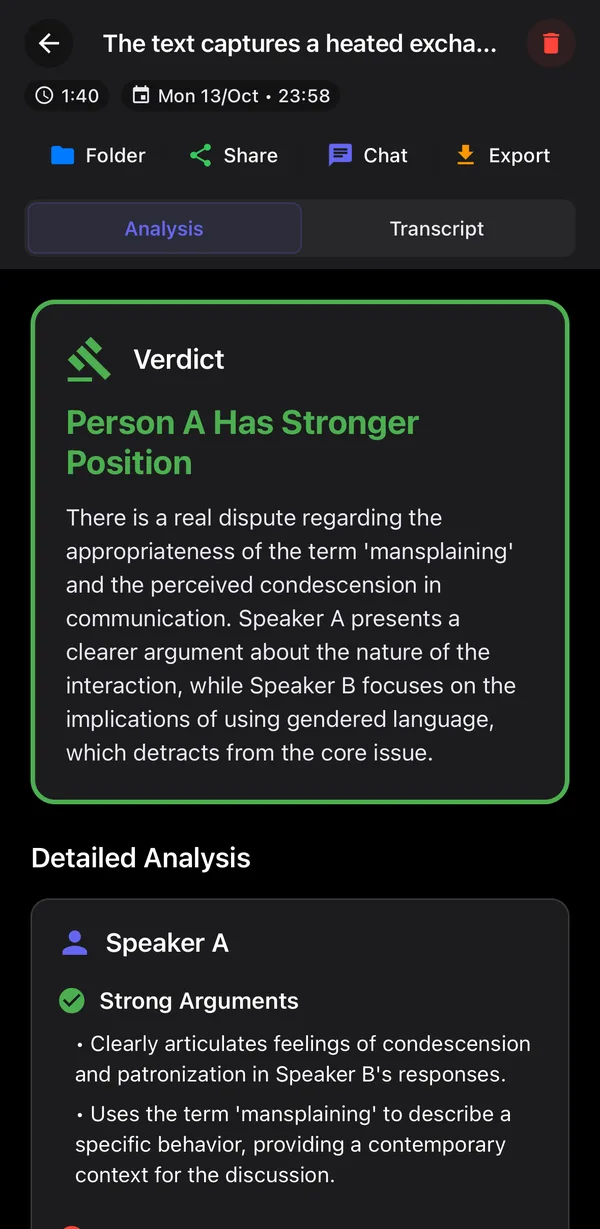
ArgueResolver listens while you talk it out, works out who said what, and gives an honest verdict on what was actually said, with compromises and steps to fix it.
Free to start · See how it works