Arguments With Parents: Why They Happen and How to Handle Them
Also called: fighting with parents, how to argue with parents
Updated · 6 min read · 3 sources
The short answer
Arguments with parents are normal at every age. For teens they usually involve freedom and rules; for adult children, life choices, advice and boundaries. They go better when you pick a calm time, say clearly what you want (to be heard, advice, or permission), describe your feelings without blaming, and listen long enough to understand their worry.
Why arguments with parents happen
Arguments with parents happen because two generations are trying to share a relationship while their needs change at different speeds. A 14-year-old wants more freedom faster than a parent is ready to give it. A 30-year-old wants to be treated as an adult while a parent still feels responsible. Neither side is crazy; they are standing at different points in the same transition.
Researchers have a name for this: the developmental schism, the idea that parent and child tensions come from their different developmental needs. In a study of 158 families, Kira Birditt and colleagues surveyed adult sons and daughters aged 22 to 49 and their mothers and fathers. They found that tensions between parents and adult children are normal, that what causes tension differs by generation, gender and the child's age, and that tensions about the relationship itself (how you treat each other) were linked to less closeness than tensions about individual issues such as one person's habits or choices.
Fighting with parents as a teenager
Many people assume parent-teen conflict climbs to a peak in the middle teen years and then fades. A meta-analysis by Brett Laursen and colleagues found little support for that rise-and-fall picture. Instead, the number of conflicts tended to decline from early to late adolescence, while the emotional intensity of conflicts increased from early to mid adolescence. In other words, you may fight less often at 16 than at 12, but the fights you do have can feel bigger.
The usual topics are familiar: curfew, phones, chores, grades, friends, privacy. Underneath most of them is the same negotiation over trust. The fastest way to win more freedom is rarely the argument itself. It is a track record: doing what you said, telling the truth when it's inconvenient, and texting when plans change.
What it sounds like
How to argue with parents (and actually get somewhere)
Nemours KidsHealth suggests teens prepare for a hard conversation by knowing what they want from it, putting their feelings into words, practicing and picking a good time. Two more steps help at any age.
- Know what you want
- Do you want them to listen, to give advice, or to give permission? Say it up front: 'I just need you to hear me out, I'm not asking for advice yet.'
- Name your feelings
- 'I'm nervous to tell you this' or 'I'm worried you'll be disappointed' lowers everyone's guard. See I statements.
- Pick the moment
- Not when they're walking in from work or in the middle of dinner prep. 'Is now a good time to talk?' goes a long way.
- Practice
- Rehearse the opening line, in your head or with a friend. The first sentence sets the tone for the rest.
- Listen to the worry under the rule
- Most parental rules are about fear (for your safety, your future, your health). Ask what they're worried about, then address the worry, not just the rule. That's active listening.
- Offer a deal
- 'If I text you when I get there and when I leave, can curfew be 11?' Proposals with built-in reassurance get further than demands.
Arguments with parents as an adult
As an adult child, the arguments shift to your choices (partner, career, money, where you live, how you raise your kids) and to unsolicited advice. The core skill becomes setting a boundary without starting a war. That means separating their opinion, which they're allowed to have, from your decision, which is yours: 'I know you'd do it differently. We've decided, and I'd like your support even if you don't agree.'
Holiday plans, visits and grandchildren are frequent flashpoints because they mix logistics with love. Discuss them early, in a calm call rather than a family group chat, and have the conversation with your partner first so you present one plan. If a parent keeps bringing up a settled topic, you can decline to re-argue it kindly: 'I hear you. We're not going to change this one. How's the garden?'
What not to do
Some moves feel satisfying and make every future argument harder. Bringing up old grievances in the middle of a current one turns a talk about curfew into a trial about your childhood. Sarcasm and eye-rolling communicate contempt, which parents (like everyone) respond to by digging in. And 'all my friends' parents let them' is the bandwagon fallacy: it rarely persuades, because their job is your safety, not other people's rules.
Parents make these mistakes too: lecturing instead of listening, 'because I said so', or bringing up a sibling's better behavior. You can't control their moves, but you can avoid answering one bad move with another.
If arguments at home ever involve hitting, threats, or feeling unsafe, that is no longer a disagreement to work through on your own. Talk to a trusted adult such as a school counselor, teacher, relative or doctor, and contact emergency services if you are in danger.
What to say
I need to tell you something and I'm worried about how you'll react. Can you hear me out first?
What are you most worried about? Maybe I can help with that part.
I know you see it differently. This is our decision, and I'd really like your support.
I hear you. We've talked this through and it's decided. Can we talk about something else?
I didn't like how I talked to you earlier. Can we try again?
In an argument right now?
Type both sides and get a fair verdict, with the fallacies on each side. Free.
Questions people ask
Is it normal to argue with your parents?
Yes. Research on both teens and adult children finds conflict with parents is a normal part of the relationship. What matters is whether you can disagree respectfully and repair afterward.
How do I stop fighting with my parents?
Pick calm moments to talk, say what you want from the conversation, ask what's behind their rules, and offer proposals instead of demands. Building trust by following through on agreements reduces fights over time.
How do you argue with parents without disrespecting them?
Disagree with the decision, not the person. Avoid sarcasm, eye-rolling and old grievances, use 'I' statements about how you feel, and acknowledge their concern before making your case.
What should adult children do when parents give unwanted advice?
Thank them for caring, make clear the decision is yours, and change the subject if needed. Repeating a calm boundary works better than arguing the merits every time.
Sources
- Birditt, Miller, Fingerman and Lefkowitz (2009), Tensions in the parent and adult child relationship, Psychology and Aging (PMC)
- Laursen, Coy and Collins (1998), Reconsidering changes in parent-child conflict across adolescence: a meta-analysis, Child Development (PMC)
- Nemours KidsHealth: Talking to Your Parents or Other Adults
Keep reading
- GuidesI StatementsI statements are sentences that describe your own feelings and needs instead of judging the other person, for example 'I feel overwhelmed when the dishes pile up, and I need a hand tonight' instead of 'You never help.' They raise a problem without putting the listener on trial, so it can be solved.
- GuidesActive ListeningActive listening is listening to understand rather than to reply: you let the other person finish, summarize what you heard in your own words, ask questions to check, and acknowledge their feelings before giving your side. In an argument it lowers the temperature fast, because people stop repeating themselves once they feel understood.
- FallaciesTu Quoque FallacyTu quoque (Latin for 'you too') is a fallacy that dismisses a criticism by pointing out that the critic does the same thing: 'You can't tell me to stop vaping, you smoked for ten years.' The critic may well be a hypocrite, but that doesn't make the advice wrong. It's also called the appeal to hypocrisy.
- FallaciesBandwagon FallacyThe bandwagon fallacy treats something as true, good or acceptable because many people believe it or do it: 'Everyone in my class has a phone.' Popularity can be a useful hint, but it isn't evidence that a claim is correct or that a choice is right for you. It's also called the appeal to popularity or argumentum ad populum.
- GuidesHow to Apologize SincerelyTo apologize well, name exactly what you did, take responsibility without excuses, acknowledge how it affected the other person, say what you will do differently, and offer to make it right. Research on apologies finds that taking responsibility and offering repair matter most, while asking to be forgiven matters least.
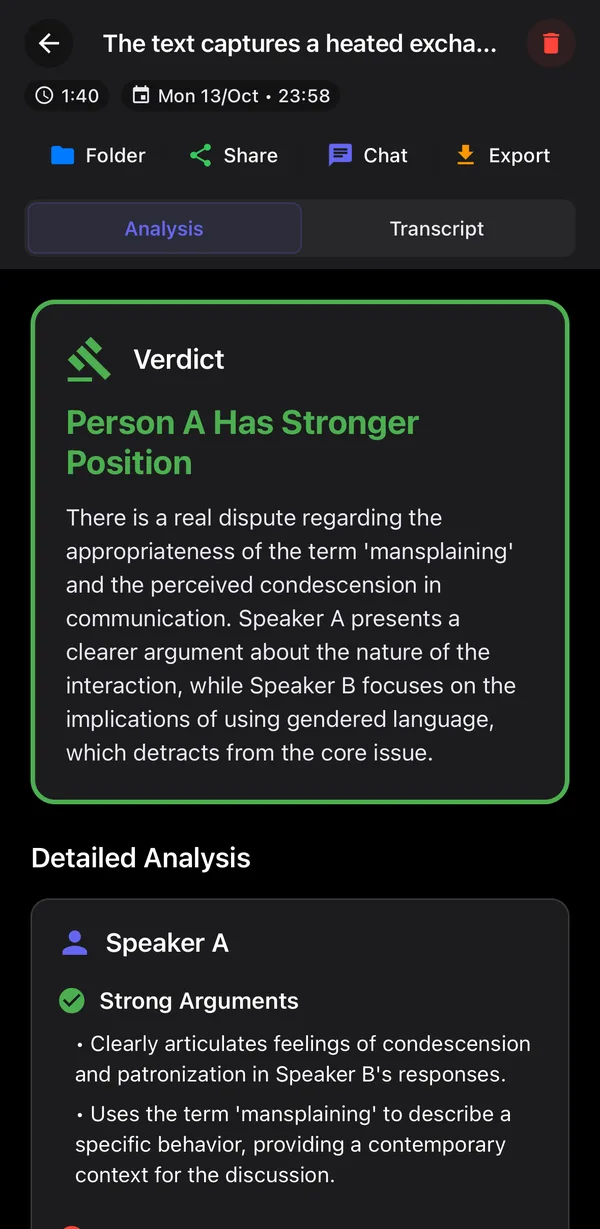
The ArgueResolver app · iPhone and Android
Record the argument. Get the verdict.
ArgueResolver listens while you talk it out, works out who said what, and gives an honest verdict on what was actually said, with compromises and steps to fix it.
Free to start · See how it works