Contempt in Relationships: Signs, Examples and the Antidote
Also called: contempt, contemptuous behavior
Updated · 5 min read · 4 sources
The short answer
Contempt in relationships is treating your partner as beneath you: mockery, sneering, name-calling, eye-rolling, sarcasm meant to wound. The Gottman Institute calls it the single greatest predictor of divorce among the Four Horsemen. It grows from long-held resentment, and the antidote is to state your needs directly and rebuild appreciation.
What is contempt in relationships?
Contempt in relationships is communication that says "I'm better than you." Where criticism attacks what your partner did or who they are, contempt adds disgust and superiority, often moral superiority. The Gottman Institute lists its forms: sarcasm, cynicism, name-calling, eye-rolling, sneering, mockery and hostile humor.
It is the second of John Gottman's Four Horsemen, and the one the Gottman Institute treats as the most destructive. Contempt makes problem-solving almost impossible, because nobody negotiates well with someone who is visibly disgusted by them.
Signs of contempt
Contempt is often in the delivery more than the words. Watch for:
- Eye-rolling, scoffing or a sneer while the other person is talking.
- Mocking imitation of their voice or words.
- Sarcasm designed to sting: "Wow, you remembered. Should I alert the press?"
- Name-calling: lazy, pathetic, useless, stupid.
- Hostile humor at their expense, especially in front of others.
- Correcting their grammar or facts mid-argument to show who is smarter.
- Talking about them to friends or family with disgust rather than frustration.
What it sounds like
Why contempt is so damaging
The Gottman Institute describes contempt as the number one predictor of divorce found in John Gottman's research. It attacks a person's sense of self rather than any behavior they could change, so there is nothing for them to fix except, apparently, being who they are. That leaves two options: fight back or withdraw, which is why contempt so often leads to stonewalling.
The damage is not only emotional. The Gottman Institute reports that its research found couples who are contemptuous of each other more likely to suffer from infectious illnesses such as colds and flu than couples who are not.
Where contempt comes from
Contempt rarely appears out of nowhere. The Gottman Institute says it is fueled by long-simmering negative thoughts about a partner. Complaints that were never voiced, or voiced and ignored, harden into a story: "he's lazy", "she's selfish". Once that story is in place, every new incident becomes evidence, and the tone shifts from frustration to disdain.
That is why criticism matters so much. When complaints are regularly expressed as attacks on character, both people start keeping score, and contempt is the next step.
Contempt, anger and teasing
Anger is not contempt. You can be furious and still treat your partner as an equal: "I'm really angry that you didn't tell me about the loan." Contempt is the added message that they are lesser.
Teasing is not automatically contempt either. Affectionate teasing that both people enjoy, and that stops when one person says it stings, is part of many happy relationships. The line is crossed when the joke is aimed at a sore spot, used to win an argument, or delivered with a sneer.
When contempt becomes emotional abuse
Occasional contemptuous moments are a serious warning sign but not, on their own, abuse. Constant belittling, humiliation in front of others, and put-downs that come with control over money, friends or decisions are something else. The National Domestic Violence Hotline defines relationship abuse as a pattern of behavior one partner uses to keep power and control over the other, and that pattern can be emotional as well as physical. If you recognize that pattern, you deserve support from someone outside the relationship.
The antidote to contempt
The Gottman Institute describes two antidotes. In the moment, describe your own feelings and needs instead of judging your partner: "It's really important to me that we're on time. Can you help me with that?" rather than "I learned to tell time when I was five. When will you?" I statements are built for exactly this.
Over the long term, build a culture of fondness and admiration: small, regular expressions of thanks, affection and respect. The Gottman motto is "small things often." The more positive moments a relationship has, the less room contempt has to grow.
What to say
That was mean, and I'm sorry. What I actually mean is I'm overwhelmed and I need help with the kids tonight.
I'm willing to talk about the chores. I'm not willing to be mocked. Can we try that again?
Something's been building up for me, and I'd rather talk about it now than let it turn into resentment.
I don't say it enough, but thanks for handling the car stuff this week. It made a difference.
In an argument right now?
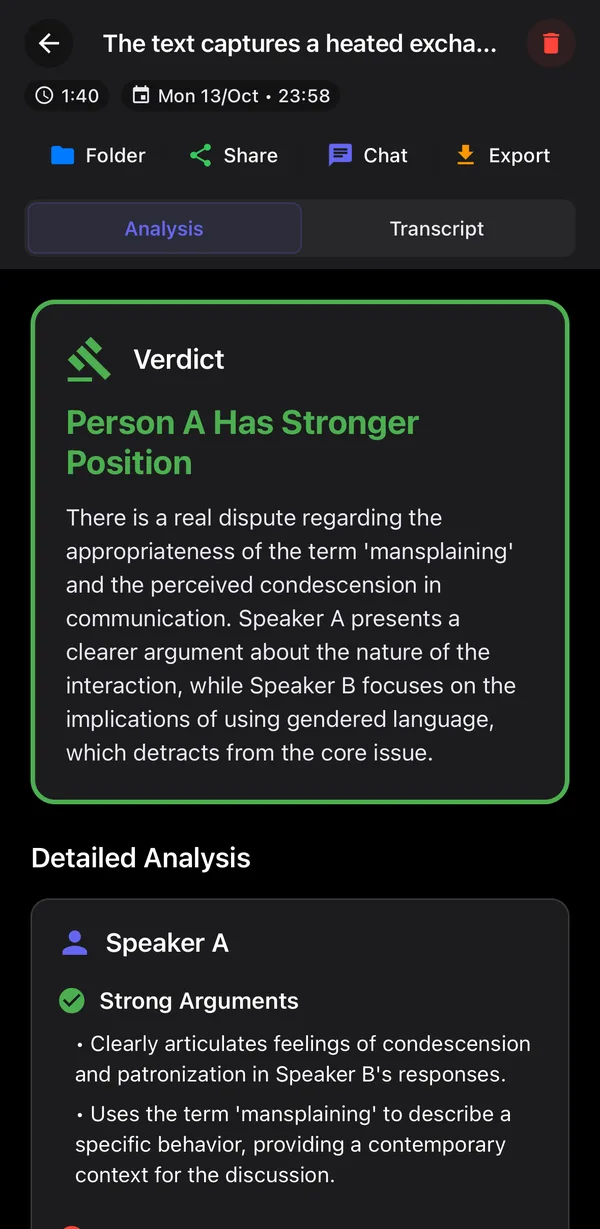
Type both sides and get a fair verdict, with the fallacies on each side. Free.
Questions people ask
What is the difference between contempt and criticism?
Criticism attacks a person's character ("you're selfish"). Contempt adds disgust and superiority ("you're pathetic"), often through sarcasm, mockery or eye-rolling. Contempt is the more damaging of the two.
Can a relationship recover from contempt?
Many can. It takes both people noticing it, replacing it with direct statements of feelings and needs, and rebuilding everyday appreciation. A couples therapist can help, especially if resentment has built for years.
Is sarcasm always contempt?
No. Light sarcasm that both people enjoy is not contempt. It becomes contempt when it is meant to belittle, aimed at a sore spot, or used to win an argument.
Why is contempt the worst of the Four Horsemen?
Because it attacks a person's worth rather than a behavior. The Gottman Institute describes it as the strongest predictor of divorce in its research.
Sources
Keep reading
- GuidesThe Gottman Four HorsemenThe Gottman Four Horsemen are four ways of fighting that John Gottman's research links to relationships falling apart: criticism, contempt, defensiveness and stonewalling. Each has an antidote: a gentle start-up, a culture of appreciation, taking responsibility, and a real break to calm down. How you fight matters more than whether you fight.
- GuidesDefensiveness in RelationshipsDefensiveness in relationships means protecting yourself from a complaint with excuses, counter-complaints or wounded innocence instead of hearing it. It is one of John Gottman's Four Horsemen, and nearly everyone does it. The antidote is to accept responsibility for at least part of the problem, which lets the conversation move forward.
- GuidesPassive Aggressive Behavior ExamplesPassive aggressive behavior is showing anger indirectly instead of saying it: a cold "I'm fine", a joke with a sting, a favor done badly on purpose, a loud sigh instead of a request. Common passive aggressive behavior examples include backhanded compliments, convenient forgetting and pointed silence. The fix is saying the feeling directly.
- FallaciesAd HominemAd hominem (Latin for 'to the person') is a fallacy in which someone attacks the person making an argument instead of the argument itself: their character, motives, intelligence or circumstances. The attack may sting, but it doesn't show the point is wrong. 'You're just jealous' and 'What would you know, you're nineteen' are classic ad hominem replies.
- GuidesI StatementsI statements are sentences that describe your own feelings and needs instead of judging the other person, for example 'I feel overwhelmed when the dishes pile up, and I need a hand tonight' instead of 'You never help.' They raise a problem without putting the listener on trial, so it can be solved.
The ArgueResolver app · iPhone and Android
Record the argument. Get the verdict.
ArgueResolver listens while you talk it out, works out who said what, and gives an honest verdict on what was actually said, with compromises and steps to fix it.
Free to start · See how it works