I Statements: The Formula, Real Examples and When They Backfire
Also called: I-messages, I statement examples
Updated · 6 min read · 4 sources
The short answer
I statements are sentences that describe your own feelings and needs instead of judging the other person, for example 'I feel overwhelmed when the dishes pile up, and I need a hand tonight' instead of 'You never help.' They raise a problem without putting the listener on trial, so it can be solved.
What are I statements?
I statements (also called I-messages) are a way of raising a complaint that starts from your experience rather than from a verdict about the other person. 'You're ignoring me' is a you statement: it accuses. 'I feel lonely when we're both on our phones all evening' is an I statement: it reports. The facts can be identical, but the second one is much easier to hear.
The idea comes from psychologist Thomas Gordon, who described I-messages in the 1960s in his parent training work. Couples researchers later reached the same conclusion from a different direction. The Gottman Institute found that arguments tend to end the way they begin, and recommends a 'soft start-up' built on two questions: what do I feel, and what do I need?
The I statement formula
There are two, three and four part versions. The four part version covers almost every situation:
- When (the specific, observable event): 'When the car came back with the tank on empty...'
- I feel (one honest feeling word): '...I felt frustrated...'
- Because (why it matters to you): '...because I was late to work looking for a gas station.'
- Could we / I need (a doable request): 'Could you fill it up when it's under a quarter?'
What it sounds like
I statements examples
The pattern is the same everywhere; only the details change. Notice that each one names a specific moment instead of a personality trait.
- With a partner
- Instead of 'You care more about your friends than me,' try 'When plans get made for Saturday without checking with me, I feel left out. Could we look at the weekend together on Thursdays?'
- With a roommate
- Instead of 'You're so messy,' try 'When the sink is full in the morning, I end up cleaning before I can make breakfast. Can we agree that dishes get done before bed?'
- With a parent
- Instead of 'You treat me like a kid,' try 'When you check my location every hour, I feel like you don't trust me. Could we agree on a check-in text instead?'
- With a teen
- Instead of 'You're always on that phone,' try 'When phones are out at dinner, I miss hearing about your day. Can dinner be phone-free?'
- At work
- Instead of 'You keep interrupting me,' try 'When I get cut off in the client meeting, I lose my point. I'd like to finish before we discuss it.'
When I statements backfire
The most common mistake is the disguised you statement: 'I feel like you never listen to me.' It starts with 'I', but everything after 'feel like' is an accusation, and 'never' is a hasty generalization the other person will argue with. The Gottman Institute flags exactly this phrasing as a harsh start-up wearing a soft costume. A real feeling is one word or two: hurt, worried, embarrassed, lonely, overwhelmed.
The second mistake is using the formula as a script while your tone says something else. An I statement delivered through clenched teeth with an eye-roll is still contempt. The words help, but they cannot carry a message your face is contradicting.
The third is stopping at the feeling. 'I feel hurt' with no request leaves the other person guessing what would help, and guessing wrong starts a second fight. Always end with something specific and doable.
Why I statements work
People defend themselves against judgments, not against information. A you statement hands the listener a charge to deny, so they reach for defensiveness or a counter-accusation. An I statement gives them nothing to deny: you are the expert on your own feelings. That leaves the actual request as the only thing to respond to.
I statements also force you to get specific before you speak. Turning 'you're inconsiderate' into a when-I-feel-because sentence often reveals what you actually want, which is half of solving any disagreement. They pair naturally with active listening: you state your side with an I statement, then make sure you understood theirs before answering.
What I statements are not
They are not a way to avoid responsibility for a complaint. You are still raising a problem, and the other person may still disagree. They are also not a magic sentence that makes anyone agree with you. They simply make it likelier that the two of you argue about the dishes rather than about whether one of you is a bad person. If you want a neutral read on whether your message landed as a request or an accusation, you can paste both sides into our free argument judge.
What to say
Let me restart. When that happened last night, I felt really hurt.
I'm angry right now, and underneath that I'm worried we can't afford this.
It sounds like something I did upset you. What was the specific moment?
What would help me is a heads-up text before you invite people over.
In an argument right now?
Type both sides and get a fair verdict, with the fallacies on each side. Free.
Questions people ask
What is an example of an I statement?
'When I come home to a sink full of dishes, I feel overwhelmed, because I've been working all day. Could we split them tonight?' It names the event, one feeling, the reason and a request.
Is 'I feel like you...' an I statement?
No. Anything that follows 'I feel like you' is a judgment about the other person, so it works like a you statement. Replace it with a feeling word: 'I feel hurt' rather than 'I feel like you don't care.'
Who invented I statements?
Psychologist Thomas Gordon is credited with coining the term I-message in the 1960s and described it in his parent training book Parent Effectiveness Training. Couples therapists later adopted the idea widely.
Do I statements work with someone who is very defensive?
They help, because they remove the accusation the other person is defending against. With a very defensive person, keep the statement short, use one feeling, and follow it with a question about their side.
Sources
Keep reading
- GuidesActive ListeningActive listening is listening to understand rather than to reply: you let the other person finish, summarize what you heard in your own words, ask questions to check, and acknowledge their feelings before giving your side. In an argument it lowers the temperature fast, because people stop repeating themselves once they feel understood.
- GuidesFair Fighting RulesFair fighting rules are agreements two people make about how they will argue: one topic at a time, complaints about behavior instead of attacks on character, no contempt or name-calling, real listening before rebutting, and a time-out when either person is too upset to think. The goal is to solve the problem without wounding each other.
- GuidesDefensiveness in RelationshipsDefensiveness in relationships means protecting yourself from a complaint with excuses, counter-complaints or wounded innocence instead of hearing it. It is one of John Gottman's Four Horsemen, and nearly everyone does it. The antidote is to accept responsibility for at least part of the problem, which lets the conversation move forward.
- GuidesThe Gottman Four HorsemenThe Gottman Four Horsemen are four ways of fighting that John Gottman's research links to relationships falling apart: criticism, contempt, defensiveness and stonewalling. Each has an antidote: a gentle start-up, a culture of appreciation, taking responsibility, and a real break to calm down. How you fight matters more than whether you fight.
- FallaciesHasty GeneralizationA hasty generalization is a sweeping conclusion drawn from too few examples, or from examples that aren't typical: one unanswered text becomes 'you never answer me', one messy roommate becomes 'people from that school are slobs'. The examples may be real. There just aren't enough of them to support a claim about always, never or everyone.
The ArgueResolver app · iPhone and Android
Record the argument. Get the verdict.
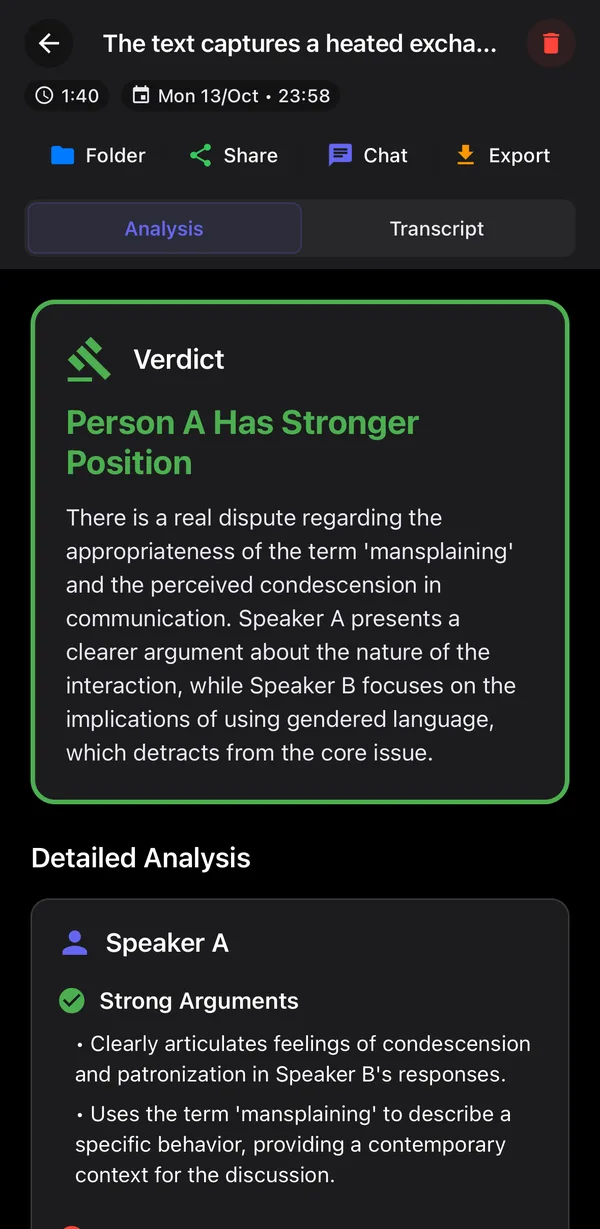
ArgueResolver listens while you talk it out, works out who said what, and gives an honest verdict on what was actually said, with compromises and steps to fix it.
Free to start · See how it works