Active Listening: How to Use It in an Argument (With Examples)
Updated · 5 min read · 4 sources
The short answer
Active listening is listening to understand rather than to reply: you let the other person finish, summarize what you heard in your own words, ask questions to check, and acknowledge their feelings before giving your side. In an argument it lowers the temperature fast, because people stop repeating themselves once they feel understood.
What is active listening?
Active listening means paying full attention to someone and showing them, out loud, that you understood what they meant. Psychologists Carl Rogers and Richard Farson are credited with coining the term. It is the opposite of what most of us do in an argument, which is wait for a gap so we can say the thing we have been rehearsing.
Agreeing is not part of it. You can summarize your partner's view perfectly and still think they are wrong. What active listening changes is the order: understand first, persuade second. Couples researchers at the Gottman Institute found that partners in satisfying, lasting relationships tend to postpone persuasion. The listener asks questions and summarizes, checks the summary with the speaker, and only then presents their own view.
Active listening steps
The Greater Good Science Center at UC Berkeley breaks the practice into a handful of steps. You don't need every one every time, but the more you use, the better it works.
- Let them finish
- Do not interrupt to correct a detail. Note it and come back to it later if it still matters.
- Paraphrase
- Summarize in your own words: 'So what I'm hearing is that you felt blindsided when I told my parents first.'
- Ask, don't assume
- Clarify instead of guessing: 'When you say I don't help, do you mean with the kids, the house, or both?'
- Acknowledge the feeling
- 'That sounds really frustrating' is not a confession. It shows you see their experience, even if you see the facts differently.
- Watch your body language
- Face them, put the phone down, keep your face neutral. An eye-roll undoes ten good sentences.
- Hold the advice
- Problem solving works better once both people feel heard. Jumping to fixes too early makes the other person feel brushed off.
- Then take your turn
- Ask, 'Can I tell you how it looked from my side?' and use an I statement.
What it sounds like
Active listening phrases that work
Good phrases are short and open. They hand the floor back to the other person instead of steering them.
- 'Let me make sure I've got this. You're saying...'
- 'What part of that bothered you most?'
- 'Is there more?'
- 'It makes sense you'd be upset if you thought I'd forgotten.'
- 'Did I get that right?'
Why it calms an argument down
Most heated arguments are two people repeating themselves louder because neither believes the other heard. The moment you summarize someone's point accurately, the need to repeat it disappears. Very often the volume drops on its own.
It also exposes misunderstandings early. Plenty of arguments turn on two people answering different questions: one is upset about being left out, the other is defending the decision itself. A single good paraphrase ('so this is less about the trip and more about not being asked?') can move the conversation to the real issue. That is also your best protection against accidentally arguing against a straw man version of what the other person said.
Common mistakes that make it sound fake
Parroting word for word ('I hear you saying you're angry') sounds like a customer service script. Use your own words and include the specifics.
Summarizing with a twist is worse than not summarizing at all. 'So you're saying I'm a terrible father' is not a paraphrase of 'I wish you'd come to more games.' It is an exaggeration designed to be denied.
Using listening as a stall also backfires. If you nod through their whole point and then answer exactly as you planned to, they will notice. Let what you heard change at least part of your reply, even if only to concede the parts they got right.
When active listening is not enough
If you are too upset to listen (heart racing, mind blank, wanting to shout), no technique will work until your body calms down. Take a break of at least 20 minutes and come back. See emotional flooding. And listening is a two-way skill: if only one person ever does it, it becomes a way to absorb the other's anger rather than a way to solve problems together.
What to say
Hold on, I want to hear the rest before I answer. Keep going.
When you say I'm never around, do you mean weekends or evenings?
I remember it differently, but I can see why that felt awful. Can I share my side?
I think I understand your side now. Would you do the same for me for a couple of minutes?
In an argument right now?
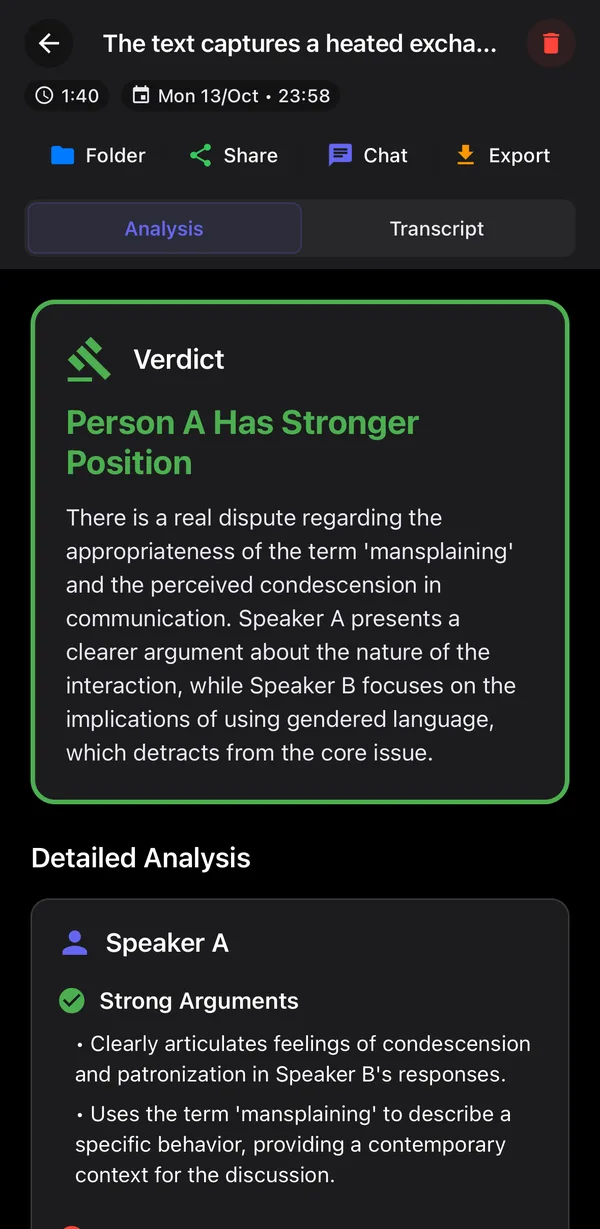
Type both sides and get a fair verdict, with the fallacies on each side. Free.
Questions people ask
What are the main steps of active listening?
Let the person finish, paraphrase what you heard, ask clarifying questions, acknowledge their feelings, and only then share your own view. Body language that shows attention, like putting the phone down, supports all of it.
Does active listening mean I agree?
No. It means you understood. You can summarize someone's view accurately and still disagree, and your disagreement will be taken more seriously because they know you heard them.
What's an example of active listening in a relationship?
Your partner says you never plan dates. Instead of listing the dates you planned, you say, 'It sounds like you've been feeling like the effort is one-sided lately. Is that right?' and let them answer.
Why is active listening hard during a fight?
Because strong emotion pushes us to defend ourselves. When your body is in fight-or-flight mode it is hard to take in what someone says, which is why a short break can make listening possible again.
Sources
Keep reading
- GuidesI StatementsI statements are sentences that describe your own feelings and needs instead of judging the other person, for example 'I feel overwhelmed when the dishes pile up, and I need a hand tonight' instead of 'You never help.' They raise a problem without putting the listener on trial, so it can be solved.
- GuidesFair Fighting RulesFair fighting rules are agreements two people make about how they will argue: one topic at a time, complaints about behavior instead of attacks on character, no contempt or name-calling, real listening before rebutting, and a time-out when either person is too upset to think. The goal is to solve the problem without wounding each other.
- GuidesHow to Stop ArguingTo stop arguing, pause when either of you is too upset to think, take a break of at least 20 minutes with a set time to come back, then restart gently on one issue. Understand the other person's side before persuading. If it's the same fight on repeat, talk about why it matters to each of you.
- FallaciesStraw Man FallacyA straw man fallacy is when someone replaces your actual point with a weaker or more extreme version of it, then argues against that version instead. It feels like a win because the distorted claim is easy to knock down, but your real point was never answered. In personal arguments it often starts with 'So what you're saying is...'
- GuidesEmotional FloodingEmotional flooding is physical and emotional overwhelm during conflict: your heart races, stress hormones surge, and you lose the ability to listen or think flexibly. People who are flooded tend to attack or shut down. The fix is to notice the signs early, call a break of at least 20 minutes, and actually calm your body before talking again.
The ArgueResolver app · iPhone and Android
Record the argument. Get the verdict.
ArgueResolver listens while you talk it out, works out who said what, and gives an honest verdict on what was actually said, with compromises and steps to fix it.
Free to start · See how it works