How to Stop Arguing: 9 Ways to End the Same Fight on Repeat
Updated · 6 min read · 5 sources
The short answer
To stop arguing, pause when either of you is too upset to think, take a break of at least 20 minutes with a set time to come back, then restart gently on one issue. Understand the other person's side before persuading. If it's the same fight on repeat, talk about why it matters to each of you.
How to stop arguing in the moment
If you want to know how to stop arguing right now, the honest answer is: stop trying to finish it right now. Most fights escalate because both people keep going after they've stopped being able to listen. Couples researchers at the Gottman Institute call that state flooding: the body reacts to the argument as a threat, the heart races (often above 100 beats per minute), and the part of you that can weigh another person's point goes offline.
The fix is physical before it is verbal. Say you need a break, say when you'll be back, and leave the conversation for at least 20 minutes. In one experiment at Gottman's research lab, couples were interrupted mid-argument and asked to read magazines for half an hour while the equipment was supposedly adjusted. When they resumed, their heart rates were significantly lower and their conversation was more productive.
9 ways to stop arguing (and actually solve things)
The first three steps stop the fight. The rest stop it from coming back.
- 1. Notice the signs early
- Raised voice, clenched jaw, rehearsing comebacks while they talk, the urge to say something you know is cruel. Those are your cue to pause, not to push harder.
- 2. Call a break the right way
- 'I'm too upset to do this well. Can we pick it up at 8?' The person who asks for the break is responsible for coming back. A break with no return time feels like abandonment.
- 3. Actually calm down during the break
- Walk, shower, play a game, breathe slowly. Don't spend 20 minutes rehearsing your case; that keeps you flooded. See emotional flooding.
- 4. Restart soft
- Come back with how you feel and what you need, not with the sharpest version of your argument. I statements are the easiest way.
- 5. One topic only
- If the dishes became the dishes plus your mother plus the vacation, pick one and park the others.
- 6. Understand before you persuade
- The Gottmans found that partners in lasting, satisfying relationships postpone persuasion: the listener asks questions and summarizes until the speaker agrees they got it, then they switch. Use active listening.
- 7. Name the loop
- Most repeat fights follow a script. A common one is pursue and withdraw: one partner pushes to talk, the other shuts down, which makes the first push harder. Saying 'we're doing our thing again' out loud can break it.
- 8. Talk about how each of you fights
- Some people grew up in homes where arguments were loud and over fast; others where any conflict meant something terrible. Knowing that changes how you read each other's raised voice or silence.
- 9. Accept what won't be solved
- Some differences are permanent. For those, aim for an ongoing, friendly conversation instead of a final win.
What it sounds like
How to de-escalate an argument
De-escalating is about lowering the threat level so both nervous systems can stand down. Slow your speech and lower your volume; people tend to match each other. Sit down if you're both standing. Acknowledge one thing that is true in what they said ('you're right that I forgot to call'), which costs you little and signals you're not at war.
Avoid the moves that predictably raise the temperature: sarcasm and eye-rolling (contempt), counter-accusations (defensiveness), dragging in a separate grievance (whataboutism), and absolutes like 'you always'. And avoid telling someone to calm down. Offer a break instead.
Why you keep having the same argument
According to the Gottman Institute, about 69 percent of relationship conflict is about perpetual problems: lasting differences in personality or needs. One of you is a saver and one a spender, one wants more social time, one needs more quiet. Those don't get solved once. When couples try to win them, they get stuck in what Gottman calls gridlock: the same fight, more hurt each time.
The way out is to stop arguing about the position and start asking about the meaning. Why does a clean kitchen matter so much to you? What does a spontaneous weekend away mean to them? The Gottmans note that couples often jump to a compromise before they understand each other, and then wonder why the agreement doesn't hold. Understanding first is slower, and it is the only kind of agreement that lasts.
When one of you wants to talk and the other shuts down
A diary study of 116 couples by Lauren Papp and colleagues found that this demand-withdraw pattern ran in both directions about equally (men and women were equally likely to be the one pushing), showed up more often when the topic was the relationship itself, and was linked to more negative emotion and less resolution. In other words, it is common, and it doesn't work for either partner.
If you're the pursuer, ask for a specific time instead of an immediate answer. If you're the one who withdraws, say what's happening ('I'm overwhelmed, not ignoring you') and commit to coming back. Silence without explanation reads as stonewalling, even when it's really self-protection.
When to get help
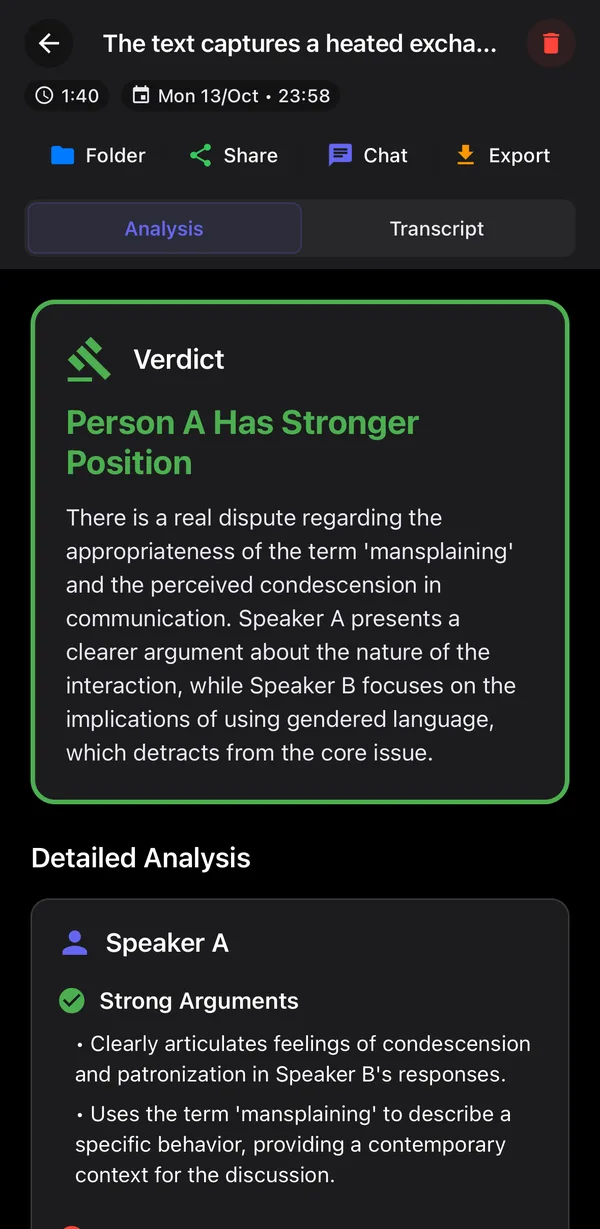
If the same fight keeps getting meaner, if one of you regularly mocks or insults the other, or if arguments leave anyone afraid, a couples therapist is worth the cost. If there are threats or physical intimidation, that is a safety issue first, and individual support matters more than joint problem-solving. For everyday stalemates, a neutral outside view can also help you see which part of the fight is actually about the issue; you can write out both sides in our free argument judge.
What to say
I don't want to say something I'll regret. Let's take 20 minutes and come back at 7:30.
We keep ending up here. Can we talk about why this matters so much to each of us, instead of who's right?
I'm not ignoring you. I'm overwhelmed. I'll come back to this tonight.
You're right about part of this. Let me start with that part.
Maybe we need someone outside this to help us see it. Would you be open to that?
In an argument right now?
Type both sides and get a fair verdict, with the fallacies on each side. Free.
Questions people ask
How do you stop an argument from escalating?
Pause as soon as either of you is too upset to listen, take a break of at least 20 minutes with a set time to return, and restart with a calm, specific statement of what you feel and need. Avoid sarcasm, absolutes and counter-accusations.
How long should a break during an argument last?
The Gottman Institute recommends at least 20 minutes so the body can settle, and sometimes longer. Agree on when you'll come back, and the person who asked for the break should restart the conversation.
Why do we keep arguing about the same thing?
Most likely it's a perpetual problem: a lasting difference in needs or personality. Those can't be won, only understood and managed. Talk about what the issue means to each of you instead of re-arguing the positions.
Is it better to just stop talking when we argue?
A planned pause is good; open-ended silence isn't. Silence without an explanation or a return time usually escalates things, because the other person feels shut out.
Sources
- The Gottman Institute: Who Has to Calm Down First?
- The Gottman Institute: We Agreed. Why Are We Having This Argument Again?
- The Gottman Institute: When the Fight Never Ends
- The Gottman Institute: Managing Conflict, Solvable vs. Perpetual Problems
- Papp, Kouros and Cummings (2009), Demand-Withdraw Patterns in Marital Conflict in the Home (PMC)
Keep reading
- GuidesEmotional FloodingEmotional flooding is physical and emotional overwhelm during conflict: your heart races, stress hormones surge, and you lose the ability to listen or think flexibly. People who are flooded tend to attack or shut down. The fix is to notice the signs early, call a break of at least 20 minutes, and actually calm your body before talking again.
- GuidesFair Fighting RulesFair fighting rules are agreements two people make about how they will argue: one topic at a time, complaints about behavior instead of attacks on character, no contempt or name-calling, real listening before rebutting, and a time-out when either person is too upset to think. The goal is to solve the problem without wounding each other.
- GuidesStonewalling in RelationshipsStonewalling is when one person in an argument shuts down and stops responding: no eye contact, no answers, eyes on a phone, or walking off without a word. It is one of John Gottman's Four Horsemen. It usually happens when someone feels overwhelmed, and what helps is an agreed break, not more pressure.
- GuidesWhat Do Couples Fight About?What do couples fight about? Most often chores, money, children, in-laws and extended family, time together, attention and phones, sex and affection, and plans. Research suggests the topic matters less than what sits underneath it: money fights, for example, are not the most frequent but tend to be the most recurring and least resolved.
- GuidesActive ListeningActive listening is listening to understand rather than to reply: you let the other person finish, summarize what you heard in your own words, ask questions to check, and acknowledge their feelings before giving your side. In an argument it lowers the temperature fast, because people stop repeating themselves once they feel understood.
- FallaciesWhataboutismWhataboutism is answering a criticism with a counter-accusation instead of a response: 'What about the time you...' The other person's faults may be real, but they don't make the original criticism wrong. It's a way of changing the subject, and in personal arguments it turns one problem into a contest over who has done worse.
The ArgueResolver app · iPhone and Android
Record the argument. Get the verdict.
ArgueResolver listens while you talk it out, works out who said what, and gives an honest verdict on what was actually said, with compromises and steps to fix it.
Free to start · See how it works