
Skip to content
ArgueResolver
4.7 on the App Store

Who's right?
Let a fair AI settle it.

Type both sides of the argument. In about 20 seconds you'll know who has the stronger case, where each of you went wrong, and how to make peace.

New argument

Free · no sign-up

Stuck?Need an idea?Not sure what to write?

First side
Second side

We don't save what you write; it goes to our AI provider only to write the verdict. An AI opinion, not legal, medical or therapy advice. Privacy

How it works

From a fight to a plan in three steps

  1. 1Write both sides

    Give each side a name and their position, in their own words. Add background if it matters.

  2. 2Get an honest verdict

    Who has the better-supported case and how sure that is, each side's strong and weak points, and any fallacies.

  3. 3Settle it

    Concrete next steps, fair compromises, and words you can actually say to each other.

A real verdict

This is what you get

The judge's actual answer to a fight about dishes, word for word. It doesn't side with whoever is more tired or more upset: it finds the agreement, checks who kept it, and suggests the sentence that ends the argument.

Maya

I cooked dinner every night this week, and we agreed months ago that whoever doesn't cook does the dishes. Tonight Jordan left everything in the sink again and said he'd do it tomorrow. I'm tired of waking up to a dirty kitchen.

Jordan

I had a 12 hour shift and I'm exhausted. I said I'd do them first thing in the morning, which I always do. She acts like I never help, but I do the laundry and all the grocery runs.

Sample verdict67% confidence

Maya has the stronger case

Maya’s position is better supported on tonight’s dishes: she says the agreement was that the person who did not cook would wash up, and Jordan’s account does not dispute that agreement or say he did the dishes. Jordan’s exhaustion and household contributions are relevant, but they do not establish that postponing the agreed task is fair; the accounts do not clarify whether the agreement allowed exceptions or whether his usual morning follow-through is reliable.

MayaStronger case

65

Strong points

  • Identifies a specific division-of-labor agreement and the immediate problem: dishes left overnight after she cooked.

Jordan

55

Strong points

  • Explains that he was exhausted after a long shift and says he would do the dishes in the morning.
  • Raises other household contributions that may matter when reviewing the overall division of labor.

Weak points

  • Does not address whether postponing the dishes fits the agreement Maya describes.

How to resolve it

  1. 1Agree whether the dishes rule requires completion the same night or allows a specific exception after unusually long shifts.
  2. 2If a delay is allowed, set a clear deadline, such as completing the dishes before breakfast, and follow up on whether that works in practice.
  3. 3Review cooking, dishes, laundry, and grocery runs together, then agree on a division both consider workable.
  4. 4Proposed wording for Maya to Jordan: “I appreciate the other tasks you handle. Can we agree on when dishes need to be done, including after a long shift?”

Possible compromises

  • Allow a postponement after an unusually long shift only if Jordan completes the dishes by an agreed morning deadline.
  • Review the full set of household tasks together rather than evaluating the dish arrangement in isolation.

Next step

Maya’s account supports holding Jordan to the stated dishes agreement, while Jordan’s other contributions deserve consideration in a broader review of chores. The useful next step is to clarify a consistent exception and morning deadline, then assess whether both people follow the revised arrangement.

Fair by design

Honest, not diplomatic

The judge follows the same written rules the ArgueResolver app uses on recorded arguments, tested on real disputes.

01

Substance first

A valid feeling doesn't prove a factual claim, and an insult doesn't make a correct claim wrong. The verdict weighs what each side can support.

02

Same standard for both

Who writes better, who is calmer, who is listed first: none of it counts. Swapping the names should never change the verdict.

03

No forced winners

Sometimes one side is right. Sometimes both are, or neither. When the accounts can't settle it, the verdict says what's missing.

04

Safety over winning

If an account describes violence, threats or coercion, there is no winner to pick: the verdict says so plainly and points to help.

The ArgueResolver app

Don't retell the fight. Record it.

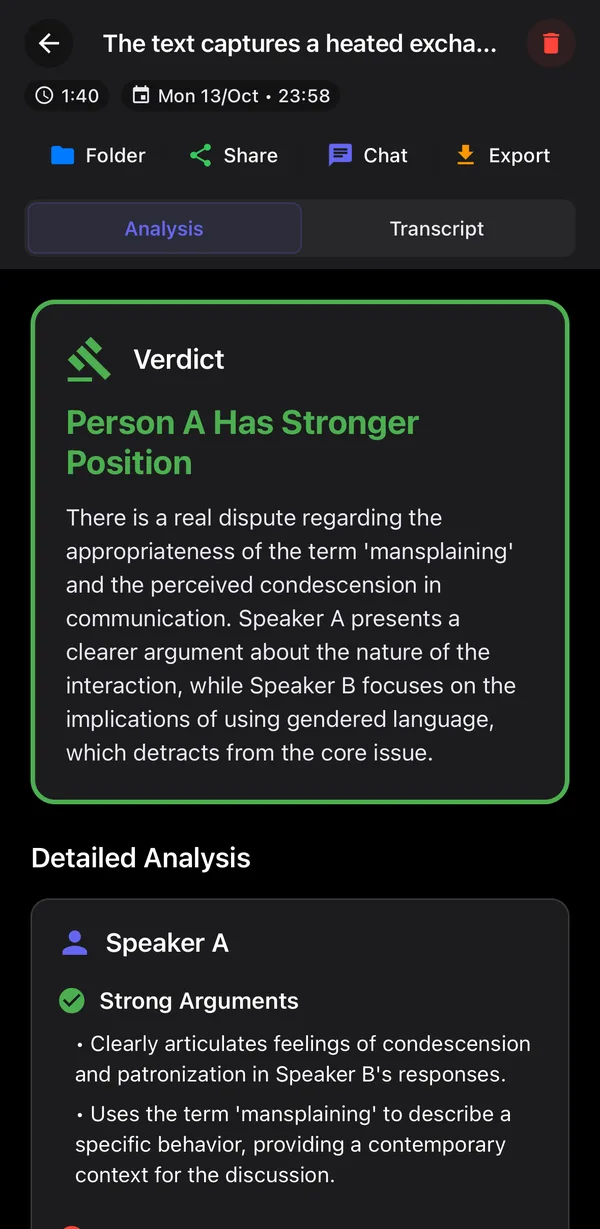
Retelling an argument always tilts it. The app records the conversation, works out who said what, and judges the words that were actually spoken. Then it helps you fix it.

  • Record live or upload a memo
  • Who said what, in 15+ languages
  • Verdict, fallacies, compromises
  • Steps you tick off together
  • An AI mediator to ask
  • Rated 4.7 on the App Store
ArgueResolver recording an argument
ArgueResolver showing a verdict: Person A has the stronger position

Argue better

Know the moves

The fallacies and habits that keep arguments going in circles, shown the way they sound at home, with what to say instead.

FAQ

Questions, answered

Something else? Write to us.

Frequently asked questions

Is ArgueResolver's argument judge really free?

Yes. You get a few free verdicts every day without signing up. The ArgueResolver app adds what a web form can't: it records the actual conversation, separates who said what, and keeps your disputes and resolution steps.

How does the AI decide who is right?

It finds the main disagreement, then judges each position on substance (is it accurate, relevant, fair?) and conduct (did it help or block solving the problem?). It names logical fallacies only when they are clear, and gives a confidence level that reflects how well the two accounts support the verdict, not a probability.

What if one person writes both sides?

That's the most common case, so the judge treats each side's text as that side's position as presented. If a side reads like a caricature of what the other person said, it says so and judges the strongest fair version. You get the best verdict when each side is written the way that person would put it.

Do you store what I write?

No. Your text is sent to our AI provider only to write the verdict and is not saved on our servers. We keep a daily count per visitor to enforce the free limit, and that count can't be traced back to what you wrote. Details are in the privacy policy.

Can an AI replace couples counseling?

No. A verdict can help two people see a disagreement clearly and find a next step, but it's an AI opinion on a short description. Recurring fights, contempt or anything that feels unsafe deserve a real counselor. See the Four Horsemen for the patterns researchers link to breakups.

Does it work in other languages?

Yes. Write both sides in the same language and the verdict comes back in that language.

The ArgueResolver app · iPhone and Android

Record the argument. Get the verdict.

ArgueResolver listens while you talk it out, works out who said what, and gives an honest verdict on what was actually said, with compromises and steps to fix it.

Free to start · See how it works