Toilet Seat Up or Down? The Fairest Rule, Settled
Updated · 5 min read · 4 sources
The short answer
Toilet seat up or down? The fairest rule for a shared bathroom is lid down for everyone: each person moves the seat the same amount and nobody drops into the bowl at night. An economist's model finds that leaving it as you used it costs the least total effort, but only a rule everyone agrees to actually ends the argument.
Toilet seat up or down?
Toilet seat up or down is less a question about plumbing than about fairness. In a shared bathroom, someone always has to move the seat, and the argument is over who carries that tiny, endlessly repeated cost. There are three real options: leave it down, leave it however you used it, or close the lid every time.
It is a small thing that feels big, because each time it happens it can read as "you didn't think about me." That is worth knowing before you argue, since winning the plumbing point does nothing for the feeling.
The case for leaving it as you used it
This side has an actual economics paper. In "Up or Down? A Male Economist's Manifesto on the Toilet Seat Etiquette," published in Economic Inquiry in 2011, Jay Pil Choi modeled the costs of moving the seat. He found that the down rule is inefficient unless there is a large difference in how inconvenient moving the seat is for different people, and that the status quo rule, leaving the seat where you used it, beats the down rule across a wide range of cases, including when the inconvenience is the same for everyone.
The logic is simple: if two people who stand alternate with someone who sits, a strict down rule makes the standing users move the seat twice per visit, while leave it as you used it only moves it when the next person needs it different. Fewer total moves.
The verdict
- An economist's model finds it beats the down rule in total effort across a wide range of cases.
- Nobody moves the seat twice in one visit.
- It treats every user's convenience the same.
- Falling into an open bowl at night is a much bigger cost than lifting a seat.
- The same model says down wins when the costs are lopsided.
- It feels considerate to the people who share the bathroom.
What it sounds like
The case for seat down
The down side points out that the costs are not equal. Lifting a seat you can see is a mild chore. Sitting on an open bowl in the dark at 3 a.m. is a cold, wet surprise. When one mistake is much worse than the other, it makes sense to protect against the worse one, and Choi's own model allows for exactly that case: the down rule wins when the inconvenience is lopsided enough.
There is also the consideration argument. Many people experience the seat left up as a small sign that the other person forgot they live there too. That feeling is real, even if it is not an efficiency argument, and an appeal to emotion only becomes a fallacy when it replaces reasons rather than adds to them.
Does closing the lid stop germs?
The lid down side often adds hygiene, and the evidence is weaker than people think. In 2022, engineers at the University of Colorado Boulder used lasers to film the plume from a lidless public restroom toilet: tiny droplets shot up at about 2 meters per second and reached about 1.5 meters above the bowl within 8 seconds. That shows flushing sends particles into the air.
But a study published in the American Journal of Infection Control, testing household toilets with a harmless virus, found that surface contamination in the restroom did not depend on whether the lid was up or down. What made a big difference was cleaning: scrubbing with a disinfectant cut the virus in the bowl water by more than 99.99 percent compared with a brush alone. So close the lid if you like, but clean the bowl with a disinfectant, and do not oversell the lid as a health measure.
The ruling
Lid down, for everyone. It is not splitting the difference between up and down, which would be the middle ground fallacy: it is a different rule that makes everybody pay the same small cost, removes the 3 a.m. surprise, and keeps things from falling in. Choi is right that leave it as you used it is cheaper in total effort, so a household that genuinely agrees on that rule is not wrong.
What does not work is a rule only one person follows. Agree on one, out loud. If you need a referee, put both sides into the argument judge, and for keeping small chores from turning into big fights, see our fair fighting rules.
In an argument right now?
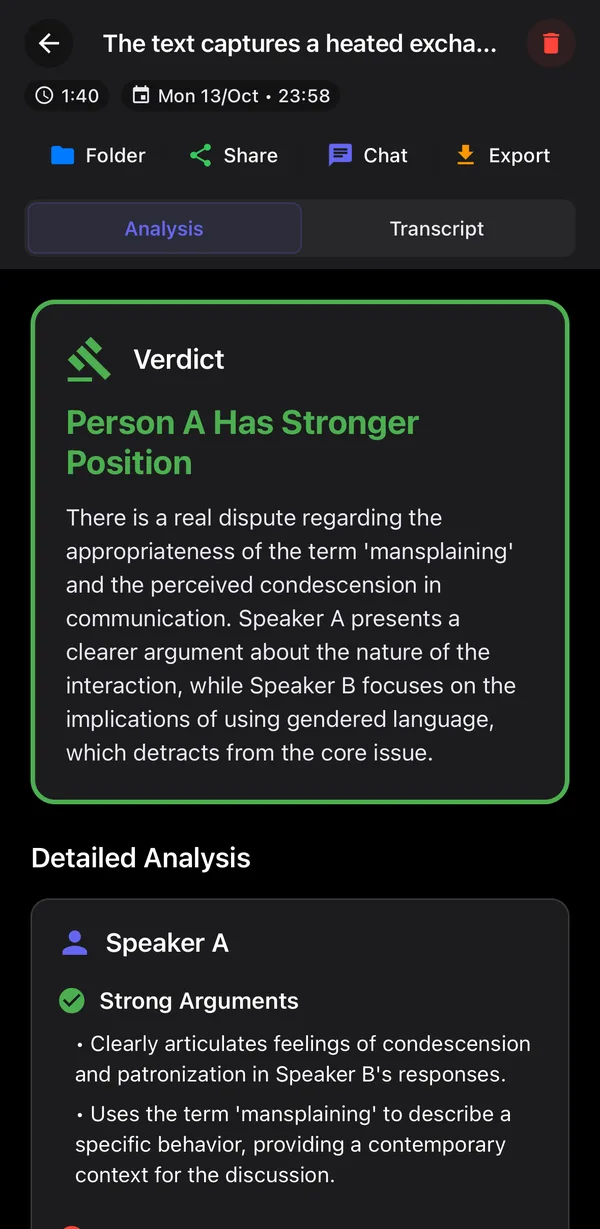
Type both sides and get a fair verdict, with the fallacies on each side. Free.
Questions people ask
Is it rude to leave the toilet seat up?
In a shared home, it can feel inconsiderate if others have asked you to put it down. It is not rude in itself; what matters is the rule your household agreed on.
Should you close the toilet lid when you flush?
You can, and many people prefer it. A study of household restrooms found that lid position did not change surface contamination, so cleaning the bowl with a disinfectant matters more.
What did the economics paper on toilet seats find?
Jay Pil Choi's 2011 paper in Economic Inquiry found that the down rule is inefficient unless inconvenience costs are very unequal, and that leaving the seat as you used it beats it in many cases.
How far does a toilet flush spray?
In CU Boulder's experiments with a lidless public restroom toilet, the plume reached about 1.5 meters above the bowl within 8 seconds.
Sources
- Jay Pil Choi, Up or Down? A Male Economist's Manifesto on the Toilet Seat Etiquette, Economic Inquiry (2011), RePEc record
- CU Boulder Today: CU scientists shine light on what comes up when you flush (2022)
- Goforth et al., Impacts of lid closure during toilet flushing and of toilet bowl cleaning on viral contamination of surfaces, American Journal of Infection Control (PubMed)
- Wikipedia: Toilet seat
Keep reading
- DebatesToilet Paper Over or Under?Toilet paper over or under? Over. The loose end is easier to see and grab, your knuckles stay off the wall, and the 1891 patent drawing for the perforated toilet paper roll shows the sheet hanging over the front. Under has one genuine use: it slows down cats and toddlers who love to unroll the paper.
- FallaciesMiddle Ground FallacyThe middle ground fallacy is assuming the truth, or the best solution, must lie halfway between two opposing positions. If one person says the bill is due on the 5th and the other says the 15th, the answer is not the 10th. Splitting the difference works for preferences, not for facts.
- FallaciesAppeal to Emotion FallacyAn appeal to emotion is a fallacy when feelings are used in place of reasons: guilt, fear, pity or flattery pushes someone to agree instead of evidence that the claim is right. 'After everything I've done for you, you'd really say no?' Feelings matter in personal arguments. The fallacy is treating a feeling as proof about facts or fairness.
- GuidesFair Fighting RulesFair fighting rules are agreements two people make about how they will argue: one topic at a time, complaints about behavior instead of attacks on character, no contempt or name-calling, real listening before rebutting, and a time-out when either person is too upset to think. The goal is to solve the problem without wounding each other.
- GuidesWhat Do Couples Fight About?What do couples fight about? Most often chores, money, children, in-laws and extended family, time together, attention and phones, sex and affection, and plans. Research suggests the topic matters less than what sits underneath it: money fights, for example, are not the most frequent but tend to be the most recurring and least resolved.
The ArgueResolver app · iPhone and Android
Record the argument. Get the verdict.
ArgueResolver listens while you talk it out, works out who said what, and gives an honest verdict on what was actually said, with compromises and steps to fix it.
Free to start · See how it works