Ad Hominem: What It Means, Examples and How to Respond
Also called: ad hominem fallacy, argumentum ad hominem, personal attack
Updated · 5 min read · 5 sources
The short answer
Ad hominem (Latin for 'to the person') is a fallacy in which someone attacks the person making an argument instead of the argument itself: their character, motives, intelligence or circumstances. The attack may sting, but it doesn't show the point is wrong. 'You're just jealous' and 'What would you know, you're nineteen' are classic ad hominem replies.
What does ad hominem mean?
An ad hominem argument rejects a claim because of who made it. The logic underneath is simple: whether a statement is true doesn't depend on the speaker. A rude person can be right about the electric bill, and a kind person can be wrong about it. When a reply targets the speaker instead of the claim, the claim is left standing, unanswered.
That's why ad hominem is classed as a fallacy of relevance. The attack may be about something real (maybe your partner really is messy), but it's beside the point if the question is whether the rent should be split differently.
Types of ad hominem
Logic textbooks split personal attacks into a few families. In real arguments they often arrive together.
- Abusive
- Plain insults used as a rebuttal: 'You're being hysterical', 'That's such a stupid idea, which figures.' Name calling replaces a reason.
- Circumstantial
- Dismissing a claim because of the speaker's situation or interests: 'You only want a cleaner because your parents pay your rent.' Motives can be worth discussing, but they don't make a proposal good or bad.
- Tu quoque
- 'You do it too.' Pointing at the other person's hypocrisy instead of answering. It has its own page: tu quoque.
- Poisoning the well
- Discrediting someone before they speak so nothing they say will be heard fairly: 'Don't bother asking Sam, he always overreacts.'
- Guilt by association
- Rejecting an idea because of the people linked to it: 'That's the kind of thing your ex used to say.'
Ad Hominem examples
Ad hominem in relationships
Couples researcher John Gottman draws a line that maps neatly onto this fallacy. A complaint is about a specific issue ('I was worried when you didn't call'). Criticism, the first of his Four Horsemen, attacks the partner's character ('You never think about anyone but yourself'). The Gottman Institute literally describes criticism as an ad hominem attack.
That's the practical reason to care. An ad hominem doesn't just lose the logical point; it changes the subject from the problem to the person. The person attacked now defends their character, the original issue goes unsolved, and the next argument starts from a lower place. Sarcasm, mockery and eye rolling take it further into contempt.
Ad hominem examples you'll recognize
Some phrases do the work of an ad hominem in almost any argument. If one of these is the main reply to a point, the point hasn't been answered:
- 'Says the person who...' (followed by an unrelated flaw)
- 'You're just like your mother.'
- 'Of course you'd say that, you're always negative.'
- 'You're too young to understand.'
- 'Nobody asked you, you don't even work here full time.'
- 'You're only upset because you're tired.'
When criticizing the person is not ad hominem
An insult isn't automatically a fallacy. If someone says 'You're being petty, and here's why the plan won't work', the insult is rude, but the argument that follows can still be valid. It's an ad hominem only when the attack is offered instead of a reason.
Questions about a person can also be relevant. If the dispute is about what happened last night and one person has a record of misremembering events, reliability matters to that factual question. If someone recommends an investment they're paid to sell, a conflict of interest is a fair reason to look harder at the evidence, though not proof that the advice is wrong. The test is whether the point about the person actually bears on the claim.
How to respond to an ad hominem
Resist the counterattack. Trading insults turns one fallacy into two and guarantees nobody talks about the actual issue. A calmer move is to acknowledge the jab briefly, without accepting it, and return to the question on the table.
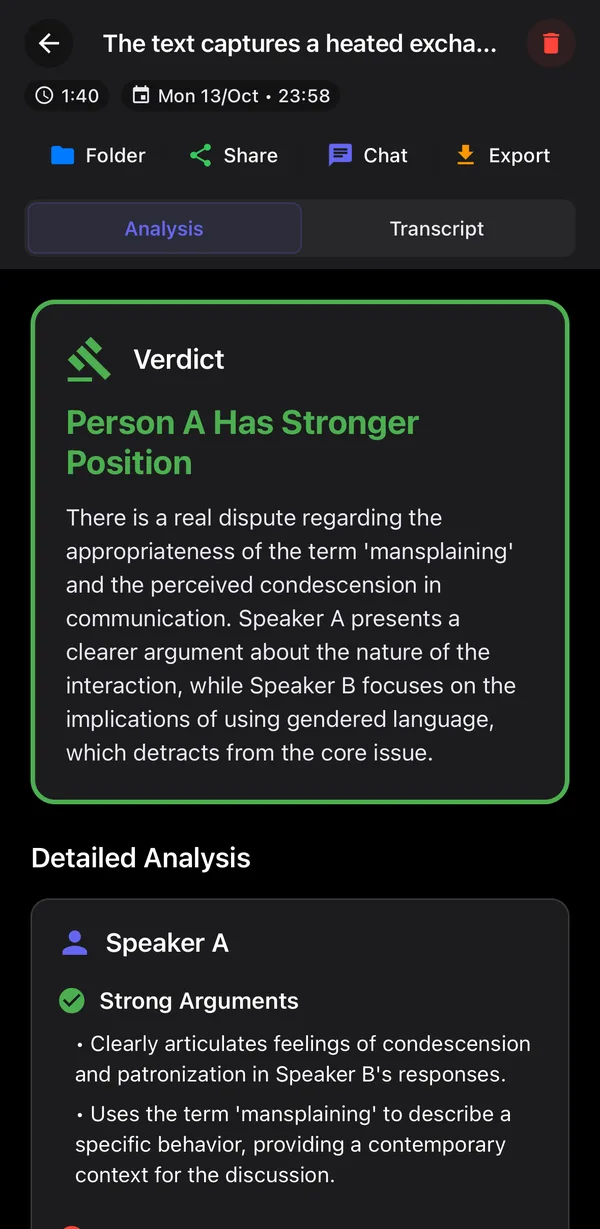
If the attacks keep coming, it's reasonable to set a boundary: you'll keep talking, just not while you're being called names. Taking a short break is not losing. The Gottman Institute suggests about 20 minutes apart when one of you is too worked up to listen, then coming back. When you return, it can help to see the exchange laid out neutrally; our free argument judge separates attacks on the person from answers to the point.
What to say
Maybe I am uptight about money. The question is still whether we can afford this. What do you think?
You can question why I'm suggesting it, but tell me what's wrong with the idea itself.
I want to keep talking about this, just not while we're calling each other names. Can we take twenty minutes and come back?
That was a cheap shot, sorry. Your point about the schedule is fair. Let me answer that instead.
In an argument right now?
Type both sides and get a fair verdict, with the fallacies on each side. Free.
Questions people ask
What is an example of ad hominem?
Someone suggests splitting chores evenly and the reply is 'You're the last person who should talk about fairness.' The reply attacks the speaker and ignores whether an even split makes sense.
Is every insult an ad hominem fallacy?
No. An insult is a fallacy only when it replaces an argument. If a valid reason comes alongside the insult, the reply is rude but not fallacious.
What is the difference between ad hominem and tu quoque?
Tu quoque is a specific kind of ad hominem: it answers a criticism by pointing out that the critic does the same thing. Other ad hominems attack character, motives or circumstances.
Is pointing out someone's bias an ad hominem?
Not necessarily. A conflict of interest is a fair reason to check the evidence more carefully. It becomes ad hominem when the bias is treated as proof that the claim is false.
Sources
Keep reading
- FallaciesTu Quoque FallacyTu quoque (Latin for 'you too') is a fallacy that dismisses a criticism by pointing out that the critic does the same thing: 'You can't tell me to stop vaping, you smoked for ten years.' The critic may well be a hypocrite, but that doesn't make the advice wrong. It's also called the appeal to hypocrisy.
- FallaciesPoisoning the WellPoisoning the well is discrediting someone in advance, before they have made their point, so the audience dismisses whatever they say next. "Before Dad tells his side, remember he exaggerates everything" is a classic example. It is a preemptive form of ad hominem: the attack comes first, so the argument never gets a fair hearing.
- FallaciesGuilt by Association FallacyThe guilt by association fallacy is concluding that a person or idea is bad because of who or what it is linked to, instead of on its own merits. "Your friend cheated, so you'd cheat too" judges you by your friend. Association can raise a question; it cannot answer it.
- GuidesContempt in RelationshipsContempt in relationships is treating your partner as beneath you: mockery, sneering, name-calling, eye-rolling, sarcasm meant to wound. The Gottman Institute calls it the single greatest predictor of divorce among the Four Horsemen. It grows from long-held resentment, and the antidote is to state your needs directly and rebuild appreciation.
- GuidesThe Gottman Four HorsemenThe Gottman Four Horsemen are four ways of fighting that John Gottman's research links to relationships falling apart: criticism, contempt, defensiveness and stonewalling. Each has an antidote: a gentle start-up, a culture of appreciation, taking responsibility, and a real break to calm down. How you fight matters more than whether you fight.
- FallaciesStraw Man FallacyA straw man fallacy is when someone replaces your actual point with a weaker or more extreme version of it, then argues against that version instead. It feels like a win because the distorted claim is easy to knock down, but your real point was never answered. In personal arguments it often starts with 'So what you're saying is...'
The ArgueResolver app · iPhone and Android
Record the argument. Get the verdict.
ArgueResolver listens while you talk it out, works out who said what, and gives an honest verdict on what was actually said, with compromises and steps to fix it.
Free to start · See how it works