Tu Quoque Fallacy: The 'You Do It Too' Reply, With Examples
Also called: appeal to hypocrisy, you too fallacy, tu quoque fallacy
Updated · 5 min read · 4 sources
The short answer
Tu quoque (Latin for 'you too') is a fallacy that dismisses a criticism by pointing out that the critic does the same thing: 'You can't tell me to stop vaping, you smoked for ten years.' The critic may well be a hypocrite, but that doesn't make the advice wrong. It's also called the appeal to hypocrisy.
What does tu quoque mean?
Tu quoque is a reply that answers 'you shouldn't do X' with 'but you do X too'. It treats the critic's inconsistency as if it settled the question. It doesn't. Whether vaping harms your lungs has nothing to do with whether your father smoked; if anything, his experience might make the warning more credible.
Logicians list it as a type of ad hominem, because it shifts attention from the claim to the person making it. It's one of the most natural replies in the world, which is why it's worth recognizing in yourself as much as in others.
Tu quoque vs. whataboutism
The difference is the target. Tu quoque points to the same behavior in the critic: 'You're on your phone just as much.' Whataboutism answers with any counter-accusation, usually a different one: 'What about the time you forgot my birthday?'
So every tu quoque is a whataboutism of a narrow kind, but most whataboutism isn't tu quoque. Both fail for the same reason: a second wrong doesn't cancel the first. They also feel similar in the moment, because each one puts the person who raised the issue on the defensive.
Tu Quoque Fallacy examples
Why 'you do it too' feels like a winning answer
People care a lot about fairness, and hypocrisy offends that instinct. Being criticized by someone who does the same thing feels unfair, and the unfairness is real. The mistake is concluding that the criticism is therefore false.
It helps to separate two questions. Is the critic consistent? That's about the critic's credibility and how the message lands. Is the criticism right? That's about the behavior itself. Tu quoque answers the first question and pretends it answered the second.
When pointing out hypocrisy is fair
Sometimes the critic's behavior is exactly the point. If you're agreeing on a household rule, a rule that one person wants for the other but won't follow is unfair, and saying so is legitimate. The fair conclusion, though, is 'let's both follow it', not 'so the rule is bad'.
Hypocrisy can also be relevant to sincerity. If someone who constantly interrupts complains about interruptions, it's fair to wonder whether they're raising a real concern or scoring a point. That's worth asking gently. It still doesn't decide whether interrupting is a problem.
Tu quoque examples
Listen for a criticism answered with a mirror:
- 'You're telling me to save money? You just bought a new phone.'
- 'Don't lecture me about yelling. You yell all the time.'
- 'You want me to call more? You never call your own mom.'
- 'Says the person who's late to everything.'
How to respond to tu quoque
If the hypocrisy is real, the most disarming answer is to admit it: 'You're right, I do it too.' Defending yourself turns the conversation into a trial about your behavior. Conceding takes that off the table and lets you return to the point: 'That doesn't make it a good idea for either of us. Can we both try?'
If you're the one tempted to say 'you too', try naming the feeling instead: 'It stings to hear this from you, since you do it too. Setting that aside, you might have a point.' That's honest, and it keeps the door open. This comes up constantly in arguments with parents, where the 'you did it at my age' reply is practically a tradition. When you'd like a neutral read on whose point holds up, paste the exchange into our free argument judge.
What to say
You're right, I do it too. That doesn't make it a good idea for either of us. Can we both try?
Fair point about me. Is the advice itself wrong, though?
Let's make it a rule for both of us, then. I'll stick to it too.
It's hard to hear this from you, since you do it too. Setting that aside, you might have a point.
In an argument right now?
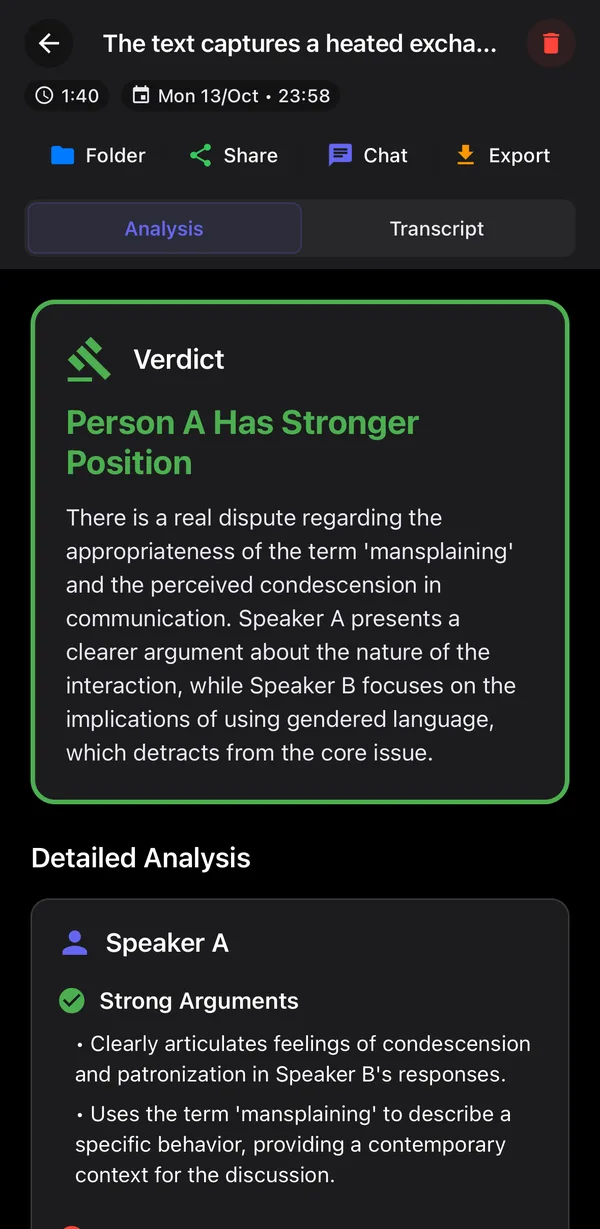
Type both sides and get a fair verdict, with the fallacies on each side. Free.
Questions people ask
What is an example of tu quoque?
A doctor who smokes tells a patient to quit, and the patient replies 'You smoke, so why should I listen?' The doctor's habit doesn't change the medical facts about smoking.
Is tu quoque a type of ad hominem?
Yes. It attacks the critic's consistency instead of the criticism, which is why it's usually classed as a form of ad hominem.
What is the difference between tu quoque and whataboutism?
Tu quoque points to the same behavior in the critic. Whataboutism answers with any counter-accusation, often about something unrelated. Tu quoque is a narrow kind of whataboutism.
Is it ever fair to point out hypocrisy?
Yes, when the question is whether a shared rule is applied fairly, or whether someone is sincere. The fair conclusion is that both people should meet the standard, not that the standard is wrong.
Sources
Keep reading
- FallaciesWhataboutismWhataboutism is answering a criticism with a counter-accusation instead of a response: 'What about the time you...' The other person's faults may be real, but they don't make the original criticism wrong. It's a way of changing the subject, and in personal arguments it turns one problem into a contest over who has done worse.
- FallaciesAd HominemAd hominem (Latin for 'to the person') is a fallacy in which someone attacks the person making an argument instead of the argument itself: their character, motives, intelligence or circumstances. The attack may sting, but it doesn't show the point is wrong. 'You're just jealous' and 'What would you know, you're nineteen' are classic ad hominem replies.
- FallaciesRed Herring FallacyA red herring fallacy is a reply that switches to a different topic, one that sounds related but doesn't answer the question, so the original point quietly drops out. The new topic may be important, even true. It still leaves the first issue unresolved. The name comes from a story about using a smelly fish to throw hounds off a trail.
- GuidesDefensiveness in RelationshipsDefensiveness in relationships means protecting yourself from a complaint with excuses, counter-complaints or wounded innocence instead of hearing it. It is one of John Gottman's Four Horsemen, and nearly everyone does it. The antidote is to accept responsibility for at least part of the problem, which lets the conversation move forward.
- GuidesArguments With ParentsArguments with parents are normal at every age. For teens they usually involve freedom and rules; for adult children, life choices, advice and boundaries. They go better when you pick a calm time, say clearly what you want (to be heard, advice, or permission), describe your feelings without blaming, and listen long enough to understand their worry.
The ArgueResolver app · iPhone and Android
Record the argument. Get the verdict.
ArgueResolver listens while you talk it out, works out who said what, and gives an honest verdict on what was actually said, with compromises and steps to fix it.
Free to start · See how it works