Guilt by Association Fallacy: Examples in Everyday Arguments
Also called: association fallacy, honor by association, bad company fallacy
Updated · 5 min read · 2 sources
The short answer
The guilt by association fallacy is concluding that a person or idea is bad because of who or what it is linked to, instead of on its own merits. "Your friend cheated, so you'd cheat too" judges you by your friend. Association can raise a question; it cannot answer it.
What is the guilt by association fallacy?
Guilt by association is a form of the association fallacy: the assumption that because two things are connected, they must share the same qualities. If a group, a friend or a relative has a bad trait, the person linked to them is assumed to have it too. The same logic works in reverse as honor by association, where a link to someone admired is treated as proof of good character.
The connection can be anything: friendship, family, a shared hobby, the same opinion on one topic. "A scammer once used that app, so everyone on it is shady" follows the same logic. In daily life it is usually much more personal, and much more hurtful.
Guilt by association examples in personal arguments
Couples, parents and friends use guilt by association most when they are worried or hurt. Some familiar versions:
- "Your best friend cheated on his wife, so why would I trust you?"
- "You sound exactly like your mother right now."
- "Those kids vape, so you're obviously vaping too."
- "That's what my ex used to say, and he was a liar."
- "You agree with them on that? So you're on their side about everything."
Guilt by Association Fallacy examples
Why it's a fallacy
People are not copies of the company they keep. Someone can have a friend who cheated and be faithful; sound like a parent on one point and be completely different in character; agree with a group on one issue and disagree on ten others. Treating the link as proof skips the only evidence that matters: what this person actually did or said.
It also tends to put people on the defensive about relationships that have nothing to do with the argument. Instead of discussing the late-night texts that worried you, the conversation becomes a fight about whether the friend is a bad person. In that sense guilt by association often works like a red herring, and when it targets someone's credibility before they speak, it overlaps with poisoning the well.
When association is a fair concern
Who someone spends time with is not always irrelevant. A parent who learns that a teenager's new friends were caught shoplifting has a reasonable concern about influence and risk. A partner who notices that nights out with a particular group often end in heavy drinking has noticed a real pattern. These are fair things to raise.
The difference is between concern and conclusion. "I'm worried, because those kids were caught vaping, so can we talk about it?" is fair. "Those kids vape, so you vape" is guilt by association. The first invites the person's own account; the second has already decided it.
How to respond to guilt by association
Separate yourself from the association without attacking the other person or abandoning your friends. "I'm not him" can sound defensive; something specific works better, like what you actually did, what you would do, or what the other person can check. Then ask what is behind the worry. Very often there is a real fear (of being betrayed, of a child getting hurt) that deserves an answer.
If you notice you are the one reasoning this way, try turning the association into a question. Instead of "you'll cheat like him," say "after what happened with him, I got scared. Can we talk about that?" That shifts the argument from a verdict to a conversation, which is where arguments with parents and partners actually get resolved.
What to say
I understand why that worries you. I'm not him. What would help you feel more secure?
Other people agreeing with me doesn't make it right or wrong. Can we talk about the idea itself?
I might sound like her. Is what I said fair or not? That's the part I'd like to talk about.
That wasn't fair. I'm scared because of what happened to them, and I want to talk about that.
In an argument right now?
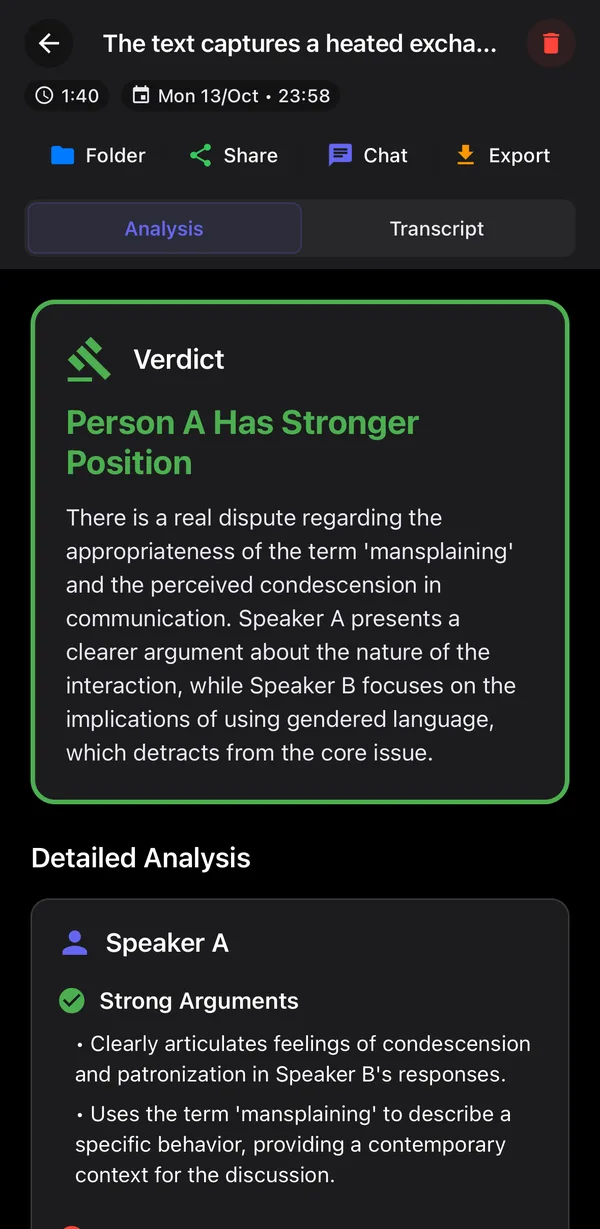
Type both sides and get a fair verdict, with the fallacies on each side. Free.
Questions people ask
What is guilt by association?
It is judging a person or idea as bad because of a connection to someone or something else seen as bad, rather than on what the person actually did or what the idea actually says.
Is guilt by association a logical fallacy?
Yes. It is a form of the association fallacy and a fallacy of relevance, because the link does not show that the person shares the other's traits.
What is honor by association?
The positive mirror image: assuming someone or something is good because of a link to someone admired. It is the same faulty reasoning in the other direction.
Can who you spend time with be a fair concern?
Yes. Friends can influence behavior, so raising it as a concern is fair. It becomes guilt by association when the link is treated as proof of what the person did.
Sources
Keep reading
- FallaciesAd HominemAd hominem (Latin for 'to the person') is a fallacy in which someone attacks the person making an argument instead of the argument itself: their character, motives, intelligence or circumstances. The attack may sting, but it doesn't show the point is wrong. 'You're just jealous' and 'What would you know, you're nineteen' are classic ad hominem replies.
- FallaciesPoisoning the WellPoisoning the well is discrediting someone in advance, before they have made their point, so the audience dismisses whatever they say next. "Before Dad tells his side, remember he exaggerates everything" is a classic example. It is a preemptive form of ad hominem: the attack comes first, so the argument never gets a fair hearing.
- FallaciesGenetic FallacyThe genetic fallacy is accepting or rejecting a claim because of where it came from rather than because of whether it holds up. "You only think that because your mom told you" dismisses an idea by its origin. Where an idea started can be interesting, but it does not decide whether the idea is right.
- FallaciesHasty GeneralizationA hasty generalization is a sweeping conclusion drawn from too few examples, or from examples that aren't typical: one unanswered text becomes 'you never answer me', one messy roommate becomes 'people from that school are slobs'. The examples may be real. There just aren't enough of them to support a claim about always, never or everyone.
- GuidesArguments With ParentsArguments with parents are normal at every age. For teens they usually involve freedom and rules; for adult children, life choices, advice and boundaries. They go better when you pick a calm time, say clearly what you want (to be heard, advice, or permission), describe your feelings without blaming, and listen long enough to understand their worry.
The ArgueResolver app · iPhone and Android
Record the argument. Get the verdict.
ArgueResolver listens while you talk it out, works out who said what, and gives an honest verdict on what was actually said, with compromises and steps to fix it.
Free to start · See how it works