Poisoning the Well: The Fallacy That Discredits You Before You Speak
Also called: poisoning the well fallacy, preemptive ad hominem
Updated · 5 min read · 2 sources
The short answer
Poisoning the well is discrediting someone in advance, before they have made their point, so the audience dismisses whatever they say next. "Before Dad tells his side, remember he exaggerates everything" is a classic example. It is a preemptive form of ad hominem: the attack comes first, so the argument never gets a fair hearing.
What does poisoning the well mean?
Poisoning the well means presenting negative information about a person (true or not) right before they speak, so that listeners are primed to reject their claims. The image is simple: once the well is poisoned, nobody drinks from it, no matter how clean the next bucket of water is.
The term in this sense goes back to the Catholic writer John Henry Newman, who used it in his 1864 book Apologia Pro Vita Sua. He was responding to a critic who had, in his view, made it impossible for anything he said in his own defense to be believed. That is the heart of the fallacy: it does not answer an argument, it prevents one.
How poisoning the well shows up in real life
In families and couples it often sounds like a warning or a prediction: "Now she's going to cry and make me the bad guy." "He'll tell you he was working late, but he always has an excuse." Said to a third person, like a parent, a friend or a therapist, these lines frame the other person's account before it starts.
It also appears as a label for anyone who disagrees: "Anyone who actually cares about this family would agree with me." Now disagreeing means admitting you do not care. At work, it can be a quiet comment before a meeting: "Sam will push back, but he's against every change." Sam's concerns are discounted before he raises them.
Poisoning the Well examples
Why poisoning the well is unfair
Even when the negative information is true, it rarely settles the question at hand. Someone who exaggerates sometimes can still be right this time. Someone who is emotional can still have a valid point. By attacking in advance, the well-poisoner gets the benefit of an ad hominem without having to wait for an argument to attack.
It also puts the target in a bind. If they protest, they seem to prove the warning ("see, he's getting defensive"). If they stay calm, their point still lands in a room that has been told not to trust it. That bind is close to a kafka trap, and it is one reason poisoned conversations escalate so quickly.
When context is fair and when it poisons
Sharing relevant context is not automatically poisoning the well. If someone has a financial stake in a decision, mentioning it helps listeners weigh what they hear. If a coworker has given wrong numbers three times this quarter, it is reasonable to suggest double-checking the next report. The context is about the reliability of a specific claim, and it invites checking rather than dismissal.
It becomes poisoning when the context is used to rule the person's view out before it is heard, when it is about character rather than the specific claim, or when it is chosen to humiliate. A useful test: does the comment encourage people to check what is said, or to stop listening?
How to respond when the well has been poisoned
Do not spend your turn defending your whole character. Acknowledge the comment briefly, ask for a fair hearing and make your point as concretely as you can. Specifics (dates, messages, what was said) are harder to dismiss than general claims. If you are speaking to a third person, you can ask them directly to judge what you say on its merits.
If you catch yourself doing it, notice what you were afraid of: usually that the other person's version will be believed. Say that instead. "I'm worried you'll only hear his side" is honest and does not poison anything. Tools that judge each side's words separately, like our free argument judge, are built to avoid exactly this kind of priming.
What to say
I hear that. I'd just ask you to judge what I'm about to say on its own. Here are the specifics.
I can care about this family and still disagree with this plan. Can we talk about the plan?
Thanks, but I'd like to hear each of you fully before I decide anything.
That wasn't fair of me. What I'm really worried about is that my side won't be heard.
In an argument right now?
Type both sides and get a fair verdict, with the fallacies on each side. Free.
Questions people ask
What is poisoning the well in simple terms?
It is saying something negative about a person before they speak, so that others will dismiss whatever they say. The attack comes before the argument.
Where does the phrase poisoning the well come from?
As a name for this fallacy it is traced to John Henry Newman's 1864 book Apologia Pro Vita Sua, where he described being made unbelievable in advance.
Is poisoning the well the same as ad hominem?
It is a special case of ad hominem. A regular ad hominem attacks the person in response to their argument; poisoning the well does it in advance, before the argument is made.
Is warning someone about a source poisoning the well?
Not if the warning is relevant to the specific claim and encourages checking. It becomes poisoning when it targets character to make people stop listening altogether.
Sources
Keep reading
- FallaciesAd HominemAd hominem (Latin for 'to the person') is a fallacy in which someone attacks the person making an argument instead of the argument itself: their character, motives, intelligence or circumstances. The attack may sting, but it doesn't show the point is wrong. 'You're just jealous' and 'What would you know, you're nineteen' are classic ad hominem replies.
- FallaciesGuilt by Association FallacyThe guilt by association fallacy is concluding that a person or idea is bad because of who or what it is linked to, instead of on its own merits. "Your friend cheated, so you'd cheat too" judges you by your friend. Association can raise a question; it cannot answer it.
- FallaciesGenetic FallacyThe genetic fallacy is accepting or rejecting a claim because of where it came from rather than because of whether it holds up. "You only think that because your mom told you" dismisses an idea by its origin. Where an idea started can be interesting, but it does not decide whether the idea is right.
- FallaciesKafka TrapA Kafka trap is an argument where denying an accusation is treated as evidence that the accusation is true. "If you weren't jealous, you wouldn't get so defensive about it" leaves no answer that counts as innocent. The trap is the structure, not the topic, and the label itself is sometimes misused to dodge fair criticism.
- GuidesContempt in RelationshipsContempt in relationships is treating your partner as beneath you: mockery, sneering, name-calling, eye-rolling, sarcasm meant to wound. The Gottman Institute calls it the single greatest predictor of divorce among the Four Horsemen. It grows from long-held resentment, and the antidote is to state your needs directly and rebuild appreciation.
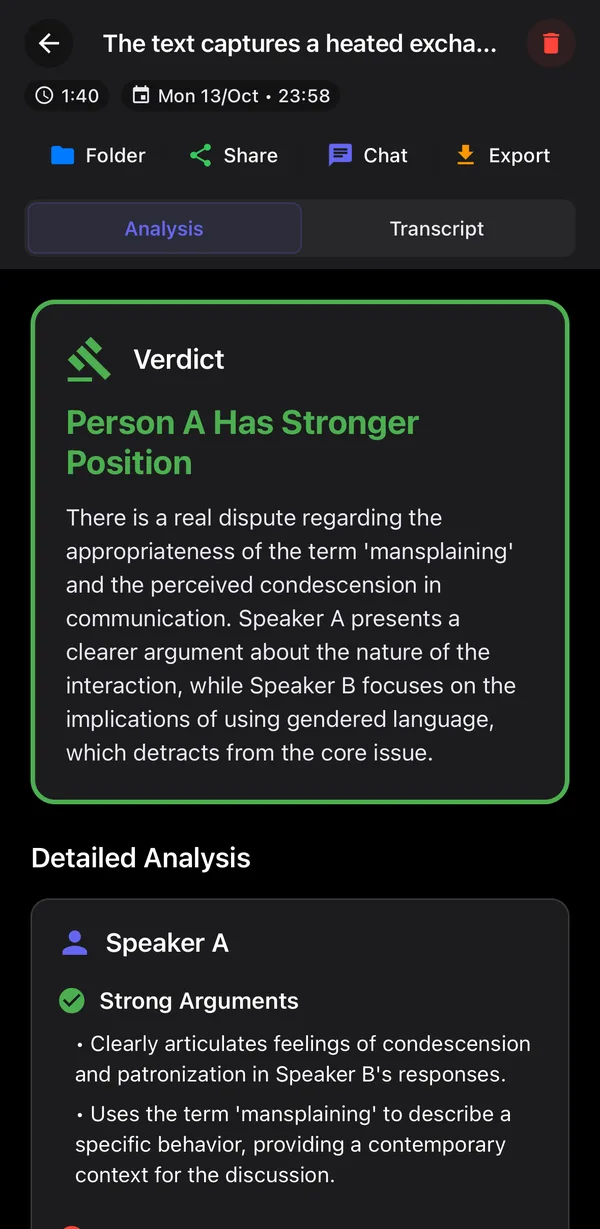
The ArgueResolver app · iPhone and Android
Record the argument. Get the verdict.
ArgueResolver listens while you talk it out, works out who said what, and gives an honest verdict on what was actually said, with compromises and steps to fix it.
Free to start · See how it works