Kafka Trap: When Denying Something Is Taken as Proof
Also called: kafkatrap, kafkatrapping
Updated · 5 min read · 3 sources
The short answer
A Kafka trap is an argument where denying an accusation is treated as evidence that the accusation is true. "If you weren't jealous, you wouldn't get so defensive about it" leaves no answer that counts as innocent. The trap is the structure, not the topic, and the label itself is sometimes misused to dodge fair criticism.
What is a Kafka trap?
A Kafka trap, also written kafkatrap, is a rhetorical setup in which any denial by the accused person is counted as proof of guilt. Agreeing proves the accusation; disagreeing proves it too, because "that's exactly what a guilty person would say." Once the trap is set, evidence stops mattering, since every possible reply has been defined in advance as confirmation.
The writer Eric S. Raymond coined the term in a 2010 blog post, naming it after Franz Kafka's novel The Trial, in which a man is arrested and prosecuted by an authority that never tells him what crime he is accused of. Raymond was writing about political and ideological arguments, but the structure turns up just as often at the kitchen table.
Kafka trap examples in personal arguments
In relationships and families, Kafka traps usually come wrapped in psychology words: denial, insecurity, defensiveness, projection. Some familiar forms:
- "If you weren't jealous, you wouldn't be so defensive about it."
- "The fact that you're upset proves I hit a nerve."
- "Only an insecure person would insist they're not insecure."
- "You're in denial. That's why you can't see it."
- "Of course you'd say you're over your ex. That's what someone who isn't over their ex says."
Kafka Trap examples
Why a Kafka trap is a fallacy
A fair claim can be tested: there should be some evidence that would count against it. A Kafka trap removes that possibility. If calm denial proves guilt and upset denial also proves guilt, the accusation has become unfalsifiable, and an unfalsifiable accusation is not an argument; it is a verdict. It is a close cousin of circular reasoning and an extreme way of shifting the burden of proof onto someone who has no way to carry it.
It is also emotionally corrosive. People caught in a Kafka trap often get more and more upset, which is then cited as further proof. Being repeatedly told that your own perceptions and denials do not count can feel disorienting, which is one reason it overlaps with patterns described in our guide on gaslighting.
When the Kafka trap label is misused
Fairness cuts both ways here. Defensiveness, denial and projection are real things people do, and noticing them is not automatically a trap. If your partner points to specific evidence (messages, repeated behavior, things you said) and also explains what would change their mind, that is an ordinary accusation that can be discussed, not a Kafka trap. Sometimes a strong reaction really does mean something touched a nerve, and it is worth asking why.
"That's a Kafka trap" can itself become a way to avoid hearing a legitimate concern. If every criticism is waved off as a trap, nothing can ever reach the person being criticized. The honest test is whether any evidence could clear the accused. If there is, it is not a Kafka trap, even if the accusation is uncomfortable.
How to respond to a Kafka trap
Do not keep denying louder; that is what the trap feeds on. Instead, step outside it by asking what evidence would count: "What could I say or do that would show you I'm not jealous?" If the answer is "nothing," you can point that out calmly. If there is an answer, you now have something concrete to talk about.
Then look for the worry underneath, because there usually is one. Accusations like "you're jealous" or "you're not over your ex" often protect someone's fear of being hurt. Answering that fear is more useful than winning the label fight. If the pattern is constant and you feel your reality is regularly overruled, it is worth talking to someone you trust or a counselor.
What to say
What could I say or do that would show you it isn't true? If nothing would count, I don't think we can solve this.
I'm upset because I feel accused, not because you're right. Can we look at what actually happened?
I want to understand what's worrying you. What have you noticed that made you feel this way?
That felt unfair at first, but you've given me specifics. Let me actually think about them.
In an argument right now?
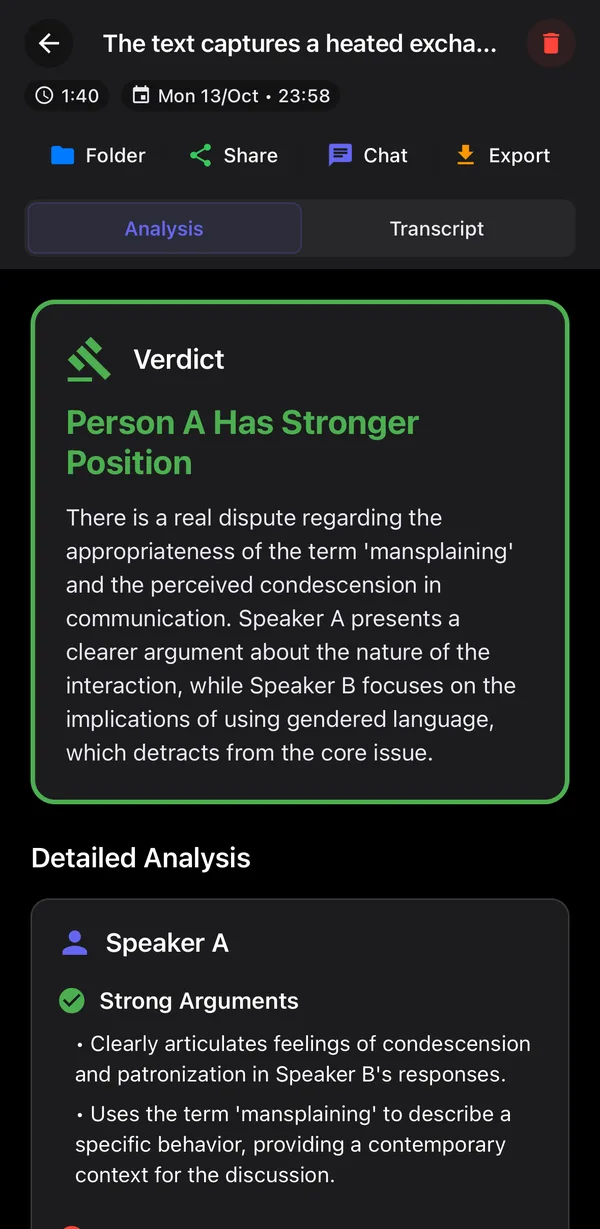
Type both sides and get a fair verdict, with the fallacies on each side. Free.
Questions people ask
What does Kafka trap mean?
It is an argument structure in which denying an accusation is treated as proof of it, so the accused person has no possible way to be found innocent.
Who coined the term kafkatrap?
Eric S. Raymond introduced it in a 2010 blog post, naming it after Franz Kafka's novel The Trial, where a man is prosecuted without ever learning what he is charged with.
Is every accusation of denial a Kafka trap?
No. If the accuser points to specific evidence and something could change their mind, it is an ordinary claim. It is a Kafka trap only when no possible response could count against it.
How do you get out of a Kafka trap?
Stop repeating denials and ask what evidence would count. Then address the fear or concern behind the accusation, which is usually where the real conversation is.
Sources
Keep reading
- FallaciesCircular Reasoning and Begging the QuestionCircular reasoning is an argument whose conclusion is already assumed in its premises, so it ends where it started: 'It was a harmless joke because it didn't hurt anyone.' It's also called begging the question. The argument sounds complete but gives no independent reason to believe the conclusion. In everyday speech, 'begs the question' usually means something else: 'raises the question'.
- FallaciesBurden of Proof Fallacy and the Appeal to Ignorance, ExplainedThe burden of proof fallacy is making a claim and then demanding that others disprove it, instead of supporting it yourself. Its close cousin, the appeal to ignorance, treats a lack of evidence as proof: "you can't prove it didn't happen, so it did." The person making a claim usually carries the burden of backing it up.
- FallaciesLoaded Question FallacyA loaded question fallacy is a question that smuggles in an assumption the other person has not agreed to, so any direct yes or no answer seems to admit it. "Why do you always embarrass me in front of my friends?" assumes you always do. The fair move is to answer the assumption first.
- FallaciesMotte and Bailey FallacyA motte and bailey is an argument move where someone makes a bold, hard-to-defend claim (the bailey), retreats to a modest, easy-to-defend claim (the motte) when challenged, and then acts as if defending the modest claim also defended the bold one. Two different positions are treated as if they were the same.
- GuidesGaslighting ExamplesGaslighting is a pattern of manipulation that makes someone doubt their own memory, perception or sanity. Gaslighting examples include "That never happened", "You're too sensitive" and "You're imagining things", used again and again to override what you know you saw. One disagreement about the facts is not gaslighting; a repeated pattern that leaves you doubting yourself is.
- GuidesDefensiveness in RelationshipsDefensiveness in relationships means protecting yourself from a complaint with excuses, counter-complaints or wounded innocence instead of hearing it. It is one of John Gottman's Four Horsemen, and nearly everyone does it. The antidote is to accept responsibility for at least part of the problem, which lets the conversation move forward.
The ArgueResolver app · iPhone and Android
Record the argument. Get the verdict.
ArgueResolver listens while you talk it out, works out who said what, and gives an honest verdict on what was actually said, with compromises and steps to fix it.
Free to start · See how it works