False Dilemma: Examples of Either/Or Thinking and How to Respond
Also called: false dichotomy, either/or fallacy, black-or-white fallacy, black and white thinking
Updated · 5 min read · 4 sources
The short answer
A false dilemma, also called a false dichotomy or either/or fallacy, presents only two options when more exist, so you feel forced to pick one: 'Either you trust me or you check my phone.' Real choices usually include middle paths, combinations or a third option nobody has mentioned yet. The fallacy works by hiding them.
What is a false dilemma?
A false dilemma frames a decision as a choice between exactly two options, usually one obviously bad and one the speaker wants. Once you accept the frame, the conclusion follows: you don't want the bad one, so you must take the other. The trick is in the frame, not the logic. If there's a third option, the whole argument falls apart.
Philosophers sometimes call it the black-or-white fallacy, because it treats a gray situation as if it had only two colors. It's one of the most common moves in arguments of every kind, from politics ('you're with us or against us') to the kitchen ('either we eat out every night or we never have fun').
False dilemma, false dichotomy and black and white thinking
False dilemma and false dichotomy mean the same thing: an argument built on two options that aren't the only ones. Black and white thinking, sometimes called all or nothing thinking, is the mental habit behind it: seeing people, choices or outcomes as all good or all bad, total success or total failure.
The habit matters in relationships because it turns disagreements into verdicts. If one forgotten errand means 'you don't care about me', there's no room for 'you care and you forgot'. Noticing all or nothing language in your own head is often the quickest way to cool down an argument.
False Dilemma examples
Why either/or shows up in arguments
Two options feel clear, and clarity feels good when you're upset. An either/or also creates pressure: if the alternative is terrible, the listener has to agree fast. That's why false dilemmas often come dressed as ultimatums.
Not every ultimatum is a fallacy, though. Sometimes there really are two options: the lease has to be signed by Friday or the apartment goes to someone else. And a personal boundary ('if the yelling continues, I'll leave the room') is a statement of what you'll do, not a fallacy. The false dilemma is when other workable options exist and are ignored.
False dilemma examples
Each of these leaves out options that are easy to find once you look:
- 'Either we spend Christmas with my family or we're basically not a family.' (Alternate years, split the day, host both.)
- 'You can have a career or you can be a good parent.' (Most parents do both, with tradeoffs.)
- 'If you're not on my side, you're on hers.' (You can care about both people and still think one is right.)
- 'We either buy the house now or we'll never own one.'
- 'Either you apologize or we're done talking.'
How to respond to a false dilemma
Ask the question directly and kindly: 'Are those the only two options?' Then make the list longer, together. Even silly ideas help, because they break the frame and make room for real ones. Collaborative problem solving, one of the core conflict resolution strategies, starts exactly here.
It also helps to look for the need behind each option. 'Either you trust me or you check my phone' is often about a need for reassurance. There are many ways to meet that need besides handing over a phone, and talking about the need opens them up.
Watch for the opposite trap too. Not every disagreement is solved by meeting in the middle; assuming the compromise must be right is its own error, the middle ground fallacy. Sometimes, after looking at every option, one side's answer simply is better. If you want an outside view on which, our free argument judge weighs both positions.
What to say
Are those really the only two choices? Let's list a few more before we decide.
I don't want either of those. What I'm after is time with both families. Could we split the holiday?
What's the worry behind that? Maybe there's another way to deal with it.
If it really is one or the other, let's spell out why the other options won't work. Then I'll accept it.
In an argument right now?
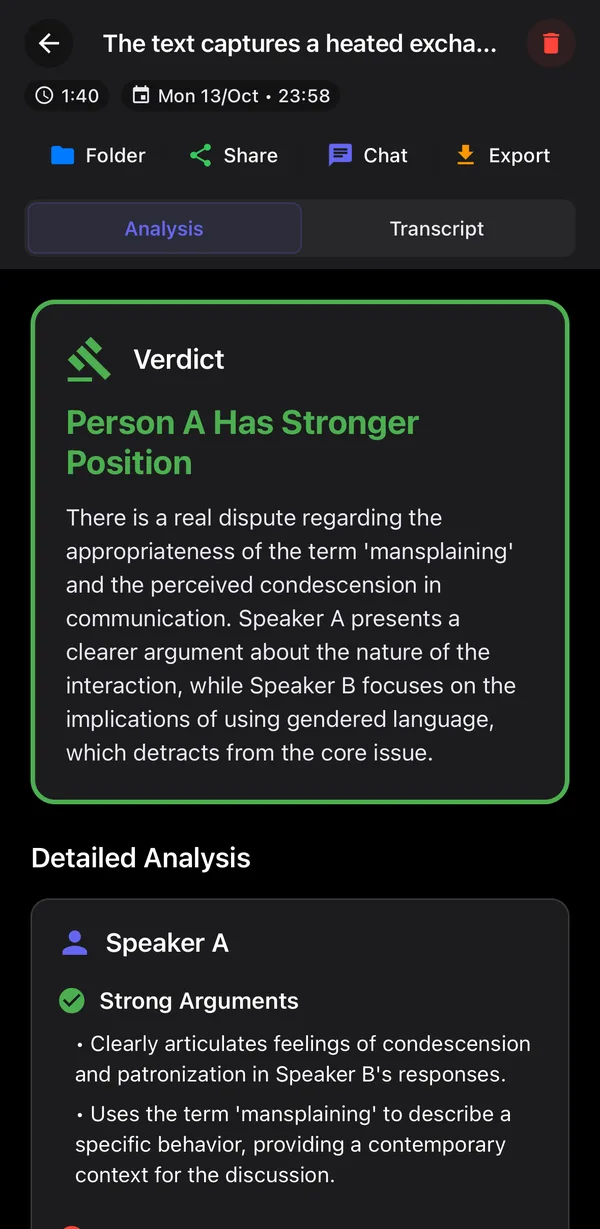
Type both sides and get a fair verdict, with the fallacies on each side. Free.
Questions people ask
What is an example of a false dilemma?
'If you loved me, you'd move to my city.' It assumes love can only be shown by moving, ignoring long distance, a later move, or both partners moving somewhere new.
Is a false dilemma the same as a false dichotomy?
Yes. Both names describe an argument that presents two options as the only ones when others exist. Either/or fallacy and black-or-white fallacy are other names for it.
Is an ultimatum a false dilemma?
Only if other reasonable options exist and are being hidden. A real deadline or a personal boundary ('I'll leave if the shouting continues') is not a fallacy.
What is the opposite of a false dilemma?
In a sense, the middle ground fallacy: assuming the answer must lie between two positions. Both errors skip the work of judging the options on their merits.
Sources
Keep reading
- FallaciesMiddle Ground FallacyThe middle ground fallacy is assuming the truth, or the best solution, must lie halfway between two opposing positions. If one person says the bill is due on the 5th and the other says the 15th, the answer is not the 10th. Splitting the difference works for preferences, not for facts.
- FallaciesSlippery Slope FallacyA slippery slope fallacy claims that one small step will set off a chain of events ending in disaster, without showing why each step would actually lead to the next. 'If we let her stay out until midnight, next she'll be skipping school.' Some chain reactions are real. The fallacy is assuming the whole chain with little or no evidence.
- FallaciesLoaded Question FallacyA loaded question fallacy is a question that smuggles in an assumption the other person has not agreed to, so any direct yes or no answer seems to admit it. "Why do you always embarrass me in front of my friends?" assumes you always do. The fair move is to answer the assumption first.
- GuidesConflict Resolution StrategiesConflict resolution strategies are structured ways to settle a disagreement so both sides can live with the result. The most reliable ones separate the people from the problem, focus on each side's underlying interests rather than fixed demands, generate several options before choosing, and use fair, objective criteria to decide.
- FallaciesStraw Man FallacyA straw man fallacy is when someone replaces your actual point with a weaker or more extreme version of it, then argues against that version instead. It feels like a win because the distorted claim is easy to knock down, but your real point was never answered. In personal arguments it often starts with 'So what you're saying is...'
The ArgueResolver app · iPhone and Android
Record the argument. Get the verdict.
ArgueResolver listens while you talk it out, works out who said what, and gives an honest verdict on what was actually said, with compromises and steps to fix it.
Free to start · See how it works