Conflict Resolution Strategies: 5 Styles, 7 Steps and Real Examples
Also called: conflict resolution steps, conflict resolution skills
Updated · 6 min read · 5 sources
The short answer
Conflict resolution strategies are structured ways to settle a disagreement so both sides can live with the result. The most reliable ones separate the people from the problem, focus on each side's underlying interests rather than fixed demands, generate several options before choosing, and use fair, objective criteria to decide.
What are conflict resolution strategies?
Conflict resolution strategies are the methods people use to get from 'we disagree' to 'we've decided'. Some are styles, habits of how you tend to respond when you clash with someone. Others are processes, step-by-step ways to work a disagreement through. The best results come from knowing your default style and then using a process that keeps it from running the show.
One caution before you start: not every conflict should be 'resolved'. The Gottman Institute prefers the word 'manage' for couples, because many recurring disagreements come from lasting differences in personality and needs. For those, the goal is an ongoing, respectful conversation, not a final verdict.
The 5 conflict resolution styles
The Thomas-Kilmann Conflict Mode Instrument, introduced by Kenneth Thomas and Ralph Kilmann in 1974, sorts responses to conflict along two dimensions: how assertive you are about your own concerns and how cooperative you are about the other person's. That produces five styles. Each fits some situations and backfires in others.
- Competing (assertive, uncooperative)
- Pushing for your outcome. Useful in an emergency or when something non-negotiable is at stake; corrosive as a habit in a relationship.
- Avoiding (unassertive, uncooperative)
- Sidestepping the issue. Fine for trivia or to buy time to cool down; harmful when important hurts go unspoken and turn into resentment.
- Accommodating (unassertive, cooperative)
- Giving the other person what they want. Generous when the issue matters far more to them; draining if it is always the same person giving in.
- Compromising (middle on both)
- Splitting the difference. Quick and often fair for divisible things like time or money; unsatisfying when neither half meets anyone's real need.
- Collaborating (assertive, cooperative)
- Working together toward an option that fully meets both sides' needs. Slowest, and the best choice when the relationship and the outcome both matter.
What it sounds like
7 conflict resolution steps
This process borrows from principled negotiation, the method Roger Fisher, William Ury and Bruce Patton described in Getting to Yes, and from couples research. It works for a fight about chores as well as a dispute over a shared budget at work.
- 1. Cool down first
- If either person is too upset to listen, pause and set a time to return. Nothing below works while someone is flooded. See emotional flooding.
- 2. Define one problem together
- Agree on the specific question: 'How do we split the evening chores?' not 'Why are you so lazy?' One problem per conversation.
- 3. Each side states interests, not positions
- A position is a demand ('the party must be at our house'); an interest is the need behind it ('I'm worried about the cost'). Use I statements.
- 4. Summarize each other
- Before proposing anything, each person restates the other's interests until they agree it's right. That is active listening, and it prevents solving the wrong problem.
- 5. Brainstorm options
- List several possible solutions without judging them yet. The first idea is rarely the best one.
- 6. Choose using fair criteria
- Decide by standards you both accept (cost, time, what's been fair before, an outside reference) instead of by who pushes hardest.
- 7. Make it concrete and check back
- Who does what, by when. Agree on a date to review how it's working, and adjust without treating a change as failure.
Conflict resolution skills that make the steps work
The steps are the skeleton. These skills are the muscle, and they can be practiced:
- Listening to understand, not to reply.
- Describing behavior instead of judging character, so the other person isn't busy defending themselves.
- Regulating your own emotions, including taking a break before you say something you can't take back.
- Spotting bad reasoning in yourself and others, such as a straw man or a false dilemma that hides other options.
- Apologizing well when you contributed to the problem. See how to apologize.
- Accepting a 'no' on some things, and knowing which disagreements you can live with.
When a strategy isn't working
If you keep reaching agreements that don't hold, you've probably skipped step 3. Couples researchers John and Julie Gottman note that partners often rush to persuade or compromise before understanding why the issue matters to the other person, and the same conversation returns a few weeks later. Slowing down to understand interests is what makes the deal stick.
If one person won't engage at all, you can still use the parts within your control: state your interests clearly, propose options, and set your own boundaries. And if you genuinely can't tell whose position holds up better, an outside view helps. A mediator, a manager or a therapist can play that role; for everyday disagreements, writing out both sides in our free argument judge gives you a neutral first read.
Conflict resolution strategies assume both people are safe and acting in good faith. Where there are threats, intimidation or fear, the priority is safety and outside support, not negotiation.
What to say
Help me understand what's most important to you about this.
Before we split the difference, can we check we understand what each of us actually needs?
Let's list three or four ways we could do this before we pick one.
What would a fair way to decide this look like to you?
Let's try it for two weeks and check in Sunday to see if it's working.
In an argument right now?
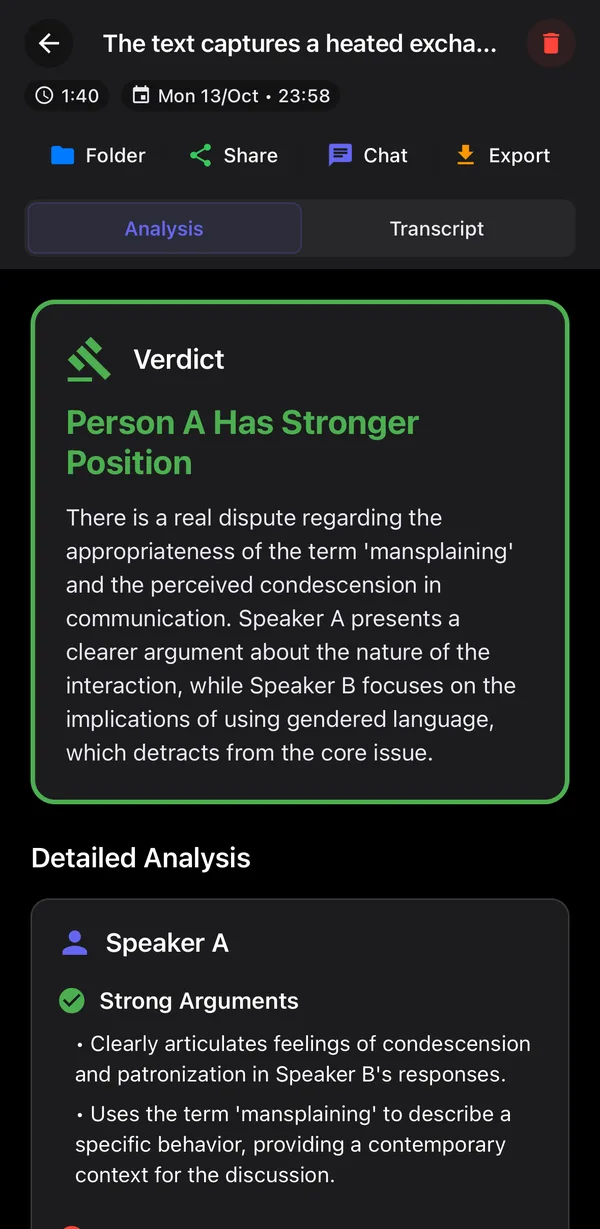
Type both sides and get a fair verdict, with the fallacies on each side. Free.
Questions people ask
What are the 5 conflict resolution strategies?
The five styles from the Thomas-Kilmann model are competing, avoiding, accommodating, compromising and collaborating. None is always right; collaborating is usually best when both the relationship and the outcome matter.
What are the steps of conflict resolution?
Cool down, define one problem together, share interests rather than positions, summarize each other's view, brainstorm options, choose using fair criteria, and agree on concrete next steps with a check-in date.
What is the most effective conflict resolution strategy?
For conflicts where you care about the relationship, collaboration through an interest-based process tends to produce the most durable agreements. For trivial issues, simply accommodating or letting it go can be the smarter move.
What are examples of conflict resolution skills?
Active listening, I statements, managing your own anger, spotting faulty reasoning, generating options, apologizing well and following through on agreements.
Sources
- Program on Negotiation, Harvard Law School: Principled Negotiation, Focus on Interests to Create Value
- Wikipedia: Thomas-Kilmann Conflict Mode Instrument
- The Gottman Institute: The Four Horsemen, The Antidotes
- The Gottman Institute: We Agreed. Why Are We Having This Argument Again?
- The Gottman Institute: Managing Conflict, Solvable vs. Perpetual Problems
Keep reading
- GuidesFair Fighting RulesFair fighting rules are agreements two people make about how they will argue: one topic at a time, complaints about behavior instead of attacks on character, no contempt or name-calling, real listening before rebutting, and a time-out when either person is too upset to think. The goal is to solve the problem without wounding each other.
- GuidesActive ListeningActive listening is listening to understand rather than to reply: you let the other person finish, summarize what you heard in your own words, ask questions to check, and acknowledge their feelings before giving your side. In an argument it lowers the temperature fast, because people stop repeating themselves once they feel understood.
- GuidesHow to Win an Argument HonestlyTo win an argument honestly, make sure you're actually right, state your claim precisely, agree on what evidence would settle it, represent the other side at its strongest, concede what's true in their view, and avoid fallacies. In personal arguments, winning means the problem gets solved and the other person still feels respected.
- GuidesHow to Stop ArguingTo stop arguing, pause when either of you is too upset to think, take a break of at least 20 minutes with a set time to come back, then restart gently on one issue. Understand the other person's side before persuading. If it's the same fight on repeat, talk about why it matters to each of you.
- FallaciesFalse DilemmaA false dilemma, also called a false dichotomy or either/or fallacy, presents only two options when more exist, so you feel forced to pick one: 'Either you trust me or you check my phone.' Real choices usually include middle paths, combinations or a third option nobody has mentioned yet. The fallacy works by hiding them.
The ArgueResolver app · iPhone and Android
Record the argument. Get the verdict.
ArgueResolver listens while you talk it out, works out who said what, and gives an honest verdict on what was actually said, with compromises and steps to fix it.
Free to start · See how it works