How to Win an Argument Honestly: Be Right, Be Clear, Be Fair
Updated · 6 min read · 4 sources
The short answer
To win an argument honestly, make sure you're actually right, state your claim precisely, agree on what evidence would settle it, represent the other side at its strongest, concede what's true in their view, and avoid fallacies. In personal arguments, winning means the problem gets solved and the other person still feels respected.
First, decide what winning means
Before learning how to win an argument, figure out which kind of argument you're in. There are roughly three. A factual dispute has a right answer: what time the reservation was, whether the policy covers water damage. A decision dispute has no single right answer but needs a choice: which apartment, whose family for the holidays. A values dispute is about what matters more: saving or enjoying, privacy or openness.
You can win a factual argument by being right. You win a decision argument by finding the choice that best meets both people's needs. Values arguments mostly can't be won at all; they get managed. Treating a values or decision argument like a debate to be won is the fastest way to win the point and lose the person.
How to win an argument: 8 honest moves
Everything below is about being persuasive because you're right, not about tricking anyone. If you discover partway through that you're wrong, the best move is to say so.
- 1. Pin down the claim
- Many arguments are two people defending different claims. 'You're always late' and 'I was late on Friday' are different arguments. Agree on the exact question before arguing the answer.
- 2. Agree on what would settle it
- Ask, 'What would change your mind?' and answer it yourself. If the answer is a receipt, a text thread or a reliable source, go look. Negotiation experts call this insisting on objective criteria.
- 3. Steelman their side
- Restate the other person's position in its strongest form until they agree you got it right. Arguing against a weaker version is a straw man, and they will notice.
- 4. Ask before you assert
- Questions like 'how would that work if we both have early shifts?' let people find the problem in their own plan, which persuades better than you announcing it.
- 5. Concede what's true
- 'You're right that the bill was higher this month' costs little and makes the rest of your case more credible. Refusing to grant anything signals you're defending your pride.
- 6. Separate the person from the problem
- Attack the plan, not the person. The moment you go after someone's character, the argument becomes about defending themselves. That's ad hominem.
- 7. Stay on one point
- Bringing in other grievances feels like piling on evidence, but it reads as a red herring and lets the original point slip away.
- 8. Know when to stop
- Once you've made your case clearly and they've heard it, repeating it louder adds nothing. Give it time.
What it sounds like
What research says about changing minds
A 2016 study titled 'Winning Arguments' by Chenhao Tan, Vlad Niculae, Cristian Danescu-Niculescu-Mizil and Lillian Lee examined ChangeMyView, an online forum where people post an opinion, invite others to challenge it, and openly acknowledge when someone has changed their view. The researchers found that persuasion depended on how the exchange unfolded, including when a challenger joined and how much back-and-forth followed, and on how the challenger's language related to the original poster's. They also found that some people were not open to changing their view at all, and that this showed in how they had stated their opinion in the first place.
Two practical lessons follow. Engage with the other person's actual words and reasoning instead of delivering a prepared speech. And accept that some people, on some topics, are not persuadable right now. Recognizing that early saves you an exhausting evening.
Tactics that look like winning but aren't
Some moves end arguments without settling them. They work in the moment and cost you trust afterward.
- Burying the other person in points they can't answer quickly (gish gallop).
- Quietly shifting your claim when it gets challenged (motte and bailey).
- Changing what would count as proof every time they meet the bar (moving the goalposts).
- Answering a criticism with one of your own instead of a response (whataboutism).
- Out-shouting, out-lasting or going silent until they give up.
How to win an argument with your partner
With a partner, 'winning' an argument that leaves them feeling dismissed is a loss on the account you both share. The Gottman Institute's research on couples found that partners in lasting, satisfying relationships postpone persuasion: they ask questions and summarize the other's view first, and only then make their own case. That's not softness. It's the most effective sequence, because people are far more willing to consider your point once they're sure you understood theirs.
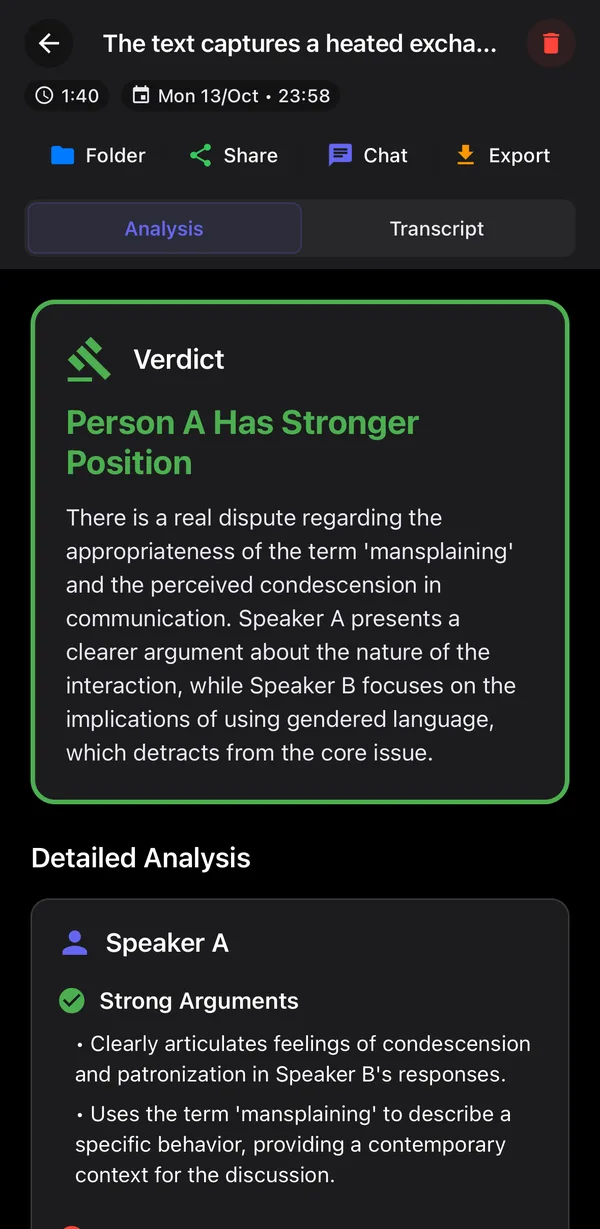
If the fight is factual, check the facts together. If it's a decision, look for the option that meets both people's real interests. If you genuinely can't tell who's right, an outside view helps: laying out both positions in our free argument judge gives you a neutral read of which side is better supported, and why.
What to say
Before we go further, are we arguing about Friday, or about whether I'm usually late?
What would change your mind about this? Here's what would change mine.
Let me make sure I've got your best argument. You're saying... Is that right?
You know what, you're right. I had that wrong.
I don't think either of us is going to convince the other. Can we figure out how to live with both?
In an argument right now?
Type both sides and get a fair verdict, with the fallacies on each side. Free.
Questions people ask
How do you win an argument with someone who won't listen?
Usually you can't in that moment. Ask a question about their view, summarize it, and suggest picking it up later. People rarely change their minds while defending themselves, but often reconsider afterward.
How do you win an argument without getting angry?
Prepare by getting clear on your claim and evidence, slow down, and take a break if you feel your heart racing. Calm delivery makes your points easier to hear, and you'll catch flaws in your own reasoning faster.
Is it better to be right or to win the argument?
Aim to be right, and to be able to show it. If you discover you're wrong, conceding quickly is the move that earns the most trust for the next disagreement.
What are the most common fallacies in arguments?
In everyday arguments, the usual ones are straw man, ad hominem, whataboutism, hasty generalizations like 'you always', and red herrings. Learning to spot them in your own arguments is the quickest way to argue better.
Sources
- Tan, Niculae, Danescu-Niculescu-Mizil and Lee (2016), Winning Arguments: Interaction Dynamics and Persuasion Strategies in Good-faith Online Discussions (arXiv)
- Program on Negotiation, Harvard Law School: Principled Negotiation, Focus on Interests to Create Value
- Purdue Online Writing Lab: Logical Fallacies
- The Gottman Institute: We Agreed. Why Are We Having This Argument Again?
Keep reading
- FallaciesStraw Man FallacyA straw man fallacy is when someone replaces your actual point with a weaker or more extreme version of it, then argues against that version instead. It feels like a win because the distorted claim is easy to knock down, but your real point was never answered. In personal arguments it often starts with 'So what you're saying is...'
- FallaciesAd HominemAd hominem (Latin for 'to the person') is a fallacy in which someone attacks the person making an argument instead of the argument itself: their character, motives, intelligence or circumstances. The attack may sting, but it doesn't show the point is wrong. 'You're just jealous' and 'What would you know, you're nineteen' are classic ad hominem replies.
- FallaciesMoving the GoalpostsMoving the goalposts is changing what counts as proof, or as success, after the other person has already met the original standard. Instead of accepting the result, the person adds a new requirement, so the conclusion they started with can never be lost. It turns a disagreement into a game nobody else can win.
- GuidesActive ListeningActive listening is listening to understand rather than to reply: you let the other person finish, summarize what you heard in your own words, ask questions to check, and acknowledge their feelings before giving your side. In an argument it lowers the temperature fast, because people stop repeating themselves once they feel understood.
- GuidesConflict Resolution StrategiesConflict resolution strategies are structured ways to settle a disagreement so both sides can live with the result. The most reliable ones separate the people from the problem, focus on each side's underlying interests rather than fixed demands, generate several options before choosing, and use fair, objective criteria to decide.
- FallaciesGish GallopA Gish gallop is an argument tactic where someone fires off so many claims, accusations or links, so quickly, that the other person cannot possibly answer them all. Quantity replaces quality: each weak point takes seconds to say and minutes to untangle, so whatever goes unanswered starts to look true.
The ArgueResolver app · iPhone and Android
Record the argument. Get the verdict.
ArgueResolver listens while you talk it out, works out who said what, and gives an honest verdict on what was actually said, with compromises and steps to fix it.
Free to start · See how it works