Slippery Slope Fallacy: Examples, and When It Isn't a Fallacy
Also called: slippery slope, domino fallacy, thin end of the wedge
Updated · 5 min read · 4 sources
The short answer
A slippery slope fallacy claims that one small step will set off a chain of events ending in disaster, without showing why each step would actually lead to the next. 'If we let her stay out until midnight, next she'll be skipping school.' Some chain reactions are real. The fallacy is assuming the whole chain with little or no evidence.
What is a slippery slope fallacy?
In a slippery slope fallacy, a choice is rejected not for what it is but for where it supposedly leads: A will lead to B, B to C, and C to something terrible, so we can't allow A. The weak spot is the links. Each step is asserted rather than supported, and the conclusion borrows all its force from the scary ending.
It's persuasive because the ending is vivid and the steps sound plausible one at a time. But plausible isn't likely. A chain is only as strong as its weakest link, and a slippery slope argument rarely examines any link at all.
When a slippery slope is not a fallacy
Some slopes really are slippery. If there's evidence that each step tends to cause the next, the argument is a reasonable prediction, not a fallacy. Rules and precedents are a common real case: if one roommate gets to skip chores 'just this week', the others may reasonably expect the same, and the rule weakens. Habits work this way too.
A quick way to judge is to put rough odds on each link. Suppose each step in a three step chain has a 70 percent chance of leading to the next. The chance of reaching the end is 0.7 times 0.7 times 0.7, about 34 percent. That's worth taking seriously, but it's a long way from 'definitely'. Most slippery slope arguments sound like 100 percent and are much lower.
Slippery Slope Fallacy examples
Why worst-case thinking takes over in arguments
In personal arguments, a slippery slope is usually fear talking. A parent who imagines a midnight curfew ending in disaster is often expressing worry, not making a logical claim. Under stress the mind jumps to the worst ending, especially when you're emotionally flooded, and the steps in between get skipped.
That's useful to know, because arguing against the logic rarely calms the fear. It often works better to name the worry and address it directly. The person worried can help too: saying 'I'm scared this becomes a habit' in the form of an I statement is more honest, and easier to work with, than predicting a catastrophe.
Slippery slope fallacy examples
Listen for a small request followed by a big, confident prediction:
- 'If I let you skip practice once, you'll quit the team by spring.'
- 'If we get a dog, we'll never travel again.'
- 'Give him one weekend off and he'll expect it every week.'
- 'If we start using a joint account, you'll be checking every purchase I make.'
- 'One drink at the work party and it'll be a disaster.'
How to respond to a slippery slope argument
Ask about the next link, not the final disaster: 'What makes you think it would go from midnight to sneaking out?' Then look for evidence together. Has it happened before? Is there a pattern? If there is, the concern deserves real weight.
Then offer a guardrail. Most slopes can be made less slippery with a trial period, a clear limit or a check-in date: 'Let's try remote Fridays for a month and review the numbers.' A guardrail respects the worry and still lets you take the step. It also turns an all or nothing fight into a smaller, testable decision, which avoids the related trap of a false dilemma.
If the prediction rests on one bad experience, you may be looking at a hasty generalization instead. And if you'd like a neutral read on whether a worry is reasonable, describe both sides to our free argument judge.
What to say
I get that you're worried about where this leads. What makes you think it would go from this to that?
Has that happened before? If it has, I understand. If not, can we judge this step on its own?
What if we try it once and check in afterward? If it goes badly, we change it.
Let's agree on the limit now so it can't creep: midnight for parties, eleven on other weekends.
In an argument right now?
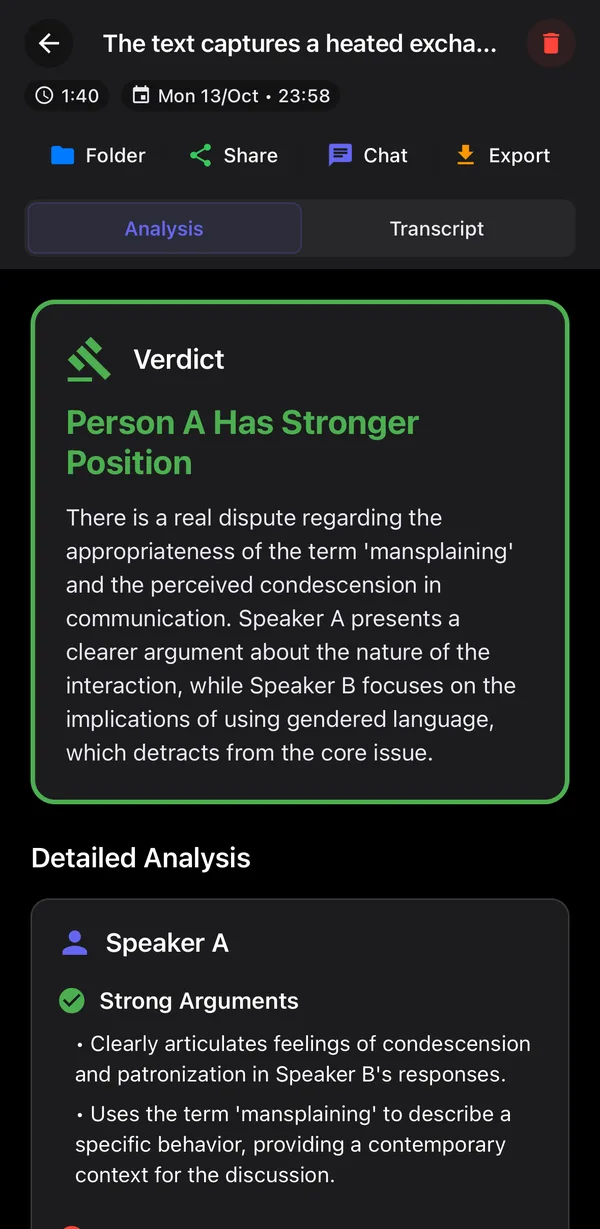
Type both sides and get a fair verdict, with the fallacies on each side. Free.
Questions people ask
What is an example of a slippery slope fallacy?
'If we let the kids have phones at twelve, they'll be on them all night, their grades will collapse and they won't get into college.' Each step is asserted without evidence that it follows from the one before.
Is a slippery slope argument always a fallacy?
No. If there's good evidence that each step tends to lead to the next, it's a reasonable warning. It's a fallacy when the chain is assumed instead of supported.
How do you counter a slippery slope argument?
Ask what makes each step likely, look for evidence together, and propose a guardrail such as a trial period or a clear limit, so the first step doesn't commit you to the rest.
Is a slippery slope the same as catastrophizing?
They're related. Catastrophizing is the habit of jumping to the worst possible outcome; a slippery slope argument often puts that habit into words as a chain of events.
Sources
Keep reading
- FallaciesFalse DilemmaA false dilemma, also called a false dichotomy or either/or fallacy, presents only two options when more exist, so you feel forced to pick one: 'Either you trust me or you check my phone.' Real choices usually include middle paths, combinations or a third option nobody has mentioned yet. The fallacy works by hiding them.
- FallaciesHasty GeneralizationA hasty generalization is a sweeping conclusion drawn from too few examples, or from examples that aren't typical: one unanswered text becomes 'you never answer me', one messy roommate becomes 'people from that school are slobs'. The examples may be real. There just aren't enough of them to support a claim about always, never or everyone.
- FallaciesAppeal to Emotion FallacyAn appeal to emotion is a fallacy when feelings are used in place of reasons: guilt, fear, pity or flattery pushes someone to agree instead of evidence that the claim is right. 'After everything I've done for you, you'd really say no?' Feelings matter in personal arguments. The fallacy is treating a feeling as proof about facts or fairness.
- GuidesI StatementsI statements are sentences that describe your own feelings and needs instead of judging the other person, for example 'I feel overwhelmed when the dishes pile up, and I need a hand tonight' instead of 'You never help.' They raise a problem without putting the listener on trial, so it can be solved.
- GuidesArguments With ParentsArguments with parents are normal at every age. For teens they usually involve freedom and rules; for adult children, life choices, advice and boundaries. They go better when you pick a calm time, say clearly what you want (to be heard, advice, or permission), describe your feelings without blaming, and listen long enough to understand their worry.
The ArgueResolver app · iPhone and Android
Record the argument. Get the verdict.
ArgueResolver listens while you talk it out, works out who said what, and gives an honest verdict on what was actually said, with compromises and steps to fix it.
Free to start · See how it works