How Often Do Couples Fight? What Research Says Is Normal
Updated · 5 min read · 6 sources
The short answer
There is no healthy number. In one diary study, married parents recorded close to one conflict a day on average, and happy, stable couples range from those who rarely argue to those who debate loudly. How often couples fight matters far less than how they fight: with respect and repair, or with contempt and stonewalling.
How often do couples fight, according to research?
How often do couples fight? More often than most people assume. In a study by Lauren Papp, Mark Cummings and Marcy Goeke-Morey, 47 married couples with children aged 8 to 16 kept diaries for 15 days. Mothers described 669 incidents of marital conflict and fathers described 551. That works out to roughly 14 conflicts per mother and 12 per father over two weeks: close to one a day.
The conflicts in that study ranged in how negative they got, and about two thirds of them happened when the children were not around. So when you hear that a couple 'never fights', it may mean they disagree as often as everyone else but out of sight, or that they resolve things before they turn into anything that feels like a fight.
Is it normal for couples to fight?
Yes. Disagreement is what happens when two people with different histories, habits and needs share a life. The Gottman Institute, which has studied couples in conflict since the 1970s, says flatly that all relationships have conflict, and that what predicts success or failure is how the conflict is managed rather than whether it appears.
Gottman's research also found that about 69 percent of relationship conflict is about perpetual problems: differences in personality or lifestyle needs that never fully go away, such as one partner wanting more social time or a tidier home than the other. Every couple has them. The goal with those is a friendly ongoing dialogue, not a final victory.
What it sounds like
Some happy couples argue a lot, some barely at all
Gottman identified three broad conflict styles, and found happy, stable couples in all three:
- Conflict-avoiding
- Partners emphasize common ground and often agree to disagree, without trying to change each other's minds.
- Validating
- Partners discuss differences calmly, consider each other's reasoning and work toward compromise.
- Volatile
- Partners argue with strong emotion and real passion, but affection and humor stay in the mix.
What matters more than frequency
If counting fights is the wrong measure, what is the right one? Gottman's work points to a few signs. The first is the balance of positive and negative moments during conflict: stable couples keep about five positive interactions (a laugh, a touch, a 'good point') for every negative one, while a ratio near one to one is a warning sign.
The second is which behaviors show up. Criticism, contempt, defensiveness and stonewalling, the four horsemen, predict trouble whether a couple fights weekly or yearly. The third is repair: whether one of you can say 'okay, I overreacted' and the other accepts it, so the fight ends instead of going underground.
Avoiding every argument is not a good sign either. Gottman therapists note that couples who avoid conflict often end up in counseling anyway, because unspoken hurts turn into resentment and then come out all at once.
Signs your arguments are not okay
Frequent disagreement is normal. These patterns are not, and they are worth taking seriously regardless of how often they happen:
- The same fight repeats with no progress and growing bitterness (Gottman calls this gridlock).
- One of you mocks, insults or treats the other with disgust. See contempt.
- One of you shuts down for hours or days, or uses silence as punishment. See the silent treatment.
- Arguments leave one person questioning their own memory or sanity. See gaslighting.
- Anyone feels afraid: threats, blocking a door, breaking things, or physical force. That is not a fighting style. It is a safety issue that deserves outside help.
How to fight less without avoiding issues
Fighting less usually comes from fighting better, not from biting your tongue. Raise things early and gently, before they build. Stick to one topic. Take a real break when either of you is flooded, and come back at a set time. Agree on a few fair fighting rules while you're calm. If the same argument keeps coming back, it may be a perpetual problem that needs understanding rather than a solution; how to stop arguing covers that loop in detail.
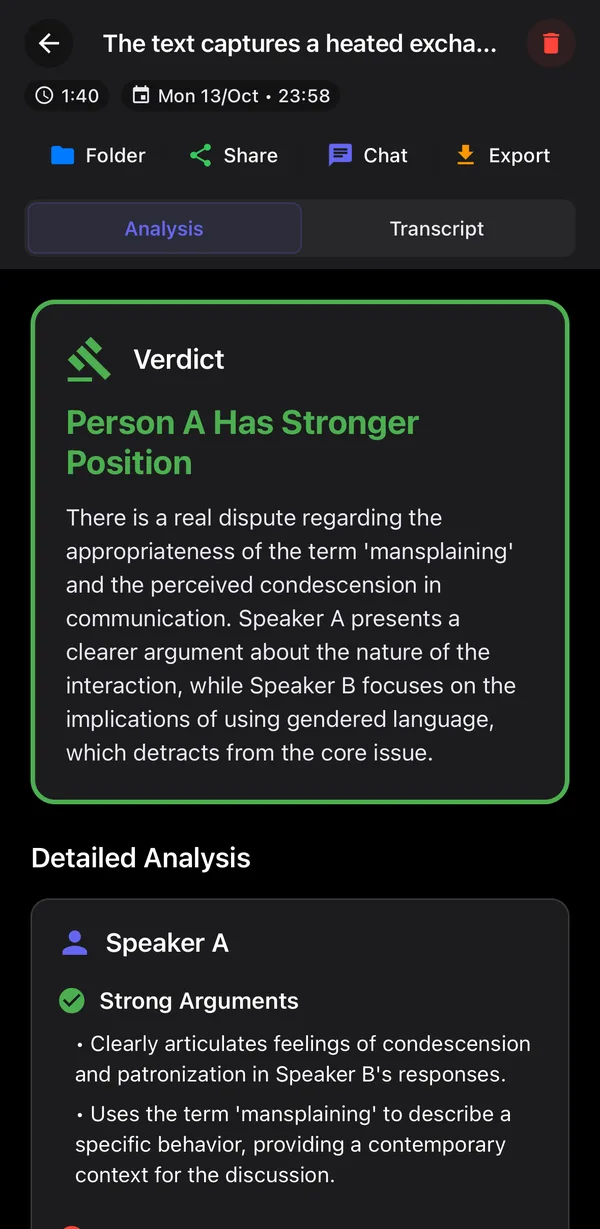
When you can't tell whether you are arguing about something real or just repeating positions, an outside view helps. Some couples see a therapist; others start by writing out both sides, which you can do in our free argument judge.
What to say
I don't think fighting is the problem. I think it's how we end up talking to each other. Can we look at that together?
We keep having this one. Can we talk about why it matters so much to each of us instead of who's right?
I want to keep talking about this, but not like this. Let's take 20 minutes.
That went better than usual. Thanks for hearing me out.
In an argument right now?
Type both sides and get a fair verdict, with the fallacies on each side. Free.
Questions people ask
How often do healthy couples argue?
There is no set number. Diary research has found disagreements happening close to daily in some families, and happy couples include both frequent arguers and rare ones. Healthy couples share the way they fight: respect, a focus on the issue, and repair afterward.
Is it bad if we never fight?
Not necessarily. Some couples are genuinely conflict-avoiding and happy. It becomes a problem when 'not fighting' means important hurts are never raised, because those tend to turn into resentment.
Is fighting every day normal in a relationship?
Small daily disagreements are common. Daily fights that involve insults, contempt, shouting matches or fear are not something to accept as normal, and they're worth working on with a couples therapist.
What percentage of couple arguments never get resolved?
According to the Gottman Institute, about 69 percent of relationship conflict is about perpetual problems rooted in lasting differences. They don't get solved so much as managed with understanding and humor.
Sources
- Papp, Cummings and Goeke-Morey (2002), Marital conflicts in the home when children are present versus absent, Developmental Psychology (PubMed)
- The Gottman Institute: Managing Conflict, Solvable vs. Perpetual Problems
- The Gottman Institute: The Magic Relationship Ratio, According to Science
- The Gottman Institute: Who Has to Calm Down First?
- The Gottman Institute: Flooding and Conflict Avoidance
- The Gottman Institute: The Four Horsemen, The Antidotes
Keep reading
- GuidesWhat Do Couples Fight About?What do couples fight about? Most often chores, money, children, in-laws and extended family, time together, attention and phones, sex and affection, and plans. Research suggests the topic matters less than what sits underneath it: money fights, for example, are not the most frequent but tend to be the most recurring and least resolved.
- GuidesThe Gottman Four HorsemenThe Gottman Four Horsemen are four ways of fighting that John Gottman's research links to relationships falling apart: criticism, contempt, defensiveness and stonewalling. Each has an antidote: a gentle start-up, a culture of appreciation, taking responsibility, and a real break to calm down. How you fight matters more than whether you fight.
- GuidesHow to Stop ArguingTo stop arguing, pause when either of you is too upset to think, take a break of at least 20 minutes with a set time to come back, then restart gently on one issue. Understand the other person's side before persuading. If it's the same fight on repeat, talk about why it matters to each of you.
- GuidesFair Fighting RulesFair fighting rules are agreements two people make about how they will argue: one topic at a time, complaints about behavior instead of attacks on character, no contempt or name-calling, real listening before rebutting, and a time-out when either person is too upset to think. The goal is to solve the problem without wounding each other.
- GuidesContempt in RelationshipsContempt in relationships is treating your partner as beneath you: mockery, sneering, name-calling, eye-rolling, sarcasm meant to wound. The Gottman Institute calls it the single greatest predictor of divorce among the Four Horsemen. It grows from long-held resentment, and the antidote is to state your needs directly and rebuild appreciation.
- GuidesThe Silent TreatmentThe silent treatment is deliberately refusing to talk to someone, or acting as if they are not there, after a conflict. Sometimes it is a clumsy way of coping with overwhelming feelings; sometimes it is used to punish or control. Intent and pattern make the difference, and they decide how you should respond.
The ArgueResolver app · iPhone and Android
Record the argument. Get the verdict.
ArgueResolver listens while you talk it out, works out who said what, and gives an honest verdict on what was actually said, with compromises and steps to fix it.
Free to start · See how it works