Appeal to Authority Fallacy: When Citing an Expert Goes Wrong
Also called: appeal to authority fallacy, argument from authority, irrelevant authority, argumentum ad verecundiam
Updated · 4 min read · 4 sources
The short answer
An appeal to authority is a fallacy when a claim is treated as settled just because someone with status said it, especially when that person isn't an expert on the topic, is quoted out of context or disagrees with most experts. Citing real expertise on its own subject is a good reason. The fallacy is using a name in place of evidence.
What is an appeal to authority?
An appeal to authority argues that a claim is true because an authority figure endorses it. Most of the time that's a reasonable shortcut: you can't personally check the safety data on every medicine, so you trust doctors and regulators. Relying on experts isn't a fallacy. Relying on the wrong authority, or on authority alone when the evidence is available and points the other way, is.
Philosophy departments often call the fallacy an appeal to irrelevant or misleading authority, which captures the problem better: a famous athlete on vaccines, a celebrity on nutrition, a confident uncle on the economy.
When citing an expert is a good reason
Before an expert's view settles an argument, it should pass a few checks:
- Right field
- Is this person an expert in this exact topic? A cardiologist on heart health, yes. The same cardiologist on tax law, not especially.
- Consensus
- Do other experts in the field broadly agree? One contrarian with credentials doesn't outweigh a field that has studied the question.
- Accurate quote
- Did they actually say this, in this context? Secondhand summaries ('my doctor basically said...') drift a lot.
- No conflict of interest
- Are they paid to hold this view? That doesn't make them wrong, but it's a reason to look at the evidence directly.
- Evidence behind it
- Could they explain why, and would the reasons hold up without their name attached?
Appeal to Authority Fallacy examples
Appeals to authority at home
Personal arguments have their own authorities. A parent's 'because I said so' is the classic. It can be a legitimate way to make a decision a parent is responsible for, but it isn't a reason, and it can't settle a factual question. A rule that comes with its reasoning is easier to accept and easier to discuss, which is why arguments with parents go better when both sides explain instead of pulling rank.
Another common one: 'My therapist says you're...' A therapist may well have useful insight, but they've usually heard one side of the story, and labels passed along secondhand rarely land as intended. Specific behaviors you can both look at are more useful than a professional's name used as a trump card. The same goes for 'my mom agrees with me', 'the internet says' and 'this guy on a podcast explained it'.
Appeal to authority examples
Each of these leans on a name rather than the evidence:
- 'My personal trainer says carbs make you fat, so I'm right.'
- 'A famous CEO said remote work kills productivity.'
- 'Dad's a lawyer, and he says you're wrong about the dishwasher.'
- 'This influencer has two million followers and she swears by it.'
- 'Because I'm your mother.'
How to respond to an appeal to authority
Get specific: what exactly did they say, and in what context? Then ask whether it's their field, and what the evidence is. These questions aren't disrespectful; they're the questions experts themselves would ask.
And when the authority is real, accept it gracefully. If the pediatrician says the fever doesn't need the ER, that's a better reason than either parent's hunch. Being skeptical of every expert is its own mistake.
Appeals to authority often travel with appeals to popularity, the bandwagon fallacy, and their mirror image is the genetic fallacy: rejecting a claim because of where it came from. If you're stuck on whose source wins, our free argument judge can point out which claims need checking.
What to say
What exactly did they say, and about what? I want to make sure we're not stretching it.
Is that their area, though? What do people who study this say?
Okay, that's a good source on that topic. I'll take it seriously.
I'd like to hear what you think I did, in your own words.
In an argument right now?
Type both sides and get a fair verdict, with the fallacies on each side. Free.
Questions people ask
What is an example of an appeal to authority fallacy?
'A Nobel Prize winner in physics said this diet works, so it must.' A physics prize says nothing about nutrition, so the endorsement isn't evidence for the diet.
Is an appeal to authority always a fallacy?
No. Relying on a relevant expert, quoted accurately, who reflects the consensus of their field, is usually good reasoning. It's a fallacy when the authority is irrelevant, misquoted or contradicted by the evidence.
Is 'because I said so' an appeal to authority?
It's authority used in place of a reason. Parents can legitimately make decisions, but 'I said so' doesn't explain or justify the decision, and it can't settle a factual question.
What's the difference between appeal to authority and appeal to expertise?
They're often used for the same thing. Some writers use 'appeal to expertise' for the legitimate version and 'appeal to authority' for the fallacy.
Sources
Keep reading
- FallaciesBandwagon FallacyThe bandwagon fallacy treats something as true, good or acceptable because many people believe it or do it: 'Everyone in my class has a phone.' Popularity can be a useful hint, but it isn't evidence that a claim is correct or that a choice is right for you. It's also called the appeal to popularity or argumentum ad populum.
- FallaciesGenetic FallacyThe genetic fallacy is accepting or rejecting a claim because of where it came from rather than because of whether it holds up. "You only think that because your mom told you" dismisses an idea by its origin. Where an idea started can be interesting, but it does not decide whether the idea is right.
- FallaciesAnecdotal FallacyThe anecdotal fallacy is using a personal story or an isolated example in place of solid evidence about a general claim. "My grandpa never wore a seatbelt and lived to ninety" says nothing about whether seatbelts save lives. Stories are vivid and memorable, which is exactly why they can outweigh better evidence in an argument.
- FallaciesCircular Reasoning and Begging the QuestionCircular reasoning is an argument whose conclusion is already assumed in its premises, so it ends where it started: 'It was a harmless joke because it didn't hurt anyone.' It's also called begging the question. The argument sounds complete but gives no independent reason to believe the conclusion. In everyday speech, 'begs the question' usually means something else: 'raises the question'.
- GuidesArguments With ParentsArguments with parents are normal at every age. For teens they usually involve freedom and rules; for adult children, life choices, advice and boundaries. They go better when you pick a calm time, say clearly what you want (to be heard, advice, or permission), describe your feelings without blaming, and listen long enough to understand their worry.
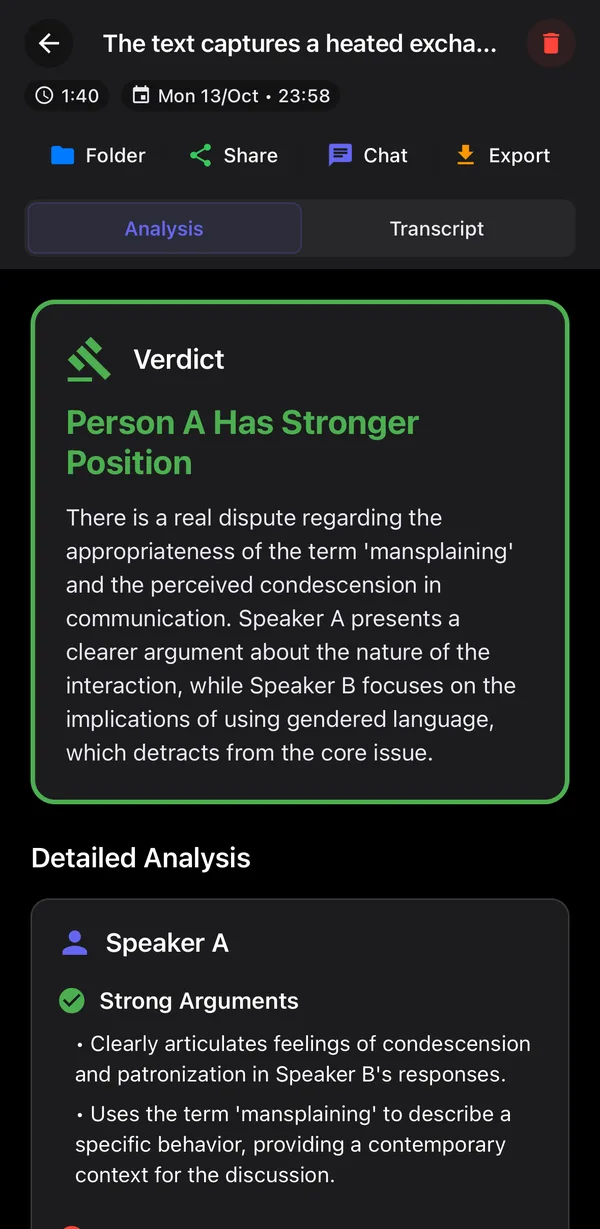
The ArgueResolver app · iPhone and Android
Record the argument. Get the verdict.
ArgueResolver listens while you talk it out, works out who said what, and gives an honest verdict on what was actually said, with compromises and steps to fix it.
Free to start · See how it works