Post Hoc Ergo Propter Hoc: The False Cause Fallacy, With Examples
Also called: post hoc fallacy, false cause fallacy, questionable cause, after this, therefore because of this
Updated · 5 min read · 4 sources
The short answer
Post hoc ergo propter hoc (Latin for 'after this, therefore because of this') is the fallacy of assuming that because one thing happened after another, the first caused the second: 'Ever since your mom visited, you've been distant.' The timing may be a clue, but coincidence, a shared cause or something else entirely could explain it.
What does post hoc ergo propter hoc mean?
Post hoc ergo propter hoc, usually shortened to the post hoc fallacy, treats sequence as proof of cause. Event A happened, then event B happened, so A must have caused B. Purdue's writing lab gives a simple example: 'I drank bottled water and now I am sick, so the water must have made me sick.' Maybe. Or maybe it was lunch, or a cold going around the office.
It's one of the most natural mistakes we make, because looking for causes in sequences is usually useful. Touch a hot stove, get burned, learn. The fallacy is jumping from 'after' to 'because' without checking anything else.
Post hoc, false cause and 'correlation is not causation'
Post hoc is one member of a family often called false cause or questionable cause fallacies. Its close relative is assuming that two things that happen together cause each other, which is what people mean by 'correlation is not causation'. Ice cream sales and sunburns rise together, but neither causes the other; summer causes both.
In arguments, the post hoc version usually sounds like a story: 'Since you started that job, we fight all the time.' Stories are persuasive because they have a beginning and a cause. That's exactly why they're worth checking.
Post Hoc Ergo Propter Hoc examples
Post hoc thinking in relationships
When something feels off in a relationship, the mind grabs the most recent change and pins the problem on it: the new friend, the new job, the in-law's visit, the new phone. Sometimes that's right. A new job really can mean less time and more stress. But blaming the wrong cause has a cost: you fight about the visit while the real issue, maybe exhaustion or a worry that hasn't been said out loud, goes untouched.
It also tends to put a person on trial. 'Ever since your friend moved back, you've changed' makes the friend the defendant. A more useful version is to describe what you've noticed and ask what's going on. Many of the things couples fight about have causes neither person has named yet.
Post hoc examples
Each of these treats 'after' as 'because':
- 'The dishwasher broke right after you used it, so you broke it.'
- 'We lost because you didn't wear the lucky jersey.'
- 'You've been moody since you started seeing that therapist.'
- 'My headache started after I ate that sushi, so it was the sushi.'
- 'Sales dropped after the new manager arrived, so she's the problem.'
How to test a 'because' claim
Treat the timing as a hypothesis, not a verdict, and test it with three questions. What else changed around the same time? Does the effect ever happen without the supposed cause, or does the cause happen without the effect? And is there a plausible way the first thing would produce the second?
If the answers point the same way, the cause may be real. If they don't, keep looking. Be careful not to settle the question with one memorable example; that slides into the anecdotal fallacy or a hasty generalization.
When the timing really is the cause
Sometimes after does mean because. If a known side effect shows up right after starting a new medication, the timing plus a known mechanism is a good reason to call the doctor. If the arguments started the week a partner began working nights, and they ease when the schedule changes, the connection is well supported.
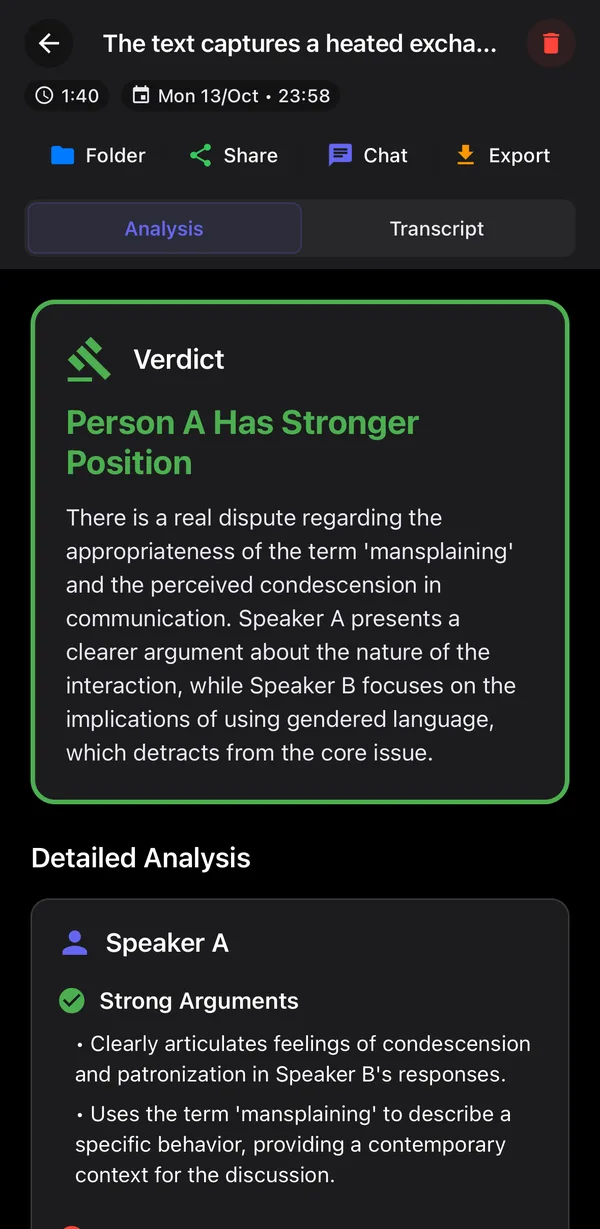
The difference is evidence beyond the sequence: repetition, a mechanism, and the absence of better explanations. If you can't agree whether a cause is real, it can help to lay out both accounts for a neutral reader like our free argument judge.
What to say
That might be part of it. What else changed around the same time?
Has it happened when that wasn't going on? That would tell us a lot.
I can see why the timing points there. Can we look at other explanations before we decide it's about her?
Let's test it: if it's the late shifts, things should get better when your schedule changes.
In an argument right now?
Type both sides and get a fair verdict, with the fallacies on each side. Free.
Questions people ask
What is an example of post hoc ergo propter hoc?
'I wore my new sneakers and got a cold the next day, so the sneakers made me sick.' The cold followed the sneakers, but nothing connects them except timing.
What does post hoc ergo propter hoc mean in English?
It's Latin for 'after this, therefore because of this'. It names the mistake of treating a sequence of events as proof that the first caused the second.
Is post hoc the same as 'correlation does not imply causation'?
They're closely related false cause errors. Post hoc relies on order in time; the correlation version relies on two things occurring together. In both, a hidden third factor or coincidence may explain the pattern.
Is timing ever good evidence of cause?
Yes, when it comes with more: the pattern repeats, there's a plausible mechanism, and other explanations have been ruled out. Timing alone is a clue, not proof.
Sources
Keep reading
- FallaciesHasty GeneralizationA hasty generalization is a sweeping conclusion drawn from too few examples, or from examples that aren't typical: one unanswered text becomes 'you never answer me', one messy roommate becomes 'people from that school are slobs'. The examples may be real. There just aren't enough of them to support a claim about always, never or everyone.
- FallaciesAnecdotal FallacyThe anecdotal fallacy is using a personal story or an isolated example in place of solid evidence about a general claim. "My grandpa never wore a seatbelt and lived to ninety" says nothing about whether seatbelts save lives. Stories are vivid and memorable, which is exactly why they can outweigh better evidence in an argument.
- FallaciesCherry Picking FallacyThe cherry picking fallacy is selecting only the facts, examples or quotes that support your side while ignoring the ones that don't. Each picked item may be true, but the overall picture is false. Showing a friend three screenshots out of a two-hour text fight is a common everyday version.
- FallaciesSlippery Slope FallacyA slippery slope fallacy claims that one small step will set off a chain of events ending in disaster, without showing why each step would actually lead to the next. 'If we let her stay out until midnight, next she'll be skipping school.' Some chain reactions are real. The fallacy is assuming the whole chain with little or no evidence.
- GuidesWhat Do Couples Fight About?What do couples fight about? Most often chores, money, children, in-laws and extended family, time together, attention and phones, sex and affection, and plans. Research suggests the topic matters less than what sits underneath it: money fights, for example, are not the most frequent but tend to be the most recurring and least resolved.
The ArgueResolver app · iPhone and Android
Record the argument. Get the verdict.
ArgueResolver listens while you talk it out, works out who said what, and gives an honest verdict on what was actually said, with compromises and steps to fix it.
Free to start · See how it works