No True Scotsman Fallacy: Meaning, Examples and How to Respond
Also called: no true scotsman, appeal to purity, the 'real' fallacy
Updated · 5 min read · 3 sources
The short answer
The no true Scotsman fallacy protects a sweeping claim from a counterexample by redefining the group: 'No real friend would forget your birthday.' 'Mine did.' 'Then she was never a real friend.' Instead of admitting the claim was wrong, the speaker changes the definition so nothing could ever disprove it. The name comes from philosopher Antony Flew.
What is the no true Scotsman fallacy?
The no true Scotsman fallacy happens in three steps. Someone makes a general claim about a group. Someone else offers a counterexample. The first person rescues the claim by declaring that the counterexample doesn't really belong to the group, usually by adding the word 'true' or 'real'.
The British philosopher Antony Flew named it with a story about a man who insists that no Scotsman puts sugar on his porridge. Told of a Scotsman who does, he replies that no true Scotsman puts sugar on his porridge. The claim survives, but only because it no longer says anything that could be checked.
Why it's a fallacy
A claim about a group is only meaningful if some possible evidence could count against it. The no true Scotsman move removes that possibility: any counterexample is simply defined out of the group. The original statement, which sounded like an observation about the world, quietly becomes true by definition, which is a close cousin of circular reasoning.
It's also a way of avoiding a small, honest concession. 'Most friends would remember, but people slip' is easy to say and keeps the conversation going. The redefinition turns a disagreement about a generalization into a fight about who counts as a real friend, partner or fan. When the standard keeps shifting as each example is met, the move becomes moving the goalposts.
No True Scotsman Fallacy examples
No true Scotsman in personal arguments
In relationships, this fallacy shows up wherever there's an ideal: real friends, real men, good mothers, true fans, a loving partner. The ideal isn't the problem. The problem is using it to win a point by excluding anyone who doesn't fit, including the person you're arguing with.
'If you really loved me, you'd know what I wanted' is a common version. It defines love so that any failure to read minds proves its absence. Combined with guilt, it becomes an appeal to emotion as well. These standards hurt because they're about identity: being told you're not a real friend lands much harder than being told you forgot something.
No true Scotsman examples
Watch for 'real' or 'true' appearing right after a counterexample:
- 'No real fan would complain about the new album.'
- 'A good mother never loses her temper.' 'You did yesterday.' 'Then I wasn't being a good mother.'
- 'Real men don't need help.'
- 'No true professional would take a sick day before a deadline.'
- 'Anyone who actually cares about the environment would never fly.'
How to respond to a no true Scotsman
Ask for the definition before the example: 'What do you mean by a real friend?' Agreeing on terms up front makes it harder for them to shift later. If they've already shifted, point it out kindly: 'It sounds like the rule changed once we found an exception.'
Another good question: what would count as a counterexample? If nothing could, the claim is a definition or an ideal, not an observation, and you can talk about it on those terms. Often the most useful move is to set the label aside and talk about the actual expectation: 'I think what you're saying is you expect friends to remember birthdays. Can we talk about that?'
Sweeping claims that need this kind of rescue usually started as a hasty generalization. If you're going in circles about who counts, our free argument judge can show where the definition shifted.
When 'not a real X' is fair
Some groups have clear definitions, and pointing them out isn't a fallacy. Someone who eats meat every day isn't a vegetarian; that's what the word means. Criteria agreed on in advance are fine too: if your book club's rule is that members read the book, someone who never has isn't really a member in the sense you agreed on.
The fallacy is when the definition is invented or changed after the counterexample appears, specifically to protect the claim.
What to say
What do you mean by a real friend? Let's agree on that first.
If she still counts as a friend, maybe the rule needs adjusting. How about 'good friends usually remember'?
Is there anything that would change your mind? If not, I think we're talking about an ideal, not a fact.
I think the question is what we expect from each other. Can we talk about that instead of who counts as real?
In an argument right now?
Type both sides and get a fair verdict, with the fallacies on each side. Free.
Questions people ask
What is an example of the no true Scotsman fallacy?
'No good parent lets their kid have screen time.' 'My sister does, and she's a great parent.' 'Then she's not a good parent.' The definition of 'good parent' was changed to exclude the counterexample.
Why is it called no true Scotsman?
Philosopher Antony Flew used the example of a man who claims no Scotsman puts sugar on his porridge and, faced with one who does, says no true Scotsman would. The name stuck.
What is the difference between no true Scotsman and moving the goalposts?
No true Scotsman redefines a group to exclude a counterexample. Moving the goalposts raises or changes the standard of evidence each time it's met. Both make a claim impossible to disprove.
Is it ever fair to say someone isn't a real member of a group?
Yes, when the group has a clear definition or agreed criteria, like a vegetarian who eats meat. It's a fallacy when the definition is invented after the fact to protect a claim.
Sources
Keep reading
- FallaciesMoving the GoalpostsMoving the goalposts is changing what counts as proof, or as success, after the other person has already met the original standard. Instead of accepting the result, the person adds a new requirement, so the conclusion they started with can never be lost. It turns a disagreement into a game nobody else can win.
- FallaciesCircular Reasoning and Begging the QuestionCircular reasoning is an argument whose conclusion is already assumed in its premises, so it ends where it started: 'It was a harmless joke because it didn't hurt anyone.' It's also called begging the question. The argument sounds complete but gives no independent reason to believe the conclusion. In everyday speech, 'begs the question' usually means something else: 'raises the question'.
- FallaciesHasty GeneralizationA hasty generalization is a sweeping conclusion drawn from too few examples, or from examples that aren't typical: one unanswered text becomes 'you never answer me', one messy roommate becomes 'people from that school are slobs'. The examples may be real. There just aren't enough of them to support a claim about always, never or everyone.
- FallaciesMotte and Bailey FallacyA motte and bailey is an argument move where someone makes a bold, hard-to-defend claim (the bailey), retreats to a modest, easy-to-defend claim (the motte) when challenged, and then acts as if defending the modest claim also defended the bold one. Two different positions are treated as if they were the same.
- FallaciesEquivocation FallacyThe equivocation fallacy is using one word in two different senses within the same argument, so a conclusion seems to follow when it doesn't. "You told me to be more spontaneous, so why are you mad I booked a trip without asking?" slides from spontaneous dates to spontaneous spending. Most equivocation in arguments is accidental.
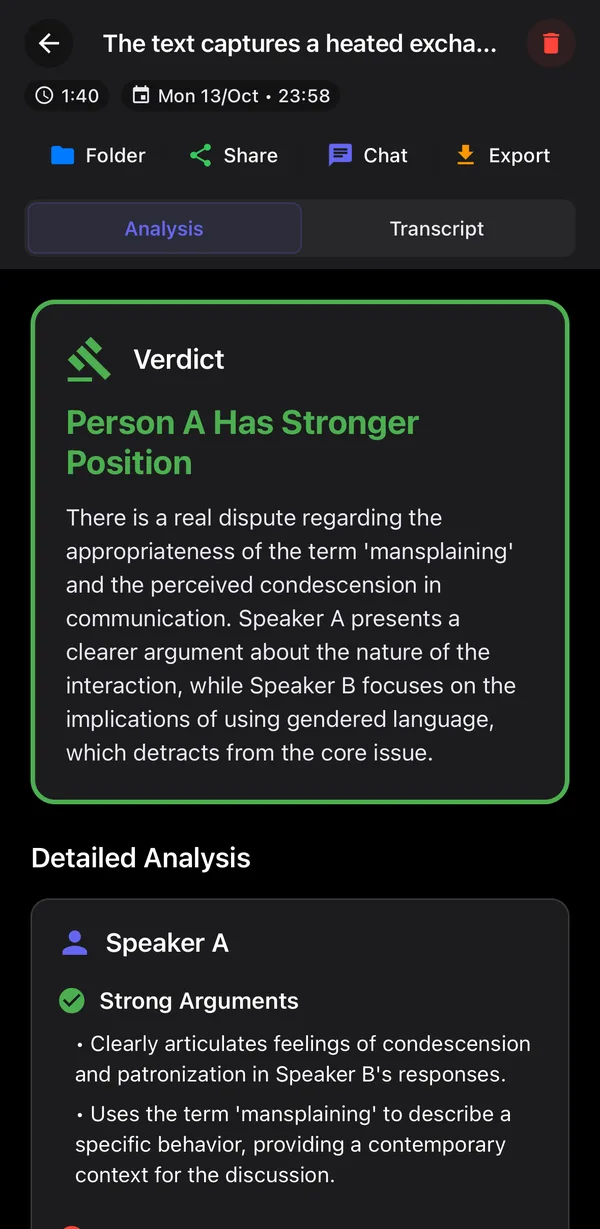
The ArgueResolver app · iPhone and Android
Record the argument. Get the verdict.
ArgueResolver listens while you talk it out, works out who said what, and gives an honest verdict on what was actually said, with compromises and steps to fix it.
Free to start · See how it works