Equivocation Fallacy: When One Word Means Two Things
Also called: equivocation, fallacy of ambiguity, semantic equivocation
Updated · 4 min read · 3 sources
The short answer
The equivocation fallacy is using one word in two different senses within the same argument, so a conclusion seems to follow when it doesn't. "You told me to be more spontaneous, so why are you mad I booked a trip without asking?" slides from spontaneous dates to spontaneous spending. Most equivocation in arguments is accidental.
What is the equivocation fallacy?
Equivocation is a fallacy of ambiguity. A key word or phrase is used with one meaning in one part of an argument and a different meaning in another, and the argument only works if you do not notice the switch. The classic textbook example: a feather is light; whatever is light cannot be dark; therefore a feather cannot be dark. "Light" means low in weight the first time and bright the second.
Real equivocation is rarely that obvious. It hides in everyday words that carry several meanings: help, clean, early, fine, there for me, cheating, respect. Two people can argue for an hour and both be right, because they are each using the same word to mean something different.
Equivocation examples in everyday arguments
Some common words that shift meaning mid-argument:
- Help
- "You said you'd help with the move." One person meant carrying boxes all day; the other meant lending the car for an hour.
- Early
- "I said I'd be home early." Before dinner, or before midnight?
- Clean
- "My room is clean." Nothing on the floor, or vacuumed and dusted?
- Cheating
- Physical contact only, or also secret emotional closeness, or flirty messages? Couples genuinely differ here.
- There for me
- Physically present, or reachable by phone, or emotionally attentive?
- Fine
- "You said it was fine." Acceptable, or "I don't want to talk about it"?
Equivocation Fallacy examples
Why equivocation keeps arguments going in circles
When the key word means different things to each person, every argument about it is really two arguments happening at once. Each side can point to evidence that proves their version, so neither side ever feels wrong. Both people walk away convinced the other is being stubborn or dishonest, when the real problem is a definition nobody stated.
Equivocation is also a building block of other moves. In a motte and bailey, a word like "care" stretches from a bold meaning to a modest one when challenged. In the no true Scotsman fallacy, a category like "real friend" gets redefined to exclude counterexamples.
Deliberate vs accidental equivocation
Sometimes equivocation is a tactic: a promise worded loosely enough to be technically kept, or a word picked because it means one thing to the listener and another to the speaker. "I didn't drink at the party" can be technically true if the drinks were at the after-party.
Most of the time, though, it is innocent. People grow up with different meanings for words like "clean" or "on time," and nobody thinks to check. That is good news, because the fix for accidental equivocation is simple and calm: define the word together. Many recurring fights about what couples fight about, like chores and time, shrink dramatically once both people agree what "done" or "late" means.
How to respond to equivocation
Ask what the word means, without sarcasm. "When you say help, what did you picture?" is a genuine question, and the answer often ends the argument on the spot. If you suspect the meaning shifted, point to both uses: "Earlier, spontaneous meant date nights. Now it seems to mean big purchases too. Are those the same for you?"
For recurring issues, write the definition down: what clean means for the kitchen, what time counts as late, what kinds of contact with an ex feel okay. Good active listening, repeating back what you heard in your own words, also catches equivocation early, because the mismatch becomes obvious when you paraphrase.
What to say
When you say help, what exactly did you picture? I think we might mean different things.
Earlier you used that word to mean one thing, and now it means something bigger. Which one are we talking about?
Let's write down what clean means for the kitchen, so we're both checking the same list.
I think I stretched what I meant. Let me say it more precisely.
In an argument right now?
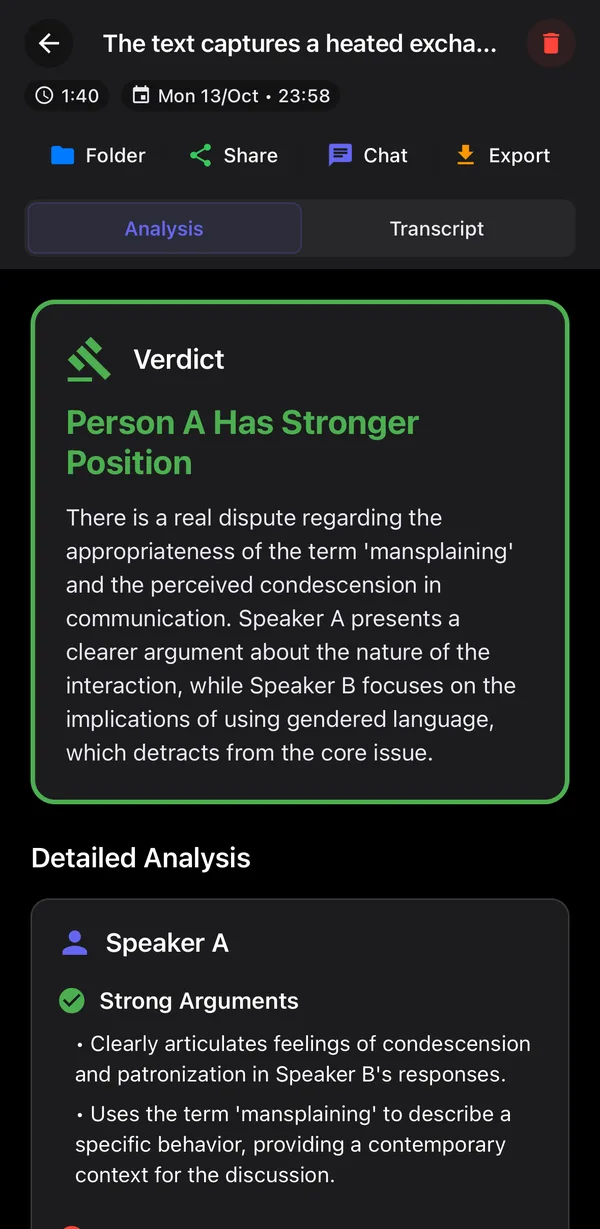
Type both sides and get a fair verdict, with the fallacies on each side. Free.
Questions people ask
What is the equivocation fallacy?
It is using a word or phrase in two different senses within one argument, so the conclusion seems to follow only because the meaning quietly changed.
What is a simple example of equivocation?
"A feather is light; light things can't be dark; so a feather can't be dark." The word light switches from meaning not heavy to meaning bright.
Is equivocation always intentional?
No. Most equivocation in personal arguments is accidental, because people use everyday words like clean, early or help with different meanings without realizing it.
How do you stop equivocation in an argument?
Ask what the key word means to each person and agree on one definition. Repeating back what you heard also exposes mismatched meanings early.
Sources
Keep reading
- FallaciesMotte and Bailey FallacyA motte and bailey is an argument move where someone makes a bold, hard-to-defend claim (the bailey), retreats to a modest, easy-to-defend claim (the motte) when challenged, and then acts as if defending the modest claim also defended the bold one. Two different positions are treated as if they were the same.
- FallaciesNo True Scotsman FallacyThe no true Scotsman fallacy protects a sweeping claim from a counterexample by redefining the group: 'No real friend would forget your birthday.' 'Mine did.' 'Then she was never a real friend.' Instead of admitting the claim was wrong, the speaker changes the definition so nothing could ever disprove it. The name comes from philosopher Antony Flew.
- FallaciesStraw Man FallacyA straw man fallacy is when someone replaces your actual point with a weaker or more extreme version of it, then argues against that version instead. It feels like a win because the distorted claim is easy to knock down, but your real point was never answered. In personal arguments it often starts with 'So what you're saying is...'
- GuidesActive ListeningActive listening is listening to understand rather than to reply: you let the other person finish, summarize what you heard in your own words, ask questions to check, and acknowledge their feelings before giving your side. In an argument it lowers the temperature fast, because people stop repeating themselves once they feel understood.
- GuidesWhat Do Couples Fight About?What do couples fight about? Most often chores, money, children, in-laws and extended family, time together, attention and phones, sex and affection, and plans. Research suggests the topic matters less than what sits underneath it: money fights, for example, are not the most frequent but tend to be the most recurring and least resolved.
The ArgueResolver app · iPhone and Android
Record the argument. Get the verdict.
ArgueResolver listens while you talk it out, works out who said what, and gives an honest verdict on what was actually said, with compromises and steps to fix it.
Free to start · See how it works