Gaslighting vs Manipulation (and Lying): How to Tell Them Apart
Also called: gaslighting vs lying, is gaslighting manipulation
Updated · 6 min read · 6 sources
The short answer
Gaslighting vs manipulation is a part versus the whole. Manipulation is any attempt to influence or control someone for your own advantage. Gaslighting is one specific kind: repeatedly making someone doubt their own memory, perception or judgment. A single lie, an honest disagreement or a fuzzy memory is not gaslighting. A pattern that leaves you distrusting your own mind is.
What is the difference between gaslighting and manipulation?
The difference between gaslighting and manipulation is scope. The APA Dictionary of Psychology defines manipulation as behavior designed to exploit, control or otherwise influence others to your advantage. Guilt trips, flattery to get a favor, pressure, playing on someone's fears: all manipulation.
Gaslighting is a narrower move. The APA Dictionary defines to gaslight as to manipulate another person into doubting their perceptions, experiences or understanding of events. The name comes from the 1938 play Gaslight and its film versions, in which a husband deceives his wife until she doubts her own sanity. So every act of gaslighting is manipulation, but most manipulation is not gaslighting. What makes it gaslighting is the target: not your choices, but your trust in your own mind.
Gaslighting vs manipulation vs lying at a glance
Four things that get called gaslighting, and what each one actually aims at:
- Manipulation
- Aims at what you do. "After everything I've done for you, you can't drive me to the airport?" is pressure through guilt.
- Lying
- Aims at what you believe about a fact. "I didn't eat the last slice" (when they did) is a lie about the pizza.
- Gaslighting
- Aims at your confidence in your own perception. "There was no last slice. You're always imagining things lately" is an attack on your memory itself.
- Honest disagreement
- Two people remember or interpret something differently, and both are open to checking. Nobody is aiming at anything.
What it sounds like
Gaslighting vs lying
A lie tries to make you believe something false about the world. Gaslighting goes after the tool you would use to check: your memory, your senses, your judgment. A lie says "I was at the office." Gaslighting adds "You're paranoid. You always get confused about this stuff. Maybe you should get your memory checked."
Cleveland Clinic makes an important point here: lying, guilt-tripping and shaming are not gaslighting on their own, and the word is overused online. It describes gaslighting as a pattern of manipulation repeated over time, not a single tactic. It also notes that the person doing it may or may not realize it. That matters, because it means you can name the pattern without having to prove what is going on in their head.
What gaslighting is not
Memory is imperfect for everyone. Two people can honestly remember the same evening differently, and saying "I don't think that's what I said" is not gaslighting. Neither is disagreeing with your interpretation of something, being told that you hurt someone, or a partner who forgets things. One bad argument with a denial in it is a bad argument.
Calling every disagreement gaslighting can become its own way of ending a conversation, because it turns "we remember it differently" into an accusation of abuse. Keeping the word for the real pattern protects it for people who need it. Our page of gaslighting examples shows the common phrases side by side with ordinary disagreements.
Signs it is more than an ordinary fight
The National Domestic Violence Hotline describes gaslighting as a form of emotional abuse that often happens gradually and can seem harmless at first. Tactics it lists include pretending not to understand, disputing your accurate memory of events, changing the subject to question your thinking, brushing off your feelings as too sensitive, and claiming to forget what happened or denying promises.
Peer-reviewed research describes gaslighting as a manipulative behavior aimed at altering a partner's perceptions, emotions and sense of reality. In a study of 65 people who believed they had been gaslit by a romantic partner, all said the partner insulted and demeaned them, often calling them crazy, stupid or overly emotional, and many described being kept away from friends and family.
Warning signs worth taking seriously: you leave conversations confused about what happened, you apologize without knowing what for, you double-check your own memories constantly, and the other person's response to a concern is almost always an attack on your sanity or sensitivity. When someone denies, attacks and then casts themselves as the victim, that overlaps with DARVO.
What to do if you think you're being gaslit
You don't have to win the argument about what happened. Cleveland Clinic suggests documenting your interactions, which helps you sort your own memory from what you are being told. Talking to people you trust also helps; in the study above, support from friends and family stood out among the things that helped people recover.
You can also step out of the loop with a simple line: "I remember it differently, and I'm not going to argue about my own memory." If this is a pattern, a therapist or counselor can help you sort it out, and if you feel afraid of your partner, the hotline listed on this page is free, confidential and open 24/7.
What to say
We remember it differently. Can we check the texts instead of arguing about whose memory is better?
You can disagree with me about what happened. I'm not okay with being called crazy for remembering it.
I hear that you're disappointed. My answer is still no.
I'm not trying to make you doubt yourself. I honestly remember it differently. Let's look at what we can check.
I'm not going to keep debating what I saw. I'm going to write it down and talk it through with someone I trust.
In an argument right now?
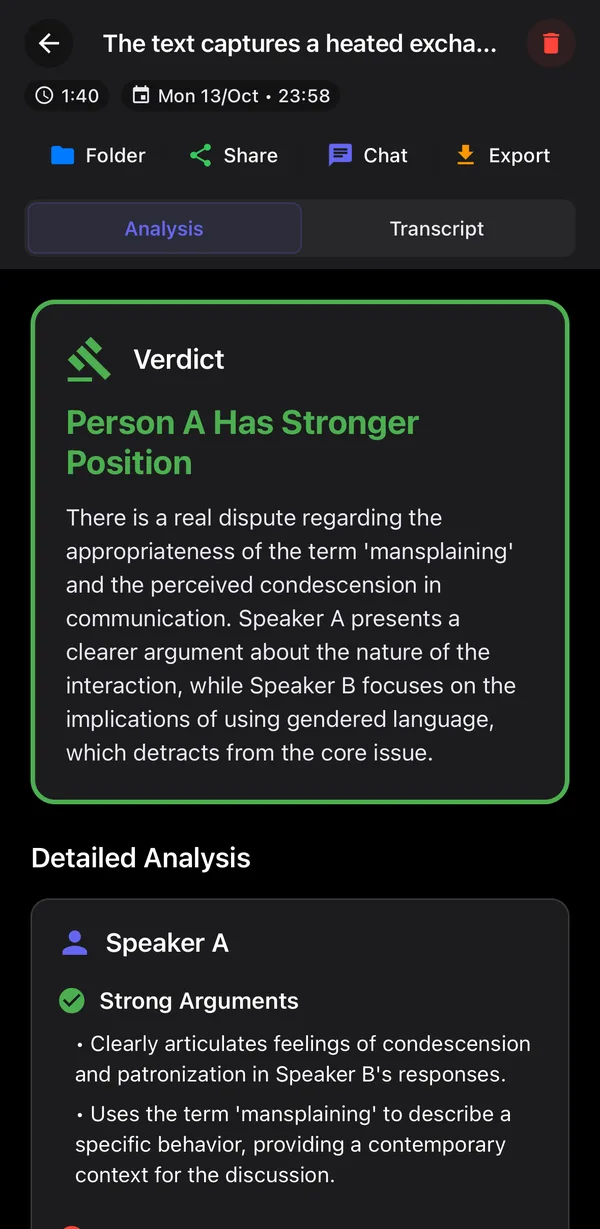
Type both sides and get a fair verdict, with the fallacies on each side. Free.
Questions people ask
Is gaslighting a form of manipulation?
Yes. Gaslighting is a specific kind of manipulation aimed at making someone doubt their own memory, perception or judgment. Manipulation is the broader category, and most of it is not gaslighting.
What is the difference between gaslighting and lying?
A lie tries to make you believe something false. Gaslighting tries to make you distrust your own mind, usually as a repeated pattern. A single lie, even a serious one, is not gaslighting by itself.
Can someone gaslight without realizing it?
Cleveland Clinic notes that the person doing it may or may not realize it. Either way, the effect on you is what to pay attention to, and you can address the pattern without proving intent.
Is it gaslighting if someone remembers things differently?
No. Different memories are normal. It starts to look like gaslighting when the response to your memory is consistently an attack on your sanity or sensitivity, rather than a willingness to check.
Is gaslighting abuse?
The National Domestic Violence Hotline describes gaslighting as a form of emotional abuse. A repeated pattern is serious, and a therapist, counselor or hotline advocate can help you think it through.
Sources
- APA Dictionary of Psychology: Gaslight
- APA Dictionary of Psychology: Manipulation
- Cleveland Clinic: What Is Gaslighting?
- National Domestic Violence Hotline: What Is Gaslighting?
- Bellomare, Genova and Miano (2024), Gaslighting Exposure During Emerging Adulthood: Personality Traits and Vulnerability Paths, International Journal of Psychological Research (PMC)
- Willis Klein, SPSP Character & Context: Gaslighting (on Klein, Li and Wood 2023, Personal Relationships)
Keep reading
- GuidesGaslighting ExamplesGaslighting is a pattern of manipulation that makes someone doubt their own memory, perception or sanity. Gaslighting examples include "That never happened", "You're too sensitive" and "You're imagining things", used again and again to override what you know you saw. One disagreement about the facts is not gaslighting; a repeated pattern that leaves you doubting yourself is.
- GuidesDARVODARVO stands for Deny, Attack, and Reverse Victim and Offender. Psychologist Jennifer Freyd named it for a reaction people may show when confronted about wrongdoing: they deny it, attack the person raising it, and recast themselves as the real victim. Research finds it is common, shifts blame onto the confronter, and loses power once people recognize it.
- GuidesBlame ShiftingBlame shifting is moving responsibility for your own action onto someone else, so the conversation becomes about their fault instead of yours: "I only yelled because you provoked me." Everyone does it occasionally when they feel attacked. As a habit, blame shifting keeps problems unsolved and can slide into manipulation.
- GuidesDeflection in ArgumentsDeflection is redirecting attention away from something uncomfortable, usually your own behavior, so it never gets discussed. In an argument it looks like changing the subject, bringing up an old fight, joking it off or turning the question back on the other person. Deflection protects the person for a moment and leaves the problem untouched.
- GuidesContempt in RelationshipsContempt in relationships is treating your partner as beneath you: mockery, sneering, name-calling, eye-rolling, sarcasm meant to wound. The Gottman Institute calls it the single greatest predictor of divorce among the Four Horsemen. It grows from long-held resentment, and the antidote is to state your needs directly and rebuild appreciation.
The ArgueResolver app · iPhone and Android
Record the argument. Get the verdict.
ArgueResolver listens while you talk it out, works out who said what, and gives an honest verdict on what was actually said, with compromises and steps to fix it.
Free to start · See how it works