DARVO: What It Means, Examples and How to Respond
Also called: deny attack reverse victim and offender, darvo meaning, what is darvo
Updated · 5 min read · 4 sources
The short answer
DARVO stands for Deny, Attack, and Reverse Victim and Offender. Psychologist Jennifer Freyd named it for a reaction people may show when confronted about wrongdoing: they deny it, attack the person raising it, and recast themselves as the real victim. Research finds it is common, shifts blame onto the confronter, and loses power once people recognize it.
What does DARVO mean?
DARVO is an acronym for Deny, Attack, and Reverse Victim and Offender. Jennifer Freyd, a psychologist and professor emerit at the University of Oregon, introduced the term in a 1997 peer-reviewed article. She describes it as a reaction that perpetrators of wrongdoing, particularly sexual offenders, may show when they are held accountable: the behavior is denied, the person confronting it is attacked, and the roles flip so that the person who did harm becomes the "falsely accused" victim.
Freyd also describes institutional DARVO, when an organization does the same thing to someone who reports abuse, and anti-DARVO: ways to reduce its impact and to respond to allegations more constructively. According to her research page, the term was added to the Merriam-Webster dictionary in 2026.
The three steps of DARVO
The steps often arrive in a single breath, which is part of why the person on the receiving end ends up confused.
- Deny
- "That didn't happen." "I never said that." The behavior itself is disputed, sometimes in the face of clear evidence.
- Attack
- The focus moves to the person raising the issue: their motives, honesty, stability or past mistakes. "You're just looking for a reason to be angry."
- Reverse victim and offender
- The accused presents themselves as the injured party: "I can't believe you'd accuse me of that after everything I do for you. You're the one hurting me." The original concern disappears, and the confronter is now the one apologizing.
What it sounds like
What the research says
DARVO has been studied directly. In a 2017 study, Harsey, Zurbriggen and Freyd found that DARVO was commonly used by people who were confronted, that women were more likely than men to be exposed to it during confrontations, and that more exposure to DARVO was linked to more self-blame among the people who did the confronting.
Later experiments by Harsey and Freyd found that a DARVO response made observers believe a victim less and blame them more. The encouraging part: participants who had learned about DARVO rated the perpetrator as less believable. A 2024 study in PLOS ONE found small but significant links between using DARVO and both sexual harassment perpetration and acceptance of rape myths. In short, the tactic works on bystanders, and naming it helps.
DARVO or ordinary defensiveness?
Almost everyone gets defensive when criticized, and a heated "that's not fair" is not DARVO. Defensiveness is a common and fixable conflict habit: excuses, a counter-complaint, a wounded tone. It slows the conversation down, but the original concern usually survives and gets addressed eventually.
DARVO is the full reversal. The concern is denied, the person raising it is put on trial, and by the end they are the one accused of causing harm. The term was developed to describe responses to abuse and serious wrongdoing, so it is worth using carefully. If you call every disagreement DARVO, the word loses its force where it matters most. It overlaps with gaslighting and with blame shifting, but its focus is specific: what happens when someone is held to account.
How to respond to DARVO
Because DARVO moves the conversation onto you, the most useful thing is to keep bringing it back:
- Restate the original issue in one sentence, and return to it calmly each time the topic shifts.
- Do not spend your energy defending your character at length; that is the debate DARVO invites.
- Name the reversal without heat: "I raised a concern, and now we're talking about what's wrong with me."
- Keep a written record of what happened and what was said.
- Get an outside perspective from someone you trust. Bystanders are influenced by DARVO too, so it helps when they know the pattern.
- If the original issue is abuse or you feel unsafe, prioritize your safety and confidential support over winning the conversation.
When you're the one being confronted
Being accused of something hurts, especially if you think it is unfair, and the urge to hit back is human. The non-DARVO response is slower: listen to the whole concern, say what part you can see, and ask questions before defending. "I hear that you felt I went behind your back. I don't think that's what happened, but tell me what you saw." If you did cause harm, our guide on how to apologize walks through an apology that does not turn into a counterattack.
What to say
I raised something that happened. I'd like to stay on that before we talk about anything else.
You can disagree with me, but the question isn't why I'm asking. It's whether this happened.
I'm sorry you're upset, but I'm not taking back the concern. Let's go back to it.
I don't see it that way yet, but I want to understand. Walk me through what you saw.
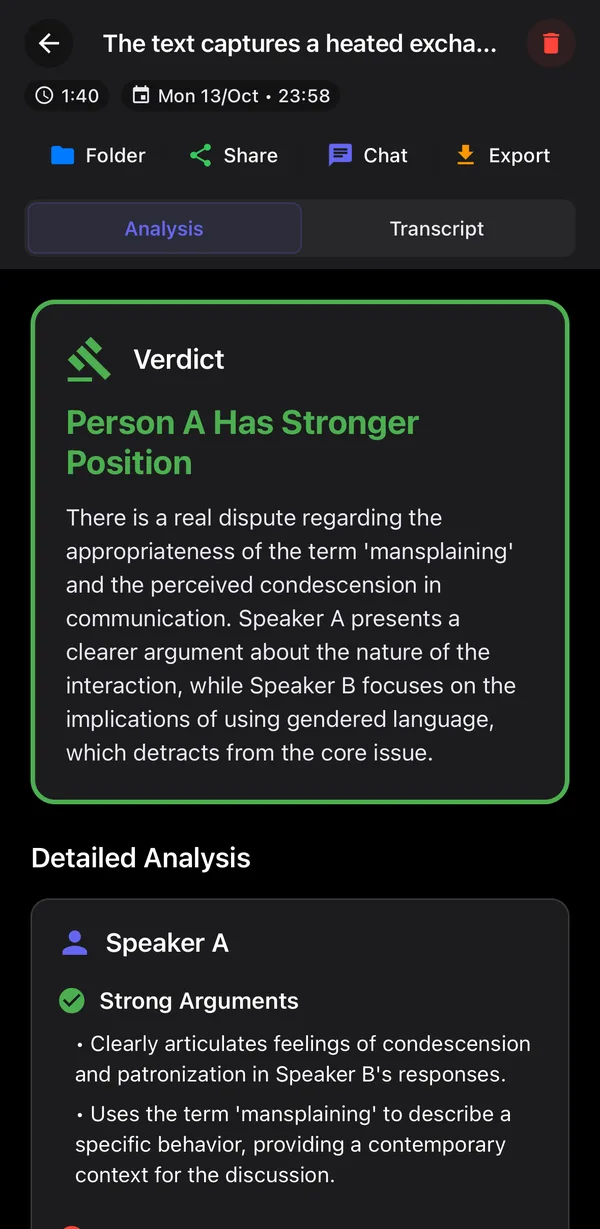
In an argument right now?
Type both sides and get a fair verdict, with the fallacies on each side. Free.
Questions people ask
What does DARVO stand for?
Deny, Attack, and Reverse Victim and Offender. The term was coined by psychologist Jennifer Freyd.
Is DARVO a form of gaslighting?
They overlap, since both distort what happened, but they are not the same. Gaslighting targets your trust in your own perception over time; DARVO is a specific reaction to being held accountable that flips who is the victim.
What is institutional DARVO?
Freyd uses the term when an institution, or people acting with its backing, responds to a report of wrongdoing by denying it, attacking the person who reported it and treating the institution as the victim.
Does recognizing DARVO help?
Research by Harsey and Freyd suggests it does: people who learned about DARVO were less swayed by it and found the perpetrator less believable.
Sources
- Jennifer J. Freyd: What Is DARVO?
- Harsey, Adams-Clark and Freyd (2024), Associations between defensive victim-blaming responses (DARVO), rape myth acceptance, and sexual harassment, PLOS ONE
- The Gottman Institute: The Four Horsemen: Defensiveness
- National Domestic Violence Hotline: Understand Relationship Abuse
Keep reading
- GuidesGaslighting ExamplesGaslighting is a pattern of manipulation that makes someone doubt their own memory, perception or sanity. Gaslighting examples include "That never happened", "You're too sensitive" and "You're imagining things", used again and again to override what you know you saw. One disagreement about the facts is not gaslighting; a repeated pattern that leaves you doubting yourself is.
- GuidesBlame ShiftingBlame shifting is moving responsibility for your own action onto someone else, so the conversation becomes about their fault instead of yours: "I only yelled because you provoked me." Everyone does it occasionally when they feel attacked. As a habit, blame shifting keeps problems unsolved and can slide into manipulation.
- GuidesDeflection in ArgumentsDeflection is redirecting attention away from something uncomfortable, usually your own behavior, so it never gets discussed. In an argument it looks like changing the subject, bringing up an old fight, joking it off or turning the question back on the other person. Deflection protects the person for a moment and leaves the problem untouched.
- GuidesDefensiveness in RelationshipsDefensiveness in relationships means protecting yourself from a complaint with excuses, counter-complaints or wounded innocence instead of hearing it. It is one of John Gottman's Four Horsemen, and nearly everyone does it. The antidote is to accept responsibility for at least part of the problem, which lets the conversation move forward.
- GuidesHow to Apologize SincerelyTo apologize well, name exactly what you did, take responsibility without excuses, acknowledge how it affected the other person, say what you will do differently, and offer to make it right. Research on apologies finds that taking responsibility and offering repair matter most, while asking to be forgiven matters least.
The ArgueResolver app · iPhone and Android
Record the argument. Get the verdict.
ArgueResolver listens while you talk it out, works out who said what, and gives an honest verdict on what was actually said, with compromises and steps to fix it.
Free to start · See how it works