Deflection in Arguments: What It Is, Examples and How to Respond
Also called: deflecting, deflecting in arguments, deflection psychology
Updated · 5 min read · 3 sources
The short answer
Deflection is redirecting attention away from something uncomfortable, usually your own behavior, so it never gets discussed. In an argument it looks like changing the subject, bringing up an old fight, joking it off or turning the question back on the other person. Deflection protects the person for a moment and leaves the problem untouched.
What is deflection?
In psychology, deflection is a defensive move: when a topic threatens how we see ourselves, we steer attention somewhere safer. In an argument, deflection is any reply that answers a concern without engaging with it. The words keep flowing, but the original point quietly disappears.
It rarely feels like a tactic from the inside. It feels like "but what about..." or "that's not even the real issue." That is why both people in a fight can deflect without noticing, and why the same argument comes back next week.
Common ways people deflect
Deflection comes in a few recognizable shapes:
- Changing the subject
- Answering "you were on your phone all through dinner" with "did you call the plumber?" In logic this is a red herring.
- The counter-accusation
- "You're on your laptop every night." Raising the other person's fault instead of answering. See whataboutism and blame shifting.
- The joke
- Turning the moment into a laugh so it cannot be taken seriously.
- Nitpicking the wording
- "I wasn't on my phone the whole time, it was maybe twenty minutes." Correcting a detail to avoid the point.
- Reopening an old fight
- "This is just like when you forgot my birthday." Pulling in history that has nothing to do with tonight.
- Questioning the tone
- "Why are you attacking me?" when the other person has stated a concern calmly.
What it sounds like
Why people deflect
Usually because the concern touches something that feels shameful or threatening, and changing the topic brings instant relief. People also deflect when they feel ganged up on, when a complaint arrives as a character attack, or when they genuinely believe the other issue matters more.
How a complaint is raised changes how likely deflection is. The Gottman Institute distinguishes a complaint about a specific behavior from criticism of the person, and notes that criticism tends to provoke defensiveness. "You never pay attention to me" invites a counter-accusation; "I missed talking with you at dinner tonight" is much harder to deflect.
Deflection or a fair response?
Not every new point is a dodge. If your partner says "you spent too much on the trip" and you answer "we agreed on that budget together", you are engaging with the claim, not deflecting. A counterpoint that bears on the issue is part of a normal argument.
Ask two questions. Does the reply address what was actually raised? And if it opens a new topic, could that topic wait until the first is settled? If the answer to the first is no and to the second is yes, it is deflection, even if the new point is valid.
How to respond when someone deflects
Catching someone out ("Ha, you're deflecting!") usually makes things worse. A gentler set of moves works better:
- Use a parking lot: "That's worth talking about. Let's do it right after we finish this." Then actually come back to it.
- Restate your point in one calm sentence, without adding new complaints.
- Acknowledge what is fair in their new point, then return: "You're right, I'm on my laptop a lot too. And I'd still like to talk about dinner."
- Ask a direct question about the original issue: "What would make phones-at-dinner work for you?"
- If the deflection is a joke, say kindly that this one matters to you.
How to deflect less yourself
Notice the urge. The moment you want to say "but what about..." is a signal that something in the complaint stung. Try answering the original point first, even in one sentence, and save your own concern for afterwards. Active listening, repeating back what you heard before responding, makes deflection almost impossible, because you cannot dodge a point you have just summarized out loud.
What to say
Good point, and I want to talk about it. Can we finish this first and then do yours?
You might be right about that too. I'd still like an answer about tonight.
I know it sounds small, but this one matters to me. Can we take it seriously for a minute?
Okay, maybe not the whole time. The point is I felt ignored, and I'd like that to change.
In an argument right now?
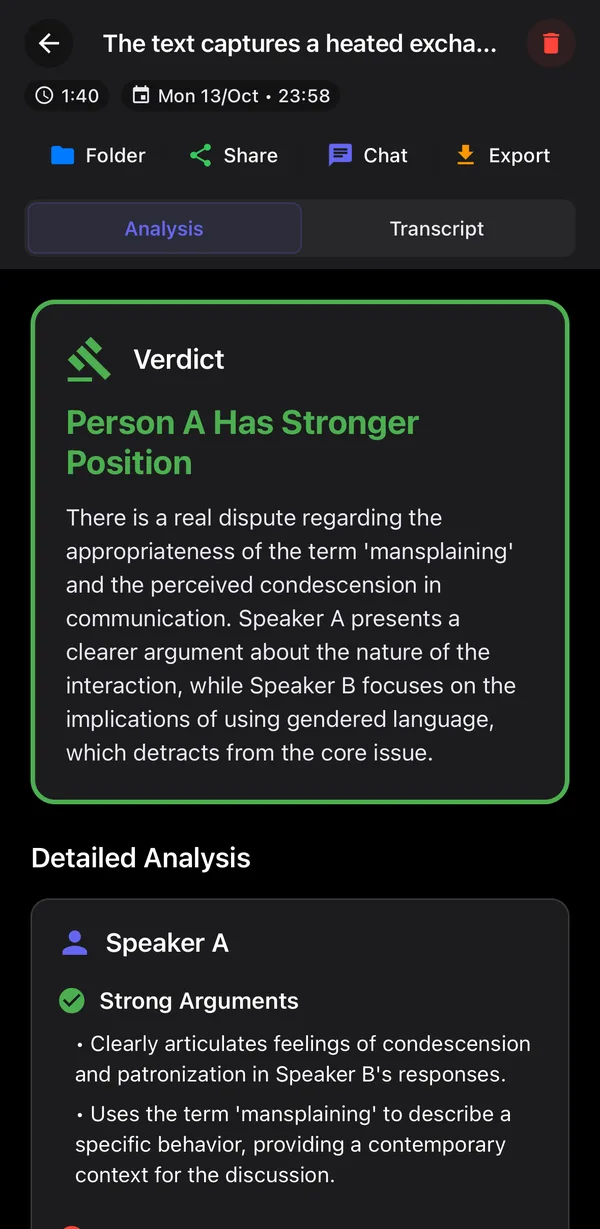
Type both sides and get a fair verdict, with the fallacies on each side. Free.
Questions people ask
What does deflection mean in an argument?
It means responding to a concern in a way that avoids it: changing the subject, joking, nitpicking, bringing up the other person's faults or an old fight, so the original point never gets addressed.
Is deflecting a sign of guilt?
Not necessarily. People deflect when they feel ashamed or attacked, but also out of habit. It is better to treat it as a signal that the topic is uncomfortable than as proof of anything.
What is the difference between deflection and whataboutism?
Whataboutism is one kind of deflection: answering a criticism by pointing to someone else's wrongdoing. Deflection also covers jokes, subject changes and nitpicking.
How do I stop someone from deflecting?
You cannot force it, but a calm parking lot ("let's do yours right after this"), a one-sentence restatement and a direct question about the original point make it much harder to keep dodging.
Sources
Keep reading
- FallaciesRed Herring FallacyA red herring fallacy is a reply that switches to a different topic, one that sounds related but doesn't answer the question, so the original point quietly drops out. The new topic may be important, even true. It still leaves the first issue unresolved. The name comes from a story about using a smelly fish to throw hounds off a trail.
- FallaciesWhataboutismWhataboutism is answering a criticism with a counter-accusation instead of a response: 'What about the time you...' The other person's faults may be real, but they don't make the original criticism wrong. It's a way of changing the subject, and in personal arguments it turns one problem into a contest over who has done worse.
- GuidesBlame ShiftingBlame shifting is moving responsibility for your own action onto someone else, so the conversation becomes about their fault instead of yours: "I only yelled because you provoked me." Everyone does it occasionally when they feel attacked. As a habit, blame shifting keeps problems unsolved and can slide into manipulation.
- GuidesDefensiveness in RelationshipsDefensiveness in relationships means protecting yourself from a complaint with excuses, counter-complaints or wounded innocence instead of hearing it. It is one of John Gottman's Four Horsemen, and nearly everyone does it. The antidote is to accept responsibility for at least part of the problem, which lets the conversation move forward.
- GuidesActive ListeningActive listening is listening to understand rather than to reply: you let the other person finish, summarize what you heard in your own words, ask questions to check, and acknowledge their feelings before giving your side. In an argument it lowers the temperature fast, because people stop repeating themselves once they feel understood.
The ArgueResolver app · iPhone and Android
Record the argument. Get the verdict.
ArgueResolver listens while you talk it out, works out who said what, and gives an honest verdict on what was actually said, with compromises and steps to fix it.
Free to start · See how it works