Blame Shifting: Examples, Why People Do It and How to Respond
Also called: shifting the blame, blame shifting in relationships
Updated · 5 min read · 4 sources
The short answer
Blame shifting is moving responsibility for your own action onto someone else, so the conversation becomes about their fault instead of yours: "I only yelled because you provoked me." Everyone does it occasionally when they feel attacked. As a habit, blame shifting keeps problems unsolved and can slide into manipulation.
What is blame shifting?
Blame shifting is answering "you did this" with "you made me do it" or "well, you did worse." The original behavior is never examined, because the conversation has been redirected onto the other person's failings, a third party or the circumstances.
It is closely related to defensiveness, one of John Gottman's Four Horsemen. The Gottman Institute describes defensiveness as, in effect, a way of blaming your partner: the message is "the problem isn't me, it's you." Blame shifting is that message said out loud.
What blame shifting sounds like
Listen for the moment the subject changes from what one person did to what the other person did:
- "You made me..."
- "You made me lose my temper." Feelings are real, but actions are still chosen.
- "If you hadn't..."
- "If you hadn't nagged me all week, I wouldn't have forgotten."
- "Well, you do it too"
- Pointing to the other person's similar behavior instead of answering. In logic this is tu quoque; when it jumps to a different issue, it is whataboutism.
- "I wouldn't have to if..."
- "I wouldn't have to check your phone if you didn't give me reasons."
- Blaming the situation
- "Work has been insane" offered instead of an acknowledgment, rather than alongside one.
- Blaming a third party
- "Your mom got me so worked up that I snapped at you."
What it sounds like
Why people shift blame
Mostly to protect themselves. Admitting a mistake can feel like admitting you are a bad partner, parent or coworker, and that shame is uncomfortable enough that the mind looks for an exit. It is also more likely when the complaint arrives as an attack: a harsh opening invites a counterattack.
Sometimes the motive is less innocent. Cleveland Clinic lists shifting blame, and making someone feel responsible for how you treat them, among the tactics used in gaslighting. At its most extreme, the person who did harm recasts themselves as the victim, a pattern called DARVO.
Blame shifting or giving context?
Explaining why something happened is not automatically blame shifting. The test is whether you still own your part. "I was late because the train stalled, and I should have texted you" gives context and takes responsibility. "I was late because the train stalled, so why are you making a big deal of it?" uses the context to escape.
The same goes for a fair counterpoint. If both people contributed to a problem, saying so is honest. The problem is using the other person's share to erase yours. Order helps: acknowledge first, then add context.
How to respond to blame shifting
Arguing about who is more to blame is a contest nobody wins. Instead:
- Keep to one issue at a time. Offer to discuss theirs next, and mean it.
- Acknowledge any part that is fair ("Yes, I did leave late too"), then return to your point.
- Do not accept responsibility for choices that were not yours. Their temper belongs to them.
- Ask what would help next time rather than who caused it this time.
- If it happens every time you raise anything, name the pattern calmly, and consider a counselor if it continues.
How to stop shifting blame yourself
The Gottman Institute's antidote to defensiveness is to accept responsibility, even if only for part of the conflict. Try saying the true part first, before any "but": "You're right, I said I'd book the restaurant and I didn't." Then pause. Often that sentence is all the other person needed, and the rest of the conversation gets much easier. If you need an outside read on who actually owns what in a messy fight, you can paste both sides into our free argument judge.
What to say
We can talk about my part next, I promise. First I want to finish this one.
I get that you were upset. How you responded was still your choice, and that's what I'm asking about.
You're right that I added to it. And I still need us to sort out the part about the bills.
Wait, I'm making excuses. You're right, I said I'd do it and I didn't.
In an argument right now?
Type both sides and get a fair verdict, with the fallacies on each side. Free.
Questions people ask
Is blame shifting a form of manipulation?
It can be. Occasional blame shifting is usually self-protection. When it is constant and paired with denying what happened or questioning your memory, it becomes manipulation and can be part of gaslighting.
Why do people blame others for their own mistakes?
Mostly to avoid shame and protect their self-image. A harsh, accusing complaint makes it more likely, because it triggers a defensive reaction.
What is the difference between blame shifting and deflection?
Deflection steers away from an uncomfortable topic in any direction: a joke, a new subject, a technicality. Blame shifting is the specific move of making someone else responsible for what you did.
How do you stop blame shifting in a relationship?
Raise one specific issue at a time without attacking, and when it is your turn, acknowledge your part before adding any context. Both people practicing this changes the pattern quickly.
Sources
Keep reading
- GuidesDeflection in ArgumentsDeflection is redirecting attention away from something uncomfortable, usually your own behavior, so it never gets discussed. In an argument it looks like changing the subject, bringing up an old fight, joking it off or turning the question back on the other person. Deflection protects the person for a moment and leaves the problem untouched.
- GuidesDefensiveness in RelationshipsDefensiveness in relationships means protecting yourself from a complaint with excuses, counter-complaints or wounded innocence instead of hearing it. It is one of John Gottman's Four Horsemen, and nearly everyone does it. The antidote is to accept responsibility for at least part of the problem, which lets the conversation move forward.
- GuidesDARVODARVO stands for Deny, Attack, and Reverse Victim and Offender. Psychologist Jennifer Freyd named it for a reaction people may show when confronted about wrongdoing: they deny it, attack the person raising it, and recast themselves as the real victim. Research finds it is common, shifts blame onto the confronter, and loses power once people recognize it.
- FallaciesTu Quoque FallacyTu quoque (Latin for 'you too') is a fallacy that dismisses a criticism by pointing out that the critic does the same thing: 'You can't tell me to stop vaping, you smoked for ten years.' The critic may well be a hypocrite, but that doesn't make the advice wrong. It's also called the appeal to hypocrisy.
- FallaciesWhataboutismWhataboutism is answering a criticism with a counter-accusation instead of a response: 'What about the time you...' The other person's faults may be real, but they don't make the original criticism wrong. It's a way of changing the subject, and in personal arguments it turns one problem into a contest over who has done worse.
- GuidesHow to Apologize SincerelyTo apologize well, name exactly what you did, take responsibility without excuses, acknowledge how it affected the other person, say what you will do differently, and offer to make it right. Research on apologies finds that taking responsibility and offering repair matter most, while asking to be forgiven matters least.
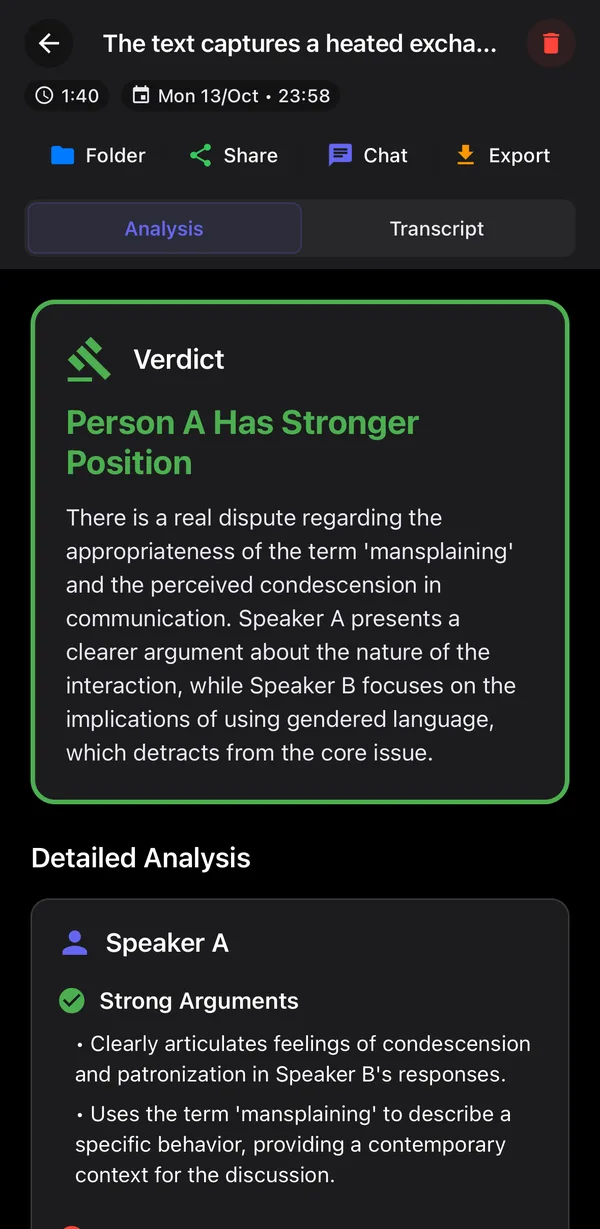
The ArgueResolver app · iPhone and Android
Record the argument. Get the verdict.
ArgueResolver listens while you talk it out, works out who said what, and gives an honest verdict on what was actually said, with compromises and steps to fix it.
Free to start · See how it works