How to Pronounce GIF: Hard G or Jif? The Argument, Settled
Updated · 5 min read · 5 sources
The short answer
How to pronounce GIF? Either way is correct. Steve Wilhite, who created the format at CompuServe in 1987, said it is pronounced "jif," with a soft g. Dictionaries list both the soft g and the hard g, as in "gift," which is more common. Our ruling: say it your way, and know the creator was team jif.
How do you pronounce GIF?
How do you pronounce GIF? There are two main answers: with a hard g, like gift, or with a soft g, like the peanut butter brand Jif. A smaller group spells it out, G-I-F. Dictionaries record both of the main pronunciations, so neither one is a mistake. The argument is really about which one deserves to win.
That makes this a fight between two kinds of authority. One side points to the person who invented the format. The other points to the word the G stands for and to how most people actually say it. Both are reasonable places to look, which is why people have been arguing about it since the 1990s.
The case for jif: the creator said so
The Graphics Interchange Format was created by Steve Wilhite, an engineer at CompuServe, one of the first big online services. The format was released in June 1987, built so that images like color weather maps could load on slow dial-up connections. Wilhite always said it was pronounced jif. According to accounts of the format's history, his team even joked in its documentation that choosy programmers choose jif, a play on the old peanut butter slogan "choosy moms choose Jif."
In May 2013 Wilhite received a lifetime achievement award at the Webby Awards and, instead of a speech, put up a slide reading that it's pronounced jif, not gif. He then told The New York Times that the Oxford English Dictionary accepts both pronunciations, that they are wrong, and that it is a soft g, end of story. Wilhite died in March 2022 at age 74.
The soft g side also has English on its side, at least partly. Plenty of words start with a soft gi: gin, ginger, giraffe, gist.
The verdict
- Steve Wilhite, the format's creator, said it is pronounced jif.
- The format's own team reportedly joked that choosy programmers choose jif.
- Many English words start with a soft gi, like gin, ginger and giraffe.
- The G stands for graphics, which has a hard g.
- Polls generally find the hard g is more common.
- Words like gift, give and girl use a hard g, and soft g words before if are usually spelled with a J.
What it sounds like
The case for the hard g: graphics
The hard g side has one very simple argument: the G stands for graphics, and graphics has a hard g. Plenty of common words agree, like gift, give, girl and gill. Jif, the soft g crowd's own example, is spelled with a J, and hard g fans point out that English usually spells that sound with a J when it comes before "if," as in jiffy.
They also have numbers and famous allies. Online polls of internet users and software developers have generally found more people saying it with a hard g. The White House's Tumblr account used the hard g in a 2013 infographic, President Obama said it with a hard g in 2014, and in 2020 Jif itself teamed up with the GIF site Giphy to sell jars labeled GIF as a joke in favor of the hard g.
What dictionaries say
Dictionaries describe how people speak rather than issuing rulings, and they accept both. The Cambridge Dictionary lists the hard g first and also gives the soft g. Merriam-Webster and the American Heritage Dictionary list the hard g first as well, while some Oxford dictionaries list the soft g first. The order differs; the acceptance does not.
Linguists who have looked at this find no knockout argument either. English has no fixed rule for how to say a g before an i, and when you weigh how often each sound shows up in real words, the two come out close to even. One linguist suggested that people basically make a coin-flip guess the first time they see the word, and then defend that guess for life.
Does the creator get the final say?
This is where the argument gets interesting. "The inventor said jif" is an appeal to an authority who actually knows the answer to one question: what he intended. It does not settle what the word now means, because pronunciation belongs to the people who use it. Treating the creator's preference as the end of the discussion can slide into an appeal to authority.
But "it stands for graphics, so it must be a hard g" has a weakness too. Judging a word by where it came from is close to the genetic fallacy, and acronyms often drift from their sources: scuba stands for self-contained underwater breathing apparatus, yet nobody says the u like the u in underwater. Neither argument is a slam dunk, which is exactly why both pronunciations survive.
The ruling
Both pronunciations are correct, and dictionaries agree. The hard g is more common, and the soft g is what the creator intended, so each side gets a real win. Nobody should be corrected mid-sentence for either one.
If you want to be maximally polite, use whichever one the person you are talking to uses. If you want a tiebreaker, the jif side has the inventor, and that is a pretty good trump card for a trivia night. For bigger disagreements than this, paste both sides into the argument judge.
In an argument right now?
Type both sides and get a fair verdict, with the fallacies on each side. Free.
Questions people ask
Is it pronounced GIF or JIF?
Both are accepted. The creator, Steve Wilhite, said jif with a soft g, while the hard g, as in gift, is more common. Major dictionaries list both.
What did the creator of the GIF say about pronunciation?
Steve Wilhite said it is a soft g, pronounced jif. He made the point with a slide at the 2013 Webby Awards and told The New York Times that the soft g is correct, end of story.
What does GIF stand for?
Graphics Interchange Format, an image format CompuServe released in 1987. The hard g side argues that since graphics has a hard g, GIF should too.
Which pronunciation is more popular?
Online polls have generally found more people using the hard g, though one analysis argued the samples overrepresent countries where the hard g dominates. In some countries, spelling out the letters G-I-F is also common.
Sources
- The New York Times, Bits blog: GIF creator Steve Wilhite receives lifetime achievement Webby Award (2013)
- NBC News: Creator of GIF files insists it's 'jif'
- TechRadar: He gave us the GIF: Stephen Wilhite has died at 74
- Cambridge Dictionary: GIF
- Wikipedia: Pronunciation of GIF (dictionaries, polls and linguistic analysis)
Keep reading
- FallaciesAppeal to Authority FallacyAn appeal to authority is a fallacy when a claim is treated as settled just because someone with status said it, especially when that person isn't an expert on the topic, is quoted out of context or disagrees with most experts. Citing real expertise on its own subject is a good reason. The fallacy is using a name in place of evidence.
- FallaciesGenetic FallacyThe genetic fallacy is accepting or rejecting a claim because of where it came from rather than because of whether it holds up. "You only think that because your mom told you" dismisses an idea by its origin. Where an idea started can be interesting, but it does not decide whether the idea is right.
- DebatesHow Many Holes Does a Straw Have?How many holes does a straw have? One. In topology, the math of shapes, a straw has a single hole running all the way through it, and the two ends are two openings of that same hole, like a tunnel with two entrances. Counting two means counting openings, not holes. Our ruling: one hole, two openings.
- DebatesIs a Hot Dog a Sandwich?Is a hot dog a sandwich? By a broad dictionary definition, yes: it is a filling served in split bread, and Merriam-Webster has said it counts. In everyday use, no: nobody orders one by asking for a sandwich, and the hot dog industry says it is its own thing. Our ruling: technically a sandwich, practically a hot dog.
- DebatesIrish GoodbyeAn Irish goodbye is leaving a party or gathering without saying goodbye to anyone. Is it rude? Usually not at a big, busy party where the host will not miss you. It is rude at a small dinner, at an event in your honor, or when someone is counting on you. A quick text to the host fixes most cases.
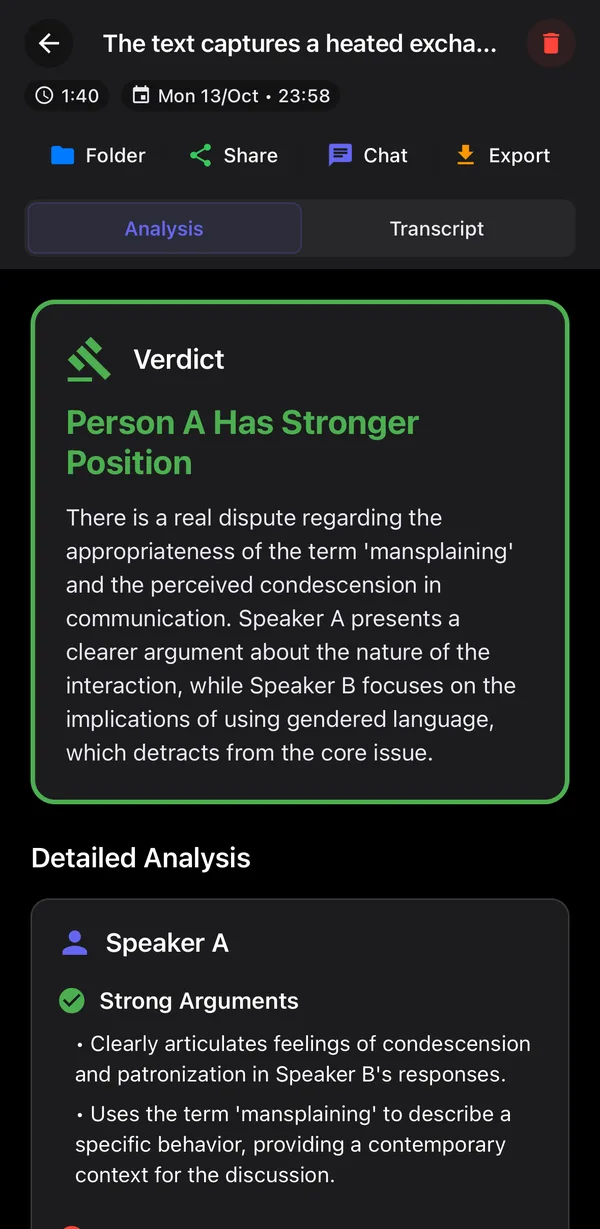
The ArgueResolver app · iPhone and Android
Record the argument. Get the verdict.
ArgueResolver listens while you talk it out, works out who said what, and gives an honest verdict on what was actually said, with compromises and steps to fix it.
Free to start · See how it works