How Many Holes Does a Straw Have? The Argument, Settled
Updated · 5 min read · 5 sources
The short answer
How many holes does a straw have? One. In topology, the math of shapes, a straw has a single hole running all the way through it, and the two ends are two openings of that same hole, like a tunnel with two entrances. Counting two means counting openings, not holes. Our ruling: one hole, two openings.
How many holes does a straw have?
How many holes does a straw have? Ask a room and you will hear two, one and, from at least one contrarian, zero. Quanta Magazine put it in the same family as "is Pluto a planet" and is a hot dog a sandwich: questions that start fights because they hinge on a definition. Here the definition in play is the word hole.
Everyday English uses hole for several different things: a pit in the ground, an opening in an object, a tunnel through a mountain, an air pocket in Swiss cheese. When one person means "opening" and the other means "a tunnel you can pass something through," they can argue forever without disagreeing about the straw at all. That is equivocation, and naming it is the first step to ending the argument.
The case for two holes
The two-hole side trusts its eyes. Look at a straw and you see a hole at the top and a hole at the bottom. Liquid goes in one and comes out the other. In everyday speech we would happily say a straw has a hole in each end, so two holes feels like simple counting.
This side also has a fair point about language: nobody is obliged to use a mathematician's definition at the dinner table. If "hole" means "opening" in your house, then a straw has two.
- You can see and touch two separate openings.
- Liquid enters through one and leaves through the other.
- In casual speech, a hole often just means an opening.
The verdict
- You can see two separate openings, one at each end.
- Liquid goes in one opening and out the other.
- In casual speech, hole often just means opening.
- Squash a straw flat and you get a ring with one hole.
- By Riemann's test, a straw can be cut only once without splitting, so it has one hole.
- The two ends are entrances to the same tunnel, not two tunnels.
What it sounds like
The case for one hole: what topologists count
Topology studies the properties of shapes that survive stretching and squishing, as long as you do not tear or glue. Wolfram MathWorld describes a hole as a feature that stops an object from being continuously shrunk down to a point. A straw has exactly one of those: you can squash it shorter and shorter until it becomes a flat ring, like a washer, and a washer plainly has one hole.
There is a second test, from the 19th-century mathematician Bernhard Riemann, as Quanta explains it: count how many cuts you can make without the object falling into two pieces. A straw can be cut only once, from end to end, before a second cut would split it, so it has one hole. And mathematician Evelyn Lamb offered a friendlier test in Scientific American: if you can put it on a necklace, it has a one-dimensional hole. A straw passes: thread a string through it and it hangs there by its one channel.
The two openings, on this view, are the two ends of one tunnel. A tunnel through a mountain has two entrances, but nobody says the mountain has two tunnels.
What about zero holes?
The zero camp says a straw is just a flat sheet rolled up, and a flat sheet has no holes. The problem is that rolling the sheet and sealing the seam is exactly what creates the hole. Their stronger point is a different one: a straw with one end sealed really does have zero holes in the topological sense, because then it is just a deep cup.
That leads to a fun trap for the two-hole side. If a straw has two holes, does a glass have one? Topologists say no: the space that holds your drink is a dent, not a hole, since you can flatten a glass into a plate without ever tearing it. Philosophers draw a similar line between hollows and cavities on one hand and perforations that go all the way through on the other.
Is a straw the same shape as a donut?
Close, but not exactly. The famous topology joke is that a donut and a coffee mug are the same shape, since each has one hole (the mug's is in the handle), or genus one, as topologists say about their surfaces. A straw shares that single hole, which is why people call it a long, skinny donut.
Strictly speaking, an open straw is a cylinder with two rims, not a closed donut surface, and you would need to glue its ends together to make a true torus. The hole count is the same either way: one. Even mathematicians admit there is no single official definition of a hole, and Lamb noted that topologists do not all agree on one, so a little humility is in order on every side.
The ruling
A straw has one hole with two openings. If you are asking as a mathematician, one is the answer, and the necklace test, the squash test and Riemann's cuts all agree. If you are asking how many ends you can drink from, two, and nobody needs to fight about that. Like whether water is wet, the argument is mostly about a word, and both sides get to be right about something.
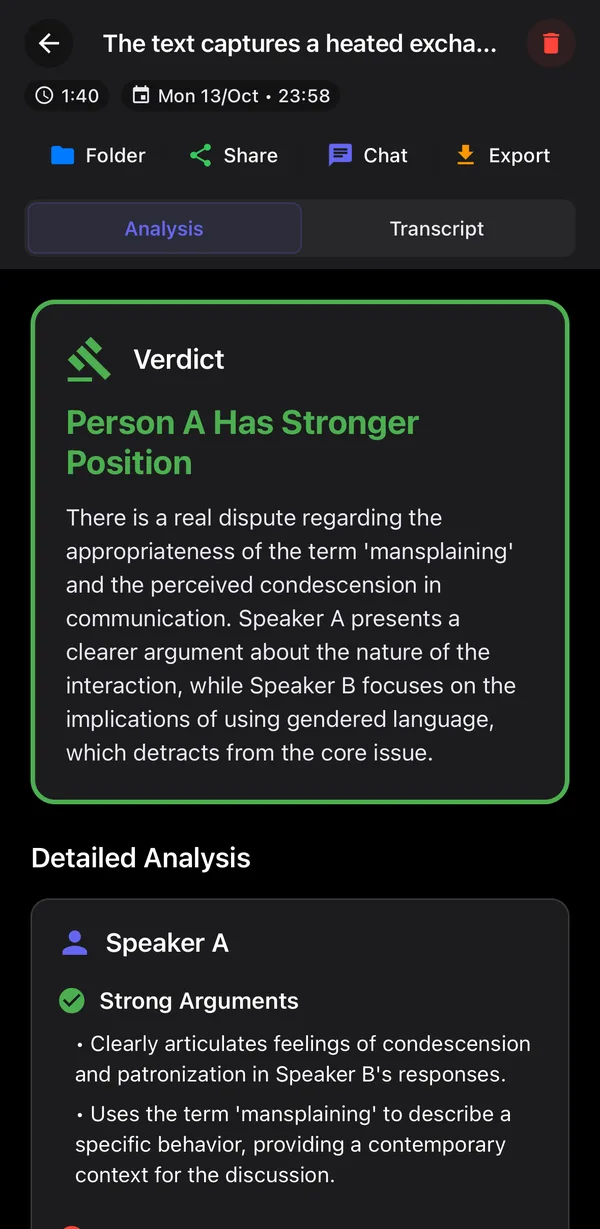
If someone insists on two, ask them how many holes a glass has. If they say one, they are being consistent, and you can call it a draw. Still deadlocked? Paste both sides into the argument judge.
In an argument right now?
Type both sides and get a fair verdict, with the fallacies on each side. Free.
Questions people ask
Does a straw have one hole or two?
One hole with two openings. In topology, the two ends belong to the same hole, the way a tunnel has two entrances but is still one tunnel.
How many holes does a cup have?
Topologically, zero. The space that holds your drink is a dent rather than a hole, because a cup can be flattened into a plate without tearing it.
How many holes does a donut have?
One. That is why topologists say a donut and a coffee mug with a handle are the same shape: each has a single hole.
What is a hole in math?
Roughly, a feature that stops a shape from being continuously shrunk to a point. Mathematicians admit the word has no single official definition, and they measure holes with tools like homology and Betti numbers.
Sources
Keep reading
- DebatesIs Water Wet?Is water wet? In everyday English, saying water is wet is fine. In science, no: wetting describes a liquid clinging to a solid surface, so wet is a condition of the thing the water touches. Water makes things wet. On precision, the 'not wet' side wins, and the 'wet' side wins on common sense.
- DebatesIs Cereal a Soup?Is cereal a soup? No. Dictionaries describe soup as a liquid food usually made by cooking vegetables, meat or fish, and cereal is dry grain with cold milk poured over it at the table. The soup side does have one great point: the earliest soups were bread soaked in liquid, which is close to what cereal is.
- DebatesIs a Thumb a Finger?Is a thumb a finger? Yes, in the broad sense. Dictionaries define a finger as any digit of the hand, especially one other than the thumb, and anatomy sets the thumb apart: two bones instead of three, and the only digit that can oppose the others. So you have ten fingers, and two of them are thumbs.
- FallaciesEquivocation FallacyThe equivocation fallacy is using one word in two different senses within the same argument, so a conclusion seems to follow when it doesn't. "You told me to be more spontaneous, so why are you mad I booked a trip without asking?" slides from spontaneous dates to spontaneous spending. Most equivocation in arguments is accidental.
- FallaciesFact vs OpinionFact vs opinion comes down to whether a claim can be checked. A factual statement can be proved or disproved with evidence, even if it turns out to be wrong. An opinion expresses a judgment, preference or value, so evidence can inform it but can't settle it. 'You were 40 minutes late' is factual; 'you're inconsiderate' is an opinion.
The ArgueResolver app · iPhone and Android
Record the argument. Get the verdict.
ArgueResolver listens while you talk it out, works out who said what, and gives an honest verdict on what was actually said, with compromises and steps to fix it.
Free to start · See how it works