Fact vs Opinion: How to Tell the Difference (and Argue About Each)
Also called: fact or opinion, difference between fact and opinion, factual vs opinion statements
Updated · 6 min read · 3 sources
The short answer
Fact vs opinion comes down to whether a claim can be checked. A factual statement can be proved or disproved with evidence, even if it turns out to be wrong. An opinion expresses a judgment, preference or value, so evidence can inform it but can't settle it. 'You were 40 minutes late' is factual; 'you're inconsiderate' is an opinion.
What is the difference between a fact and an opinion?
The difference between fact vs opinion is whether evidence could settle the question. 'The rent went up $150' can be checked against the lease. 'This apartment isn't worth it anymore' depends on what you value: space, location, quiet, your budget. Both are reasonable things to say. They just need different kinds of conversations.
One detail trips people up: a factual statement doesn't have to be true. In a 2018 study, Pew Research Center defined a factual statement as one that could be proved or disproved with objective evidence, whether it was accurate or not. 'You never do the dishes' is a factual claim. It's just usually a false one.
How to tell if a statement is fact or opinion
A few quick checks sort most statements, including the ones that mix both.
- Could you check it? Texts, receipts, a calendar, a timestamp, a measurement. If evidence could settle it, it's a factual claim.
- Look for judgment words. Best, worst, rude, lazy, too much, should, deserve, fair. These usually signal an opinion.
- Watch for 'always' and 'never'. They stretch a checkable event into a sweeping claim that is usually false and almost always heard as an attack.
- Ask whether two honest people could see the same evidence and still disagree. If yes, you're probably dealing with opinion.
- Split mixed sentences. 'You spent $300 on concert tickets, which was irresponsible' has a checkable half and a judgment half.
Fact vs Opinion examples
Why so many fights mix facts and opinions
Compare 'You're always late' with 'You were 40 minutes late to my birthday dinner.' The second is specific and checkable, so the other person can confirm it, explain it or apologize. The first sounds like a fact, but it's really a verdict on someone's character dressed up as a statistic. The Gottman Institute draws a similar line between a complaint about a specific behavior and criticism of the person, and it flags 'always' and 'never' as signs of criticism, one of the four horsemen.
The mix-up runs the other way too. People defend an opinion as if it were a fact ('That movie is objectively bad') and dismiss a fact as if it were an opinion ('That's just your opinion,' about a text sitting right there on the screen). The second move does more damage, because it blocks the one check that could settle things.
How good are people at telling fact from opinion?
Not as good as we'd like to think. In Pew's survey of 5,035 U.S. adults, a majority correctly sorted at least three of five factual statements and three of five opinion statements, which the researchers called only a little better than random guessing. Far fewer got all five right.
Pew also found that both Republicans and Democrats were more likely to call a statement factual when it appealed to their side, even when it was an opinion. The same pull works in a kitchen argument: a claim that flatters your side feels like a fact, and one that doesn't feels like 'just an opinion.' You can try Pew's quiz yourself (linked below) to see how it feels from the inside.
Value judgments: opinions that still matter
Calling something an opinion doesn't make it trivial. 'It's not okay to read my messages' and 'Kids should have a bedtime' are value judgments, and people can give good or bad reasons for them. What evidence can't do is force agreement, because the disagreement is about priorities, not data.
Many arguments are value judgments resting on facts. 'We spend too much on takeout' depends on a number you can check and on what 'too much' means for your budget and goals. Splitting the two keeps you from fighting about the number when you really disagree about the priority, or the other way around.
How to argue about a fact
If the disagreement is factual, stop debating and go check. Pull up the thread, the bank statement, the calendar. Agree beforehand what would settle it, and agree to accept the answer whichever way it goes. If nobody can check it, say so: 'Neither of us can prove what time it was, so let's talk about next time.'
Memory is not a receipt. Two people can honestly remember the same evening differently, so 'I'm sure I said it' and 'I'm sure you didn't' are both claims, not evidence. Insisting the other person prove you wrong doesn't settle it either; that just shifts the burden of proof.
How to argue about an opinion
With opinions, the goal is understanding and a decision, not a ruling on who is objectively right. Ask what matters to the other person and why. Share your own reasons with I statements: 'I feel brushed aside when plans change at the last minute' is honest in a way that 'you're rude' isn't, and it's much harder to argue with.
Then decide something you can both live with: a budget, a bedtime, a rule about phones at dinner. If you want a neutral read on which parts of a disagreement are facts and which are judgments, our free argument judge can help sort them.
What to say
Can we stick to what actually happened? Tell me the specific time, and then I'll tell you how I see it.
We don't have to guess. Let's look at the texts and go with what they say.
Neither of us can prove that. Can we focus on what we want to happen next time?
I think we both have the facts right and just weigh them differently. What matters most to you here?
That came out like a fact, but it's my opinion. What I mean is that it bothered me, and here's why.
In an argument right now?
Type both sides and get a fair verdict, with the fallacies on each side. Free.
Questions people ask
How do you tell if something is a fact or an opinion?
Ask whether evidence could settle it. If you could check it with records, a measurement or a source, it's a factual claim, true or false. If reasonable people could see the same evidence and still disagree, it's an opinion.
Can a fact be false?
A factual claim can be false. 'Factual' describes the kind of statement, one that evidence can check, not whether it's correct.
Can an opinion be wrong?
A pure preference, like liking cilantro, can't be wrong. But many opinions rest on factual assumptions that can be wrong, and some value judgments are much better reasoned than others.
Is 'you always do this' a fact or an opinion?
It's worded as a factual claim, but it's usually an exaggeration carrying a judgment. Swapping it for a specific example ('you did this on Tuesday and Friday') makes it checkable and easier to resolve.
Sources
Keep reading
- GuidesThe Gottman Four HorsemenThe Gottman Four Horsemen are four ways of fighting that John Gottman's research links to relationships falling apart: criticism, contempt, defensiveness and stonewalling. Each has an antidote: a gentle start-up, a culture of appreciation, taking responsibility, and a real break to calm down. How you fight matters more than whether you fight.
- GuidesI StatementsI statements are sentences that describe your own feelings and needs instead of judging the other person, for example 'I feel overwhelmed when the dishes pile up, and I need a hand tonight' instead of 'You never help.' They raise a problem without putting the listener on trial, so it can be solved.
- FallaciesBurden of Proof Fallacy and the Appeal to Ignorance, ExplainedThe burden of proof fallacy is making a claim and then demanding that others disprove it, instead of supporting it yourself. Its close cousin, the appeal to ignorance, treats a lack of evidence as proof: "you can't prove it didn't happen, so it did." The person making a claim usually carries the burden of backing it up.
- FallaciesDeductive vs Inductive ReasoningDeductive vs inductive reasoning is the difference between proving a conclusion and supporting it. Deductive reasoning aims for certainty: if the premises are true and the form is valid, the conclusion must be true. Inductive reasoning draws a probable conclusion from evidence such as past cases, so even strong induction can turn out wrong.
- FallaciesHasty GeneralizationA hasty generalization is a sweeping conclusion drawn from too few examples, or from examples that aren't typical: one unanswered text becomes 'you never answer me', one messy roommate becomes 'people from that school are slobs'. The examples may be real. There just aren't enough of them to support a claim about always, never or everyone.
- FallaciesCorrelation vs CausationCorrelation vs causation is the difference between two things happening together and one thing actually making the other happen. A correlation means two things tend to rise or fall together. Causation means changing one would change the other. A correlation can come from a hidden third factor, from the arrow pointing the other way, or from plain coincidence.
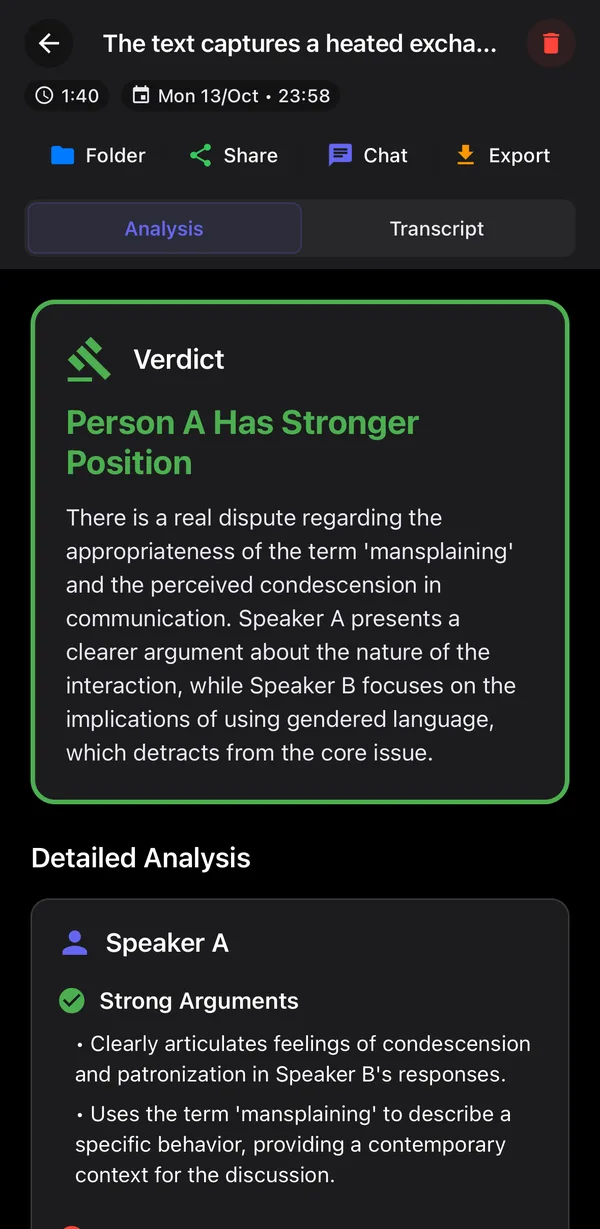
The ArgueResolver app · iPhone and Android
Record the argument. Get the verdict.
ArgueResolver listens while you talk it out, works out who said what, and gives an honest verdict on what was actually said, with compromises and steps to fix it.
Free to start · See how it works