Deductive vs Inductive Reasoning: Definitions, Examples and Differences
Also called: inductive vs deductive reasoning, deductive reasoning, inductive reasoning, deduction and induction
Updated · 6 min read · 4 sources
The short answer
Deductive vs inductive reasoning is the difference between proving a conclusion and supporting it. Deductive reasoning aims for certainty: if the premises are true and the form is valid, the conclusion must be true. Inductive reasoning draws a probable conclusion from evidence such as past cases, so even strong induction can turn out wrong.
What is the difference between deductive and inductive reasoning?
The key difference in deductive vs inductive reasoning is how much the premises promise. A deductive argument claims its premises guarantee the conclusion: 'Everyone on the lease pays rent. Jess is on the lease. So Jess pays rent.' An inductive argument claims only that its premises make the conclusion likely: 'Jess has paid late four months in a row, so she'll probably be late again.'
That is the standard textbook view, as the Internet Encyclopedia of Philosophy explains: deduction is about necessity, induction is about probability. Purdue's writing lab puts it in similar terms. In deduction the premises offer conclusive proof; in induction they offer some basis for the conclusion.
Deductive reasoning: validity and soundness
A deductive argument is valid when its form guarantees that true premises produce a true conclusion. It is sound when it is valid and its premises really are true. The classic example: all humans are mortal, Socrates is a human, so Socrates is mortal.
Validity is about structure, not truth. 'Every cat can fly. Milo is a cat. So Milo can fly' is perfectly valid and completely wrong, because the first premise is false. That's why personal arguments are rarely about the logic in the middle. They're about the premises. 'We agreed whoever cooks doesn't clean, I cooked, so you clean' stands or falls on whether you actually agreed to that.
Deductive vs Inductive Reasoning examples
Inductive reasoning: strength and cogency
An inductive argument is strong when its premises make the conclusion likely, and cogent when it is strong and its premises are true. Induction is how we learn from experience: the bus has been late every morning this week, so leave early tomorrow. Every spider anyone has checked has eight legs, so the next one probably will too.
Strength comes in degrees. Four late rent payments say more than one; a year of data says more than a bad week. The philosopher David Hume raised a famous puzzle about this in 1739: nothing in the cases we've already seen logically guarantees that the next case will match. That's why induction can be excellent and still be wrong.
Is deduction just 'general to specific'?
You'll often read that deduction moves from general to specific and induction from specific to general. It's a handy memory aid, but the Internet Encyclopedia of Philosophy calls that rule 'much too crude.' Some valid deductions go from general premises to a general conclusion, and some inductions go from one particular case to another: 'My sister loved this restaurant, so I probably will too.'
A better test is to ask what the argument claims. If it says the conclusion must follow, judge it as deduction: is the form valid, and are the premises true? If it says the conclusion is likely, judge it as induction: how much evidence is there, how typical is it, and are there counterexamples?
Where each kind of reasoning goes wrong
Both kinds of reasoning have typical failure points, and both show up in everyday fights.
- Too few cases (induction)
- 'You forgot the trash twice, so you never pay attention to anything I ask.' Two cases can't carry 'never'. This is a hasty generalization.
- Lopsided evidence (induction)
- Counting the examples that fit and skipping the ones that don't. The conclusion looks strong only because half the record is missing.
- Pattern mistaken for cause (induction)
- Two things keep happening together, so one must cause the other. See correlation vs causation.
- A false or unshared premise (deduction)
- A neat chain built on a rule the other person never agreed to: 'Good partners text back within an hour. You didn't. So...'
- A broken form (deduction)
- 'If you were hiding something, you'd change your password. You changed it, so you're hiding something.' Logicians call this affirming the consequent: other things also lead to a new password.
Using both in a fair argument
Real disagreements use both. Induction builds the case ('this is the third time this month'), and deduction applies a shared rule ('we agreed that if plans change, we text'). The fairest conversations make both visible: say what pattern you've noticed and how strong it is, and say which rule you're applying, so the other person can question a premise instead of feeling ambushed by a conclusion.
If you're stuck, separate the questions. Are you disagreeing about what happened, about the rule, or about whether the rule fits this case? Laying out both sides for our free argument judge can make that split obvious, and it often shows the fight was about a premise all along.
What to say
That's happened twice, I agree. Is twice enough to say I always do it?
I follow the steps, but I don't agree with where you started. Can we talk about that part?
I might be wrong, but I've noticed this three times this month. Am I missing something?
Here's my reasoning: we agreed on X, this looks like X to me, so I expected Y. Which part do you see differently?
In an argument right now?
Type both sides and get a fair verdict, with the fallacies on each side. Free.
Questions people ask
What is an example of deductive reasoning?
'The pharmacy closes at 9 on Sundays. It's Sunday and it's 9:15. So the pharmacy is closed.' If both premises are true, the conclusion has to be true.
What is an example of inductive reasoning?
'Every time we've ordered from that place, delivery took over an hour, so tonight will probably be slow too.' The past cases make the conclusion likely, not certain.
Which is better, inductive or deductive reasoning?
Neither; they do different jobs. Deduction gives certainty only as good as its premises, and induction gives probable conclusions about the real world. Most good arguments use both.
What's the difference between a valid and a sound argument?
A valid argument has a form in which true premises guarantee a true conclusion. A sound argument is valid and also has true premises. A valid argument with a false premise can reach a false conclusion.
Is a hasty generalization inductive or deductive?
Inductive. It's a weak inductive argument whose conclusion reaches much further than the number or kind of examples can support.
Sources
Keep reading
- FallaciesHasty GeneralizationA hasty generalization is a sweeping conclusion drawn from too few examples, or from examples that aren't typical: one unanswered text becomes 'you never answer me', one messy roommate becomes 'people from that school are slobs'. The examples may be real. There just aren't enough of them to support a claim about always, never or everyone.
- FallaciesCorrelation vs CausationCorrelation vs causation is the difference between two things happening together and one thing actually making the other happen. A correlation means two things tend to rise or fall together. Causation means changing one would change the other. A correlation can come from a hidden third factor, from the arrow pointing the other way, or from plain coincidence.
- FallaciesCircular Reasoning and Begging the QuestionCircular reasoning is an argument whose conclusion is already assumed in its premises, so it ends where it started: 'It was a harmless joke because it didn't hurt anyone.' It's also called begging the question. The argument sounds complete but gives no independent reason to believe the conclusion. In everyday speech, 'begs the question' usually means something else: 'raises the question'.
- FallaciesFact vs OpinionFact vs opinion comes down to whether a claim can be checked. A factual statement can be proved or disproved with evidence, even if it turns out to be wrong. An opinion expresses a judgment, preference or value, so evidence can inform it but can't settle it. 'You were 40 minutes late' is factual; 'you're inconsiderate' is an opinion.
- FallaciesCherry Picking FallacyThe cherry picking fallacy is selecting only the facts, examples or quotes that support your side while ignoring the ones that don't. Each picked item may be true, but the overall picture is false. Showing a friend three screenshots out of a two-hour text fight is a common everyday version.
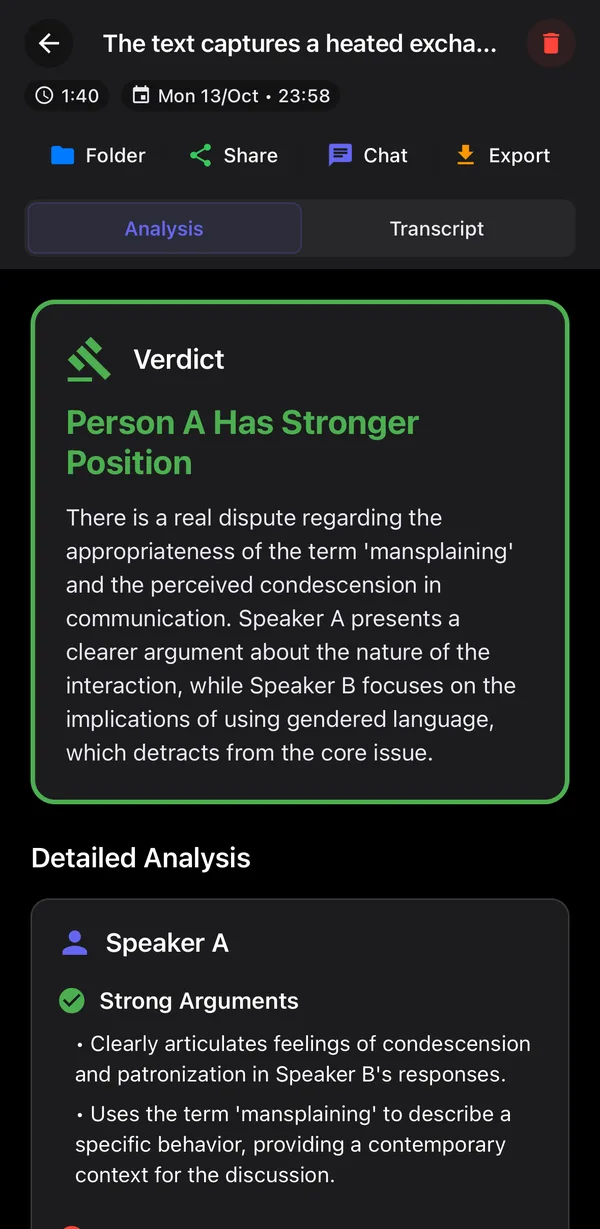
The ArgueResolver app · iPhone and Android
Record the argument. Get the verdict.
ArgueResolver listens while you talk it out, works out who said what, and gives an honest verdict on what was actually said, with compromises and steps to fix it.
Free to start · See how it works