Irish Goodbye: What It Means, Other Names, and Is It Rude?
Updated · 6 min read · 6 sources
The short answer
An Irish goodbye is leaving a party or gathering without saying goodbye to anyone. Is it rude? Usually not at a big, busy party where the host will not miss you. It is rude at a small dinner, at an event in your honor, or when someone is counting on you. A quick text to the host fixes most cases.
What is an Irish goodbye?
An Irish goodbye is slipping out of a party, a night out or a family gathering without saying goodbye to the host or anyone else. You are there, and then you are not. Dictionary.com defines it as leaving without saying goodbye, asking permission or giving notice, and labels the phrase sometimes offensive.
Nobody knows exactly where the name came from. Dictionary.com notes that one neologism database traces it to Boston, with its large Irish American population, and that the other origin stories have little evidence behind them. The habit itself is much older than the name.
It is also a reliable argument starter. One partner loves a clean exit with no twenty minute goodbye tour; the other finds it cold, or awkward to explain to friends. Most of these fights are not about manners in general. They are about one specific night and who was left behind to explain.
Other names for an Irish goodbye
Almost every language blames the habit on the neighbors. The Oxford English Dictionary's first record of French leave dates from 1751, according to Wikipedia's summary, and the French return the favor. The main names:
- French leave or French exit: the older English names for the same move.
- Irish exit: a common variant of the same phrase.
- Filer à l'anglaise, to leave English style: the French version. Italian and Polish also call it English leave.
- Taking the rat taxi or doing a Houdini: two Dutch expressions that, unusually, blame no nationality at all.
- Ghosting: now mostly used for going silent on a relationship, but sometimes for parties too.
- Houdini-ing: the term etiquette writer Lizzie Post of the Emily Post Institute prefers, because she says the Irish label stereotypes Irish people.
The verdict
- At a big event, announcing your exit can disrupt more than slipping out does.
- It skips the drawn-out goodbye loop that keeps you an extra hour.
- A text to the host still covers the thank-you.
- At small or personal events, the host notices and can feel snubbed.
- It can strand the person who drove you or worry your friends.
- Etiquette experts call it an absolute no at intimate gatherings like dinner parties.
What it sounds like
Is an Irish goodbye rude?
Etiquette experts do not give one answer, and that is the honest answer: it depends on the size of the event and your role in it. Diane Gottsman, founder of the Protocol School of Texas, told TODAY that a quiet exit can work at a large event where the host is busy or hard to find, especially after you have mingled, and that office parties, fundraisers and late nights allow more leeway.
Alison Cheperdak, an etiquette coach in Washington, D.C., went further in comments to Fox News: at a large function, announcing your departure can be the bigger faux pas, because it pulls attention to you. But the experts draw the same line. Gottsman calls skipping the goodbye at a small, intimate event like a dinner party or baby shower an absolute no, and Cheperdak calls it impolite at an intimate dinner party.
When an Irish goodbye is fine
A quiet exit is reasonable when nobody will be left waiting, worried or snubbed. That usually means:
- A big party, wedding after-party or work event where the host is busy and nobody depends on you to get home.
- You showed up, talked to people and stayed a reasonable time, so your presence was felt before you left.
- You barely know the hosts and barely spoke to anyone. Lizzie Post says leaving quietly is fine in that case.
- An emergency, such as illness, a sitter canceling or a family crisis. Gottsman lists these as good reasons for a fast exit, followed by a message later.
- A loud, late night where a round of goodbyes would turn into a second hour of staying.
When an Irish goodbye is rude
The exit stops being harmless when someone will notice the gap you leave, or worse, worry about it.
- A small dinner or gathering. With six people at the table, your empty chair is part of the evening. Thank the host in person.
- You are someone's ride. Vanishing strands a friend or partner. Tell them, or agree on a leaving time before you arrive.
- You are the guest of honor. Lizzie Post says honorees should stay through the main event unless an early exit was arranged in advance.
- Family events, weddings and milestone parties. Post advises finding the hosts and honorees before you go.
- People will worry. If your friends would search the bar or text you at 1 a.m. to check you are safe, a ten second goodbye is a kindness, not a ritual.
How to leave early without being rude
The modern fix is a message. Cheperdak suggests a quick text at the end of the night or the next day saying you were glad to see the host, and Gottsman suggests a call, text or note after a sudden exit. Lizzie Post's rule for big events: say goodbye to the people you spent time with, and wave to anyone across the room.
For couples, the fix happens before the party. Agree on a rough leaving time and a signal, and say what you need. "I'll want to go by ten, and I'd like a heads up, not a disappearance" is an I statement that heads off the fight in the car.
And if your partner pulls an Irish goodbye once, it does not prove they dislike your friends. Reading a whole character into one exit is a hasty generalization. Ask what happened first.
The ruling
The Irish goodbye is fine at big, loose events and rude at small or personal ones. The test is simple: would anyone be left waiting, worried, stranded or snubbed? If not, slip out and text the host a thank-you. If yes, take the thirty seconds.
Couples who keep fighting about exits are usually fighting about leaving times and being told, one of the everyday things couples fight about. Still not sure about one particular night? Describe it to our AITA tool for a neutral read.
In an argument right now?
Type both sides and get a fair verdict, with the fallacies on each side. Free.
Questions people ask
Is an Irish goodbye rude?
It depends on the event. At a large party where the host is busy, etiquette experts generally accept a quiet exit, ideally followed by a text. At a small dinner, a family event or a party in your honor, skipping the goodbye usually comes across as rude.
Why is it called an Irish goodbye?
No one knows for sure. Dictionary.com notes one source tracing the phrase to Boston, while older names blame the French or the English instead. Some people avoid the term because it stereotypes Irish people.
What is a French exit?
The same thing: leaving without saying goodbye. French leave is the older English name, first recorded in 1751, and in French the habit is called leaving English style.
Should you text the host after an Irish goodbye?
Yes. A short message that night or the next day thanking them is the easiest way to keep a quiet exit polite.
Sources
- Dictionary.com: Irish goodbye, definition and meaning
- Dictionary.com Slang: Irish goodbye
- Wikipedia: French leave
- AARP: When and How to Make a Graceful Exit From Any Event (Lizzie Post)
- TODAY: Irish Exit Meaning: What It Is and Whether or Not It's Rude
- Fox News: Etiquette experts say the 'Irish goodbye' isn't always rude
Keep reading
- GuidesI StatementsI statements are sentences that describe your own feelings and needs instead of judging the other person, for example 'I feel overwhelmed when the dishes pile up, and I need a hand tonight' instead of 'You never help.' They raise a problem without putting the listener on trial, so it can be solved.
- FallaciesHasty GeneralizationA hasty generalization is a sweeping conclusion drawn from too few examples, or from examples that aren't typical: one unanswered text becomes 'you never answer me', one messy roommate becomes 'people from that school are slobs'. The examples may be real. There just aren't enough of them to support a claim about always, never or everyone.
- GuidesWhat Do Couples Fight About?What do couples fight about? Most often chores, money, children, in-laws and extended family, time together, attention and phones, sex and affection, and plans. Research suggests the topic matters less than what sits underneath it: money fights, for example, are not the most frequent but tend to be the most recurring and least resolved.
- GuidesHow to Apologize SincerelyTo apologize well, name exactly what you did, take responsibility without excuses, acknowledge how it affected the other person, say what you will do differently, and offer to make it right. Research on apologies finds that taking responsibility and offering repair matter most, while asking to be forgiven matters least.
- DebatesIs Die Hard a Christmas Movie?Is Die Hard a Christmas movie? Yes. The whole story happens on Christmas Eve at an office Christmas party, the plot follows a man trying to win back his estranged wife at Christmas, and its screenwriter says it counts. It opened in July and most polls say no, but a Christmas setting plus a Christmas story is enough.
The ArgueResolver app · iPhone and Android
Record the argument. Get the verdict.
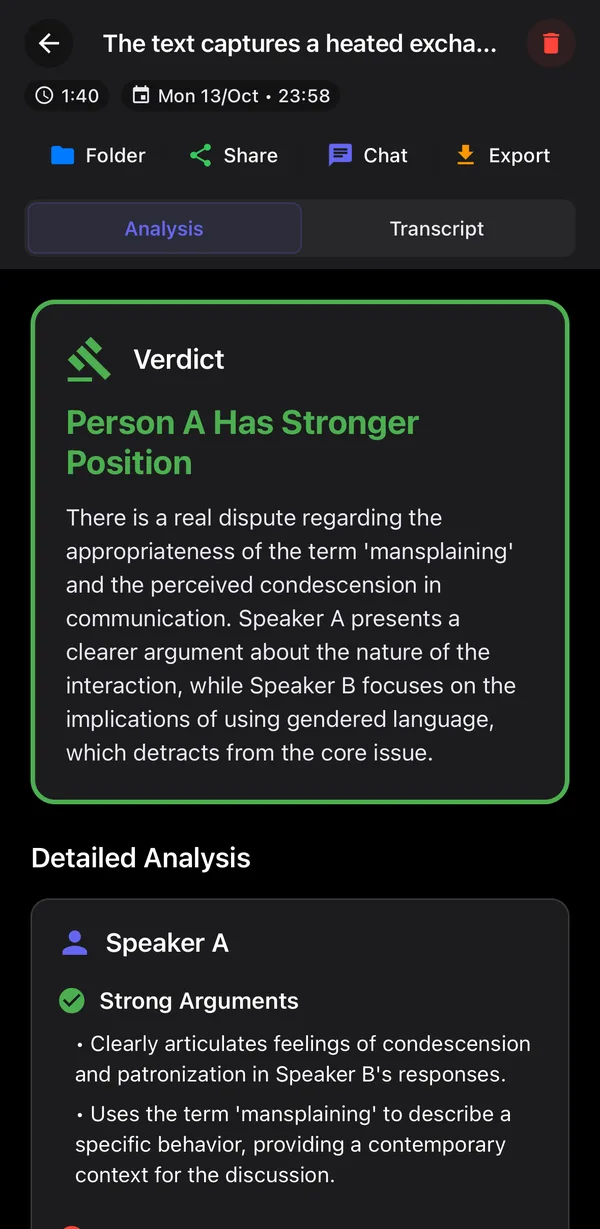
ArgueResolver listens while you talk it out, works out who said what, and gives an honest verdict on what was actually said, with compromises and steps to fix it.
Free to start · See how it works