Reason vs Excuse: How to Tell When an Explanation Crosses the Line
Also called: is it a reason or an excuse, explanation vs excuse
Updated · 5 min read · 4 sources
The short answer
Reason vs excuse depends on what the explanation is doing. A reason explains why something happened and still owns the result: "Traffic was bad, and I should have left earlier. I'm sorry." An excuse explains in order to escape responsibility: "Traffic was bad, so it's not my fault." The same fact can be either one.
What is the difference between a reason and an excuse?
The difference between a reason and an excuse is not the fact itself. "My meeting ran late" can be either. It becomes a reason when it is offered alongside ownership: yes, I was late, here is what happened, here is what I'll do. It becomes an excuse when it is offered instead of ownership, as if the explanation cancels the problem.
That is why arguments about this are so frustrating. One person says "but it's true!" and the other says "I don't care!" Both are right. The fact can be true and still be used as a shield.
Is it a reason or an excuse? Four tests
When you are not sure which one you are hearing, or saying, run through these:
- Ownership
- Does the explanation come with "that's on me" or something like it? A reason can sit next to responsibility. An excuse is there to replace it.
- Repair
- Does it come with a fix, an offer, or a plan for next time? Reasons tend to point forward. Excuses stop at "so it's not my fault."
- Repetition
- The first time traffic makes you late, it's a reason. The fifth time, traffic is predictable, and leaving at the same time is a choice. A reason that keeps recurring without a change in plan turns into an excuse.
- Order
- Acknowledgment first, explanation second sounds like a reason. Explanation first, and maybe never an acknowledgment, sounds like an excuse.
What it sounds like
Why excuses make arguments worse
The Gottman Institute treats excuses as a form of defensiveness, one of the patterns it calls the Four Horsemen. Its point is that excuses rarely make the other person back off. They signal that you aren't taking their concern seriously, so they push harder, and the actual problem never gets solved. Many excuses also carry a quiet accusation, which is how they slide into blame shifting: "I would have called if you'd reminded me."
Psychologists have a word for the more elaborate version: rationalization. The APA Dictionary of Psychology describes it as a defense in which logical-sounding reasons are given to justify behavior, which helps a person protect their self-respect and shield themselves from criticism. Everyone does a little of this. The cost is that it protects your image at the expense of fixing what went wrong.
The classic fights: late, forgot, chores
Most reason-or-excuse arguments are about the same three things. Here is how each sounds both ways.
- Being late
- Excuse: "Work ran over, what was I supposed to do?" Reason: "Work ran over, and I should have texted at seven. I'm sorry you waited."
- Forgetting
- Excuse: "I've had a million things going on." Reason: "I forgot, and that's on me. I've been overloaded, so I'm putting it in my calendar right now."
- Chores
- Excuse: "I didn't know you wanted it done today." Reason: "I assumed it could wait, and I should have asked. I'll do it before dinner."
How to explain yourself without making excuses
Lead with the acknowledgment, keep the explanation short, and end with repair. The Greater Good Science Center's guidance on apologies says a brief explanation can help show that a mistake was unintentional and won't happen again, while long explanations and blaming the other person backfire. Christine Carter, writing for Greater Good, suggests that when in doubt you leave the explanation out, and when you do give one, frame it so it doesn't excuse you, along the lines of "It's no excuse, but..."
Then say what you'll do differently and do it. A reason that is followed by the same problem next week will be heard as an excuse next time, and that is fair. Our guide on how to apologize walks through the full structure.
When the other person won't accept any reason
Fairness runs both ways. Sometimes the reason is real and big: a sick kid, a car that wouldn't start, a family emergency. Treating every explanation as an excuse can be its own way of refusing to listen. Once the impact has been acknowledged, context deserves a hearing.
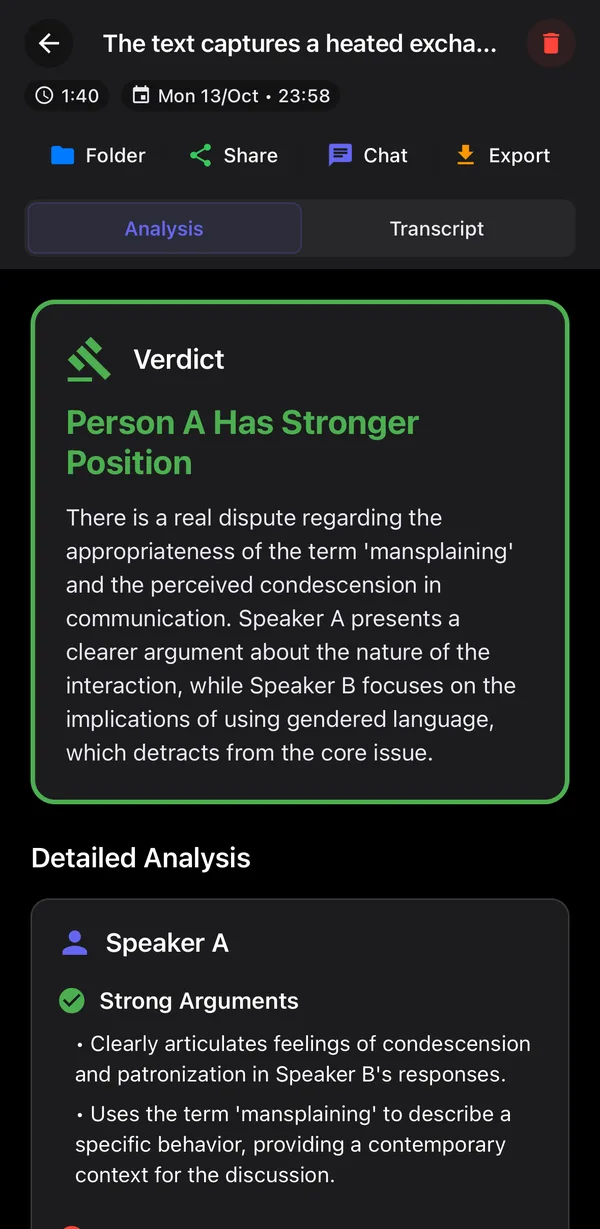
If something keeps getting in the way, like a work schedule, a health issue or simply too much on your plate, the honest move is to name it and change the plan together rather than apologize for the same thing every week. And if you can't agree whether an explanation was a reason or an excuse, you can paste both sides into our free argument judge for a neutral read.
What to say
You're right, I was late, and that's on me. Do you want to hear what happened, or just how I'll fix it?
This is the third time work has made me late, so it isn't a surprise anymore. I'm going to leave by five from now on.
I believe the meeting ran long. I still need a text when it does.
I get that it affected you, and I'm sorry. I'd also like you to know what was going on, because it wasn't that I didn't care.
In an argument right now?
Type both sides and get a fair verdict, with the fallacies on each side. Free.
Questions people ask
What is the difference between a reason and an excuse?
A reason explains what happened while still taking responsibility. An excuse uses the explanation to avoid responsibility. The same fact can be either, depending on whether it comes with ownership and a fix.
Is explaining yourself the same as making excuses?
No. Explaining becomes making excuses when it replaces an acknowledgment. Say what you did and that it's on you first, then give a short explanation if it still seems useful.
How do you apologize without making excuses?
Name what you did, acknowledge how it affected the other person, and say what you'll do differently. Keep any explanation brief and after the acknowledgment, not before it.
What do you say to someone who always makes excuses?
Acknowledge the reason and restate the need: "I believe you were busy. I still need the rent on the first." Then ask what would make it work next time, so the conversation moves from fault to a plan.
Sources
Keep reading
- GuidesHow to Apologize SincerelyTo apologize well, name exactly what you did, take responsibility without excuses, acknowledge how it affected the other person, say what you will do differently, and offer to make it right. Research on apologies finds that taking responsibility and offering repair matter most, while asking to be forgiven matters least.
- GuidesBlame ShiftingBlame shifting is moving responsibility for your own action onto someone else, so the conversation becomes about their fault instead of yours: "I only yelled because you provoked me." Everyone does it occasionally when they feel attacked. As a habit, blame shifting keeps problems unsolved and can slide into manipulation.
- GuidesDefensiveness in RelationshipsDefensiveness in relationships means protecting yourself from a complaint with excuses, counter-complaints or wounded innocence instead of hearing it. It is one of John Gottman's Four Horsemen, and nearly everyone does it. The antidote is to accept responsibility for at least part of the problem, which lets the conversation move forward.
- GuidesDeflection in ArgumentsDeflection is redirecting attention away from something uncomfortable, usually your own behavior, so it never gets discussed. In an argument it looks like changing the subject, bringing up an old fight, joking it off or turning the question back on the other person. Deflection protects the person for a moment and leaves the problem untouched.
- GuidesFair Fighting RulesFair fighting rules are agreements two people make about how they will argue: one topic at a time, complaints about behavior instead of attacks on character, no contempt or name-calling, real listening before rebutting, and a time-out when either person is too upset to think. The goal is to solve the problem without wounding each other.
The ArgueResolver app · iPhone and Android
Record the argument. Get the verdict.
ArgueResolver listens while you talk it out, works out who said what, and gives an honest verdict on what was actually said, with compromises and steps to fix it.
Free to start · See how it works