Boundaries vs Rules vs Ultimatums: What's the Difference?
Also called: boundaries vs ultimatums, boundary vs rule
Updated · 6 min read · 6 sources
The short answer
Boundaries vs rules comes down to whose behavior you are trying to control. A boundary is about what you will do: "If the yelling starts, I'll leave the room." A rule tries to control what someone else does: "You're not allowed to yell." An ultimatum is a demand with a deadline and a threat: "Stop by Friday or I'm leaving."
What is the difference between boundaries and rules?
The difference between boundaries and rules is who has to act. A boundary is a limit you set and enforce yourself. The APA Dictionary of Psychology describes a boundary as a psychological line that protects a person's integrity or helps them set realistic limits on their participation in a relationship or activity. Cleveland Clinic puts it plainly: healthy boundaries don't assert control over someone else. They communicate your needs while acknowledging other people's.
Therapist Aid describes boundaries as the rules and limits people set for themselves in relationships, and the word "themselves" is the whole point. A rule, in the sense people fight about, is aimed at the other person. It only works if they obey it. A boundary works even if they don't, because the part you control is your own response.
Boundaries vs rules vs ultimatums at a glance
Four things that get called boundaries, and how they differ:
- Boundary
- Controls: your own actions. Sounds like: "I don't lend money to friends." If it's crossed: you follow through on what you said you'd do.
- Rule
- Controls: the other person's actions. Sounds like: "You can't go out without telling me where." If it's crossed: an argument about whether they obeyed.
- Ultimatum
- Controls: the other person, under a deadline and a threat. Sounds like: "Quit by the end of the month or we're done." If it's crossed: you either carry out the threat or lose credibility.
- Shared agreement
- Controls: both of you, by choice. Sounds like: "Let's both keep phones off the table at dinner." If it's crossed: you talk about it, because you both signed up.
What it sounds like
Rules aren't always the problem
Rules have a fair place. Parents set rules for kids. Roommates agree on house rules for quiet hours and dishes. Couples can agree on how they will argue, and our fair fighting rules are exactly that kind of agreement. The difference is that these are either part of a parent's job or chosen by everyone they apply to.
The trouble starts when one adult hands another adult a rule and calls it a boundary. "My boundary is that you don't see your friends without me" is not a limit on your own behavior. It is control of someone else's. Love is respect, a relationship site from the National Domestic Violence Hotline, describes an unhealthy boundary as one that seeks to control or harm someone else, and it flags demands to stop talking to other people out of jealousy as a warning sign.
Boundaries vs ultimatums
An ultimatum is a demand that has to be met within a set time, backed by a threat of what happens if it isn't. Its goal is to force a change in someone else. A boundary describes what you will do and doesn't need a deadline to work.
The line can be thin, because the same sentence can be either. "If the drinking continues, I'll move out" is a boundary when it is an honest statement of what you can live with, said to inform. It is an ultimatum when it is a threat you don't mean, said to pressure. Three questions help: Would you do it even if they never changed? Are you saying it to inform or to win? Do you actually mean it? An empty ultimatum teaches the other person that your words don't hold.
When a "boundary" crosses into control
Some control comes dressed in boundary language. Telling a partner what to wear, who they can see, or demanding to know where they are at all times are not boundaries. The National Domestic Violence Hotline lists controlling what someone wears, isolating them from family and friends, and monitoring their activities among the signs of emotional abuse.
If you are afraid to state a boundary because of how your partner will react, love is respect calls that a warning sign too. That is not an ordinary disagreement about house rules, and a counselor or an advocate at the National Domestic Violence Hotline can help you think it through.
How to set a boundary without making it a rule
Cleveland Clinic's steps for setting healthy boundaries come down to knowing what you need, saying it directly, deciding what you will do if it isn't respected, following through, and adjusting as the relationship changes. A useful shape is: "When X happens, I will Y."
Say it as an I statement about your needs, not a verdict on theirs, and keep the consequence about your own action: leaving the room, not answering work texts after seven, not lending the car. Then do it, calmly, every time. If you are not sure a boundary you set is fair, Am I overreacting? can give you a neutral second opinion.
What to say
When we start yelling, I'm going to step outside for twenty minutes. I'm not leaving the conversation. I'll come back.
I'm not telling you what to do. I'm telling you what I'm going to do.
I hear that it bothers you when I see Sam. I'm not okay with being told who I can see, but I want to understand what's worrying you.
Before I say something I don't mean: this matters a lot to me, and I need us to make a real plan this week.
I said I'd leave if the yelling started, so I'm going to. Let's try again tomorrow.
In an argument right now?
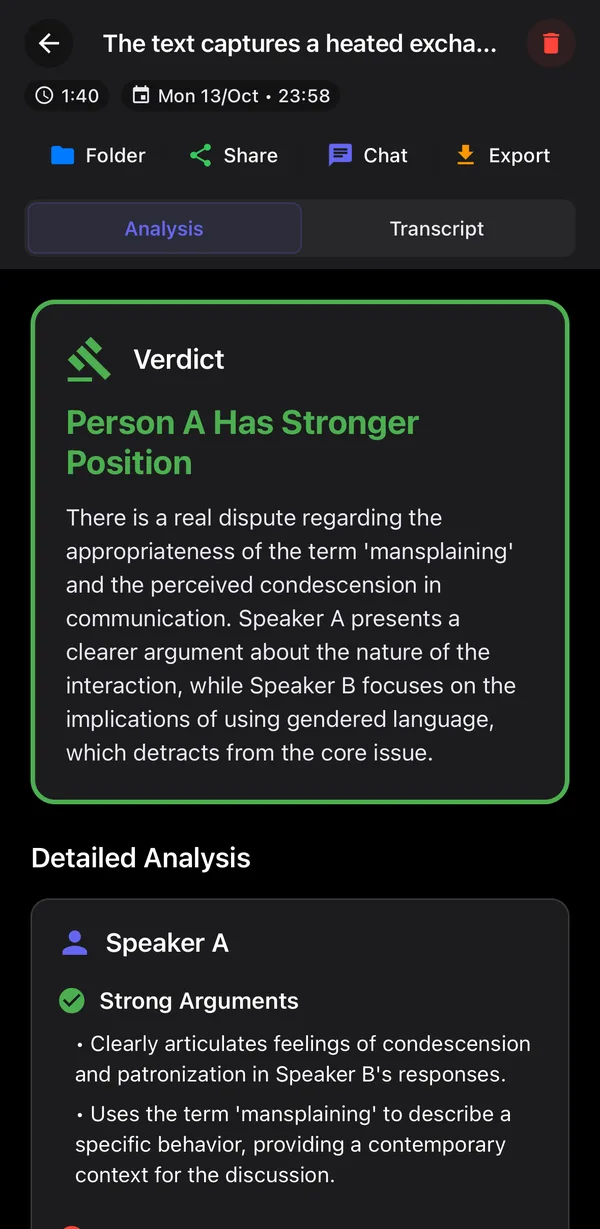
Type both sides and get a fair verdict, with the fallacies on each side. Free.
Questions people ask
What is the difference between a boundary and a rule?
A boundary is about what you will do; a rule tries to control what someone else does. Boundaries work without the other person's cooperation, while rules depend on them obeying.
Is a boundary the same as an ultimatum?
No. An ultimatum is a demand with a deadline and a threat, meant to force a change. A boundary is an honest statement of what you will do. The same words can be either, depending on whether you mean them and whether you're informing or pressuring.
Can a boundary be controlling?
When a so-called boundary dictates someone else's behavior, like who they see or what they wear, it is control rather than a boundary. Healthy boundaries protect you without restricting the other person's choices.
What is an example of a healthy boundary?
"I don't answer work messages after 7 p.m." or "If the conversation turns into yelling, I'll take a break and come back in twenty minutes." Both describe your own action and don't require anyone else to obey.
Sources
Keep reading
- GuidesFair Fighting RulesFair fighting rules are agreements two people make about how they will argue: one topic at a time, complaints about behavior instead of attacks on character, no contempt or name-calling, real listening before rebutting, and a time-out when either person is too upset to think. The goal is to solve the problem without wounding each other.
- GuidesAssertive vs Aggressive vs Passive AggressiveAssertive vs aggressive comes down to whether both people's needs count. Assertive means saying what you need directly while respecting the other person. Aggressive means pushing your needs in a way that runs over theirs. Passive means not saying what you need at all, and passive aggressive means saying it sideways, through sarcasm, sulking or "forgetting."
- GuidesI StatementsI statements are sentences that describe your own feelings and needs instead of judging the other person, for example 'I feel overwhelmed when the dishes pile up, and I need a hand tonight' instead of 'You never help.' They raise a problem without putting the listener on trial, so it can be solved.
- GuidesHow to Stop ArguingTo stop arguing, pause when either of you is too upset to think, take a break of at least 20 minutes with a set time to come back, then restart gently on one issue. Understand the other person's side before persuading. If it's the same fight on repeat, talk about why it matters to each of you.
- GuidesEmotional FloodingEmotional flooding is physical and emotional overwhelm during conflict: your heart races, stress hormones surge, and you lose the ability to listen or think flexibly. People who are flooded tend to attack or shut down. The fix is to notice the signs early, call a break of at least 20 minutes, and actually calm your body before talking again.
The ArgueResolver app · iPhone and Android
Record the argument. Get the verdict.
ArgueResolver listens while you talk it out, works out who said what, and gives an honest verdict on what was actually said, with compromises and steps to fix it.
Free to start · See how it works