Sealioning: What It Means, Where It Came From and How to Respond
Also called: sea lioning, sea-lioning
Updated · 6 min read · 3 sources
The short answer
Sealioning is a bad-faith tactic in which someone keeps a conversation going with endless, politely worded questions and demands for evidence, not to learn but to wear the other person down. Refusing to keep answering is then framed as proof you can't back up your view. The name comes from a 2014 Wondermark comic about a persistent sea lion.
What is sealioning?
Sealioning is harassment dressed up as curiosity. The sealion shows up, often uninvited, and asks for sources, definitions and explanations, one after another, in a calm and reasonable tone. Each answer earns a new question. If you get tired or annoyed, the sealion points out that they've been perfectly polite and you're the one refusing to have a civil discussion.
What makes it work is that every single question sounds fair. The problem isn't any one request; it's the pattern, the persistence and the purpose. The aim is to exhaust you or make you look unreasonable, not to understand anything.
Where does the term sealioning come from?
The word comes from 'The Terrible Sea Lion,' a Wondermark comic by David Malki, published on September 19, 2014. A woman remarks that she could do without sea lions. A sea lion overhears and keeps asking her to back up her opinion with evidence, eventually turning up in her house, complaining about her rudeness while insisting that he has been nothing but polite.
Readers quickly turned the comic into a verb. About a month later, Malki rounded up posts from people already using 'sea lioning' and 'sealioned' as verbs for a kind of online harassment. Wikipedia's account notes that the term spread as a name for a specific style of trolling and that Merriam-Webster added it to its 'Words We're Watching' list in 2020.
Sealioning examples
Signs of sealioning
No single question proves bad faith. Look at the whole exchange:
- Answers never change anything. Whatever you provide, the next demand is already waiting.
- They ask you to source things that are common knowledge, or that they could look up in seconds.
- They rarely state a position of their own, so there's nothing on their side to examine.
- Politeness is used as a weapon: 'I'm just asking a question' or 'Why are you getting so emotional?'
- They joined a conversation that wasn't with them, or keep coming back after you've stepped away.
- Declining to continue is treated as losing: 'So you admit you can't back it up.'
Sealioning vs honest questions
Asking for evidence is not sealioning. Plenty of people genuinely want to understand, and a request for sources is often fair, especially after a strong claim. If you make a big claim, you do carry some burden of proof. The difference shows up over time, in what the person does with your answers.
- An honest question
- Builds on what you said, accepts 'I don't have that handy' or 'I don't want to debate this now,' and can name what would change the asker's mind.
- Sealioning
- Skips past the answer to the next demand, never says what would be enough, and treats any limit you set as a confession.
Sealioning offline: in families and relationships
The term was born online, but the pattern shows up at home too. A partner who answers every concern with 'Prove it. When exactly? Who else heard it?' and then finds a new gap after each answer. A relative who spends a holiday dinner politely asking you to justify your career choice, one question at a time. A coworker who 'just has a few questions' about your proposals in every meeting, and never about anyone else's.
It's a cousin of the Gish gallop: both try to win by volume. The gallop floods you with claims; sealioning floods you with demands. And as with moving the goalposts, the point at which you've given 'enough' evidence never seems to arrive.
Why the label can be misused too
Calling someone a sealion can become its own dodge. If every pointed question gets dismissed as sealioning, you never have to answer anything hard. That's not fair to people who are asking in good faith, and it's worth checking yourself before you reach for the word.
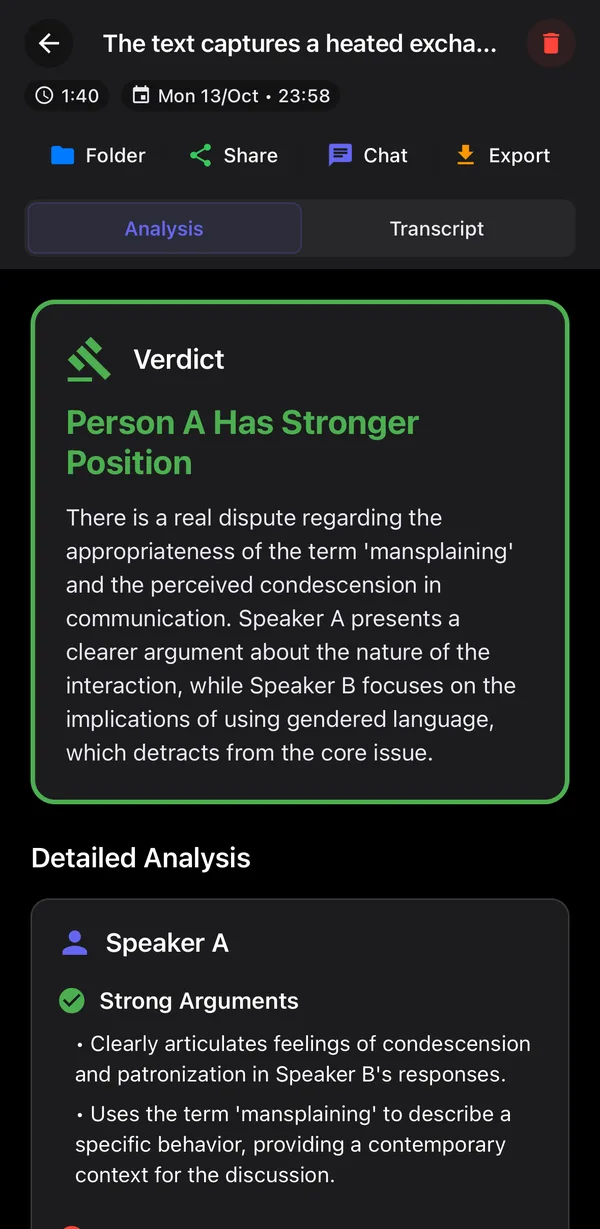
A useful test: has the person engaged with your answers, or only collected more questions? Have they said what they think? Would one more good answer actually move them? If you're unsure whether a back-and-forth was fair, pasting it into our free argument judge can give you a neutral read on who was actually responding to whom.
How to respond without getting baited
You don't owe anyone an endless debate. The goal is to stay fair to honest questions while refusing to be run in circles.
- Answer once, and answer well. Give your best explanation or source a single time.
- Ask what would settle it. 'What would change your mind?' A good-faith questioner can answer that. A sealion usually can't.
- Ask for their position. 'What do you think, and why?' puts some weight on their side of the conversation.
- Set a limit and keep it. 'I've explained my view, and I'm going to leave it there.' You don't need their agreement to end a conversation.
- Remember the audience. Online, onlookers can usually see who is being reasonable. Stepping away is not losing.
What to say
I've answered that as well as I can. What would actually change your mind?
You've asked me a lot. What's your position, and what's it based on?
Being polite doesn't make this a fair conversation. I'm going to step out of it.
Happy to answer one more. After that, I'd like to hear your take.
I don't want to be cross-examined. I do want to solve this, so let's talk about what we do now.
In an argument right now?
Type both sides and get a fair verdict, with the fallacies on each side. Free.
Questions people ask
What does sealioning mean?
Sealioning means pestering someone with relentless, polite-sounding questions and requests for evidence while claiming to be sincere, in order to exhaust them or make them look unreasonable for refusing.
Where did the term sealioning come from?
From 'The Terrible Sea Lion,' a Wondermark comic by David Malki published in September 2014, in which a sea lion overhears a woman's passing remark and keeps demanding that she justify it, even inside her home.
Is asking for sources sealioning?
No. Asking for evidence is often reasonable. It becomes sealioning when it's relentless, unwelcome, and no answer is ever accepted as enough.
Is sealioning a logical fallacy?
Not strictly. It's a conversational tactic or a form of trolling rather than an error in an argument's logic, though it often travels with fallacies such as shifting the burden of proof.
Sources
Keep reading
- FallaciesGish GallopA Gish gallop is an argument tactic where someone fires off so many claims, accusations or links, so quickly, that the other person cannot possibly answer them all. Quantity replaces quality: each weak point takes seconds to say and minutes to untangle, so whatever goes unanswered starts to look true.
- FallaciesBurden of Proof Fallacy and the Appeal to Ignorance, ExplainedThe burden of proof fallacy is making a claim and then demanding that others disprove it, instead of supporting it yourself. Its close cousin, the appeal to ignorance, treats a lack of evidence as proof: "you can't prove it didn't happen, so it did." The person making a claim usually carries the burden of backing it up.
- FallaciesMoving the GoalpostsMoving the goalposts is changing what counts as proof, or as success, after the other person has already met the original standard. Instead of accepting the result, the person adds a new requirement, so the conclusion they started with can never be lost. It turns a disagreement into a game nobody else can win.
- FallaciesLoaded Question FallacyA loaded question fallacy is a question that smuggles in an assumption the other person has not agreed to, so any direct yes or no answer seems to admit it. "Why do you always embarrass me in front of my friends?" assumes you always do. The fair move is to answer the assumption first.
- GuidesDeflection in ArgumentsDeflection is redirecting attention away from something uncomfortable, usually your own behavior, so it never gets discussed. In an argument it looks like changing the subject, bringing up an old fight, joking it off or turning the question back on the other person. Deflection protects the person for a moment and leaves the problem untouched.
The ArgueResolver app · iPhone and Android
Record the argument. Get the verdict.
ArgueResolver listens while you talk it out, works out who said what, and gives an honest verdict on what was actually said, with compromises and steps to fix it.
Free to start · See how it works