Should Eggs Be Refrigerated? In the US, Yes. Here's Why
Updated · 5 min read · 4 sources
The short answer
Should eggs be refrigerated? In the US, yes. American eggs are washed and sanitized before they are sold, and the FDA requires them to be kept at 45°F or colder starting 36 hours after they are laid. At home, store them at 40°F or below. Much of Europe skips the fridge because most EU eggs are never washed.
Should eggs be refrigerated?
Should eggs be refrigerated? If you bought them at a US grocery store, yes, every time. The FDA's advice to consumers is to buy eggs only from a refrigerated case and store them in a clean refrigerator at 40°F or below. This is not a matter of taste: American eggs go through a process that makes cold storage necessary.
The argument usually starts when someone who grew up in Europe, or has traveled there, points out that stores in many European countries sell eggs on an unrefrigerated shelf. They are right about Europe. They are just talking about a different egg.
Why US eggs need the fridge
According to the USDA's Agricultural Research Service, US producers began washing and refrigerating eggs in the early 1970s because of concerns about spoilage and foodborne illness. Processors taking part in USDA grading spray-wash eggs with warm water, use a sanitizing rinse and air-dry them. The aim is to reduce Salmonella on the shell.
Once eggs are washed, they have to stay cold. The FDA requires egg producers to keep eggs at 45°F starting 36 hours after they are laid, and its Egg Safety Rule requires refrigeration during storage and transport. The FDA estimates the rule prevents about 79,000 cases of foodborne illness and 30 deaths a year. It also warns that even fresh eggs with clean, uncracked shells may contain Salmonella, which is why cooking matters too.
The verdict
- US eggs are washed and sanitized, so they need cold storage.
- The FDA requires eggs to be kept at 45°F or colder from 36 hours after laying.
- USDA research found room temperature eggs dropped from Grade AA to Grade B within a week.
- Most of Europe sells eggs unrefrigerated.
- Unwashed eggs keep their natural shell coating.
- Generations of home cooks kept eggs out without problems.
What it sounds like
Why Europe does it differently
In most of the European Union, eggs are neither washed nor refrigerated in stores. Instead of washing the shell, European and British rules go after Salmonella at the source, with regular testing of laying flocks and strict hygiene rules on farms. Because the eggs are not washed, they keep the thin natural coating on the shell, called the cuticle.
The cuticle is often described as a shield against bacteria, but even that is debated. An ARS researcher points out that the cuticle dries and comes off after laying, and that its job is to control respiration for a developing chick, not to block Salmonella. Canada, Japan and the Scandinavian countries also wash and refrigerate their eggs, so the US is not alone.
What the egg storage research found
The USDA's Agricultural Research Service compared 5,400 eggs stored four ways over 15 weeks, including washed and unwashed eggs, refrigerated and at room temperature. Refrigerated eggs, washed or not, were still Grade A on average after 15 weeks. Unwashed eggs kept at room temperature, about 72°F, dropped from Grade AA to Grade B within a week and lost 15 percent of their weight over the study.
The summary from the study is the whole argument in one line: egg quality stays high with refrigeration and degrades rapidly without it.
How to store eggs at home
Follow the FDA's rules and the argument goes away:
- Buy eggs only from a refrigerated case.
- Store them in the refrigerator at 40°F or below. A fridge thermometer helps.
- Once eggs have been refrigerated, keep them cold. Do not leave cooked eggs or egg dishes out for more than 2 hours, or 1 hour above 90°F.
- Cook eggs until the yolk and white are firm, and cook egg dishes to 160°F.
- Farm eggs from small flocks may fall under state rules rather than federal ones. If the farmer refrigerated them, keep them refrigerated.
The ruling
In the US, refrigerate your eggs. American eggs are washed, the FDA requires them to be kept cold from soon after laying, and the research shows quality drops fast at room temperature. The European side is right about European eggs and wrong about American ones.
"They don't refrigerate eggs in Europe" is a true fact used as a bad argument, a bit of cherry picking that leaves out the washing that makes the difference. "My grandma never refrigerated hers" has the same flaw: her eggs came from her own hens, and judging store eggs by them is a hasty generalization. Still arguing? Paste both sides into the argument judge.
In an argument right now?
Type both sides and get a fair verdict, with the fallacies on each side. Free.
Questions people ask
Why don't Europeans refrigerate eggs?
Most EU eggs are not washed before sale, so they keep their natural shell coating, and Salmonella is controlled on the farm through flock testing and hygiene rules. US eggs are washed, so they must stay cold.
Can eggs sit out overnight?
Not store-bought US eggs. Once refrigerated eggs warm up they should not be left out for more than about 2 hours, and the FDA says the same for cooked eggs and egg dishes.
What temperature should eggs be stored at?
At home, 40°F or below, according to the FDA. Producers must keep eggs at 45°F or colder starting 36 hours after laying.
Do farm fresh eggs need to be refrigerated?
Small farms may follow state rules instead of federal ones, so ask how the eggs were handled. If they were washed or refrigerated, keep them in the fridge.
Sources
Keep reading
- DebatesShould You Wash Chicken Before Cooking?Should you wash chicken? No. The CDC says raw chicken is ready to cook and does not need washing, and rinsing it can spread germs around your sink and onto other food. Cooking chicken to an internal temperature of 165°F is what kills the bacteria. Wash your hands, keep raw chicken away from other food, and clean the sink instead.
- FallaciesCherry Picking FallacyThe cherry picking fallacy is selecting only the facts, examples or quotes that support your side while ignoring the ones that don't. Each picked item may be true, but the overall picture is false. Showing a friend three screenshots out of a two-hour text fight is a common everyday version.
- FallaciesHasty GeneralizationA hasty generalization is a sweeping conclusion drawn from too few examples, or from examples that aren't typical: one unanswered text becomes 'you never answer me', one messy roommate becomes 'people from that school are slobs'. The examples may be real. There just aren't enough of them to support a claim about always, never or everyone.
- FallaciesAppeal to Authority FallacyAn appeal to authority is a fallacy when a claim is treated as settled just because someone with status said it, especially when that person isn't an expert on the topic, is quoted out of context or disagrees with most experts. Citing real expertise on its own subject is a good reason. The fallacy is using a name in place of evidence.
- DebatesIs Cereal a Soup?Is cereal a soup? No. Dictionaries describe soup as a liquid food usually made by cooking vegetables, meat or fish, and cereal is dry grain with cold milk poured over it at the table. The soup side does have one great point: the earliest soups were bread soaked in liquid, which is close to what cereal is.
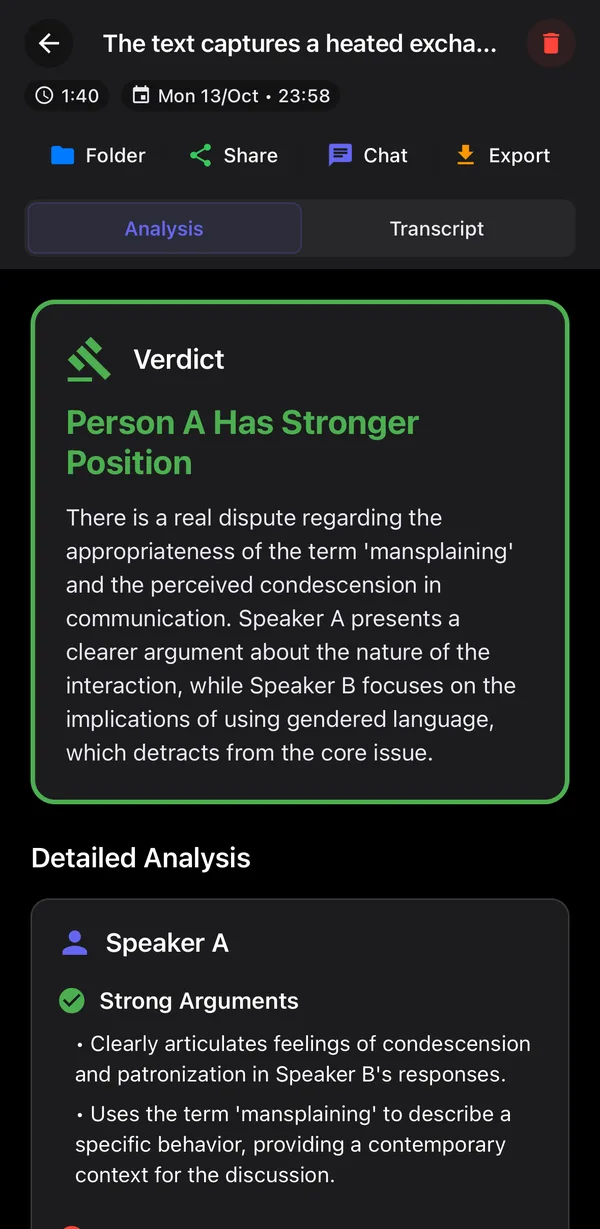
The ArgueResolver app · iPhone and Android
Record the argument. Get the verdict.
ArgueResolver listens while you talk it out, works out who said what, and gives an honest verdict on what was actually said, with compromises and steps to fix it.
Free to start · See how it works