Is Cheesecake a Cake or a Pie? The Argument, Settled
Updated · 5 min read · 6 sources
The short answer
Is cheesecake a cake or a pie? By how it is built, it is closer to a pie: a crust holding a filling of soft cheese, eggs and sugar that bakes like a custard, usually without flour. By name, it is a cake, and some dictionaries call it one. Our ruling: cheesecake is a custard pie with a cake's name.
Is cheesecake a cake or a pie?
Is cheesecake a cake or a pie? The name says cake, the structure says pie, and food writers have been arguing about it for years. Even reference books disagree: some call it a cake, some a custard pie, some a tart or a torte. Wikipedia's summary of the debate says modern cheesecake is not usually classified as an actual cake, despite the name.
Names are weak evidence in food arguments. Boston cream pie is a cake, after all, and nobody thinks its name settles anything. So the honest way through this one is to look at what cheesecake is made of and how it is baked, then decide whether the name gets a vote at all.
The case for cake
The cake side starts with the name, which has been around in English since the 15th century. It also has a dictionary: the Cambridge Dictionary defines cheesecake as a cake made from a layer of biscuit or sweet pastry base, covered with soft cheese, eggs, sugar and sometimes fruit.
Then there is how we eat it. Cheesecake is baked in a round springform pan, cut into wedges, served at birthdays, and sold in the cake case at bakeries. Some styles also lean hard toward cake: Japanese cheesecake, sometimes called cotton or souffle-style cheesecake, is airy and wobbly, closer to a chiffon cake than to a pie filling.
- It has been called cheesecake for centuries.
- A major dictionary defines it as a cake.
- It is served, sliced and sold like a cake, and some styles are light and spongy.
The verdict
- It has been called cheesecake for centuries.
- The Cambridge Dictionary defines it as a cake.
- It is served and sold like a cake, and Japanese-style cheesecake is light like one.
- It is a filling in a separate crust, the basic shape of a pie.
- The filling is a custard of cheese, eggs and sugar with little or no flour, not a cake batter.
- It is baked in a water bath like other custards, and fits the definition of a custard pie.
What it sounds like
The case for pie: crust plus custard
The pie side argues from ingredients and structure. Cambridge defines a cake as a sweet food made from flour, eggs, fat and sugar mixed together and baked. A classic cheesecake filling is soft cheese, eggs and sugar, usually with little or no flour, poured over a separate crust. That is not a cake batter.
It is, however, a custard. Custard is sweetened milk, cream or cheese thickened by cooking it with eggs. And a custard pie is defined as an uncooked custard mixture poured into a crust and baked together, which is exactly how most baked cheesecakes are made. Pumpkin pie belongs to the same family, and nobody calls pumpkin pie a cake.
How cheesecake is baked
The oven tells the same story. America's Test Kitchen groups cheesecake with creme brulee and flan as custard recipes whose success depends on a water bath, which lets these delicate desserts cook slowly and evenly. In its tests, starting the bath with boiling water gave cheesecake a smoother, more uniform texture than cold or room-temperature water.
Custards need that gentle treatment because a mixture thickened with eggs overcooks and curdles if it gets just a few degrees too hot. A typical cake batter goes into the oven with no water bath at all. Cheesecake gets handled like a custard because it is one.
Torte, tart or something else?
The argument is not only cake versus pie. Some bakers call baked cheesecake a torte, because eggs are its only leavening. Others call it a flan or a tart, and food writer Alan Davidson came down on the tart side.
Two styles muddy things further. No-bake cheesecake, set in the fridge on a cookie crumb base, is not baked at all, and Basque cheesecake skips the crust entirely and is essentially a burnt custard. Neither one behaves like a cake. If you are arguing about a slice of either, know which cheesecake you are holding before you start, or you will end up in equivocation, two people using one word for two different desserts.
The ruling
Cheesecake is a pie, specifically a custard pie, that happens to be named cake. The filling is a baked custard of cheese, eggs and sugar with little or no flour, it sits in a crust, and it is baked in a water bath like a custard. The cake side is right about the name and about how we serve it, and the light Japanese style is a genuine exception.
This is the same kind of fight as whether a tomato is a fruit or whether cereal is a soup: a structural definition on one side, a familiar name on the other. Call it cheesecake and nobody will be confused. If the birthday table cannot let it go, paste both sides into the argument judge.
In an argument right now?
Type both sides and get a fair verdict, with the fallacies on each side. Free.
Questions people ask
Is cheesecake a pie?
Structurally, yes. A baked cheesecake is a custard of soft cheese, eggs and sugar poured into a crust and baked together, which matches the definition of a custard pie, like pumpkin pie.
Why is cheesecake called a cake?
The name is centuries old and stuck regardless of how the dessert is made. Names are not reliable in baking: Boston cream pie, for example, is actually a cake.
Is cheesecake a custard?
The filling of a baked cheesecake is a custard, since it is set by baking soft cheese and sugar with eggs. That is why it is usually baked gently in a water bath, like creme brulee or flan.
Does cheesecake have flour?
Classic baked cheesecake fillings rely on soft cheese, eggs and sugar rather than flour, which is one reason many bakers argue it is not a true cake. Japanese-style cheesecake is the exception that comes closest, with a light texture like chiffon cake.
Sources
Keep reading
- DebatesIs a Tomato a Fruit or a Vegetable?Is a tomato a fruit? Botanically, yes: it grows from the flower's ovary and carries the seeds, which makes it a berry. In the kitchen it is used as a vegetable, and the US Supreme Court treated it as one for tariff purposes in Nix v. Hedden (1893). Our ruling: both sides are right, each in its own field.
- DebatesIs Cereal a Soup?Is cereal a soup? No. Dictionaries describe soup as a liquid food usually made by cooking vegetables, meat or fish, and cereal is dry grain with cold milk poured over it at the table. The soup side does have one great point: the earliest soups were bread soaked in liquid, which is close to what cereal is.
- DebatesIs a Hot Dog a Sandwich?Is a hot dog a sandwich? By a broad dictionary definition, yes: it is a filling served in split bread, and Merriam-Webster has said it counts. In everyday use, no: nobody orders one by asking for a sandwich, and the hot dog industry says it is its own thing. Our ruling: technically a sandwich, practically a hot dog.
- DebatesPineapple on PizzaDoes pineapple on pizza belong? It is a question of taste, not fact, so nobody can be proven wrong. Hawaiian pizza is credited to a restaurant owner in Ontario, Canada, in 1962, and American pizza eaters are split on it. Our ruling: pineapple belongs on the pizza of anyone who likes it, and on nobody else's slice.
- FallaciesEquivocation FallacyThe equivocation fallacy is using one word in two different senses within the same argument, so a conclusion seems to follow when it doesn't. "You told me to be more spontaneous, so why are you mad I booked a trip without asking?" slides from spontaneous dates to spontaneous spending. Most equivocation in arguments is accidental.
The ArgueResolver app · iPhone and Android
Record the argument. Get the verdict.
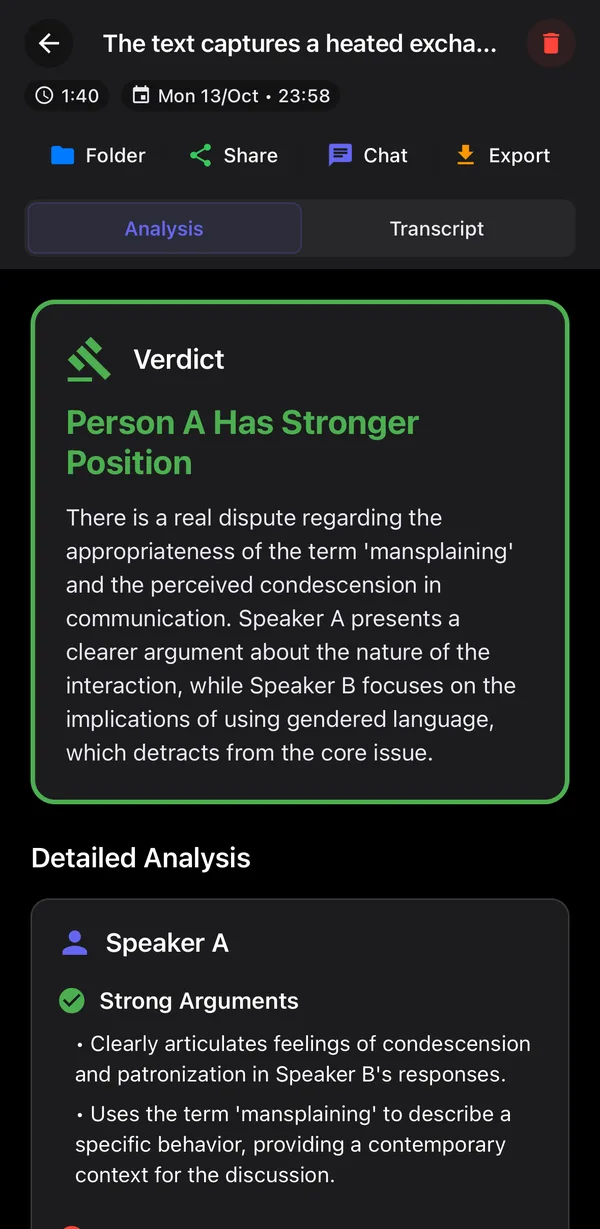
ArgueResolver listens while you talk it out, works out who said what, and gives an honest verdict on what was actually said, with compromises and steps to fix it.
Free to start · See how it works