Does Cracking Knuckles Cause Arthritis? What the Evidence Says
Updated · 5 min read · 6 sources
The short answer
Does cracking knuckles cause arthritis? No. Studies comparing habitual knuckle crackers with people who don't crack have found no difference in hand arthritis, and a doctor who cracked only his left hand for more than 60 years found no difference between his hands. The pop comes from gas in the joint fluid, not bones grinding.
Does cracking knuckles cause arthritis?
Does cracking knuckles cause arthritis? The research says no. Harvard Health and Cleveland Clinic both conclude that the habit is not linked to arthritis, and studies of hundreds of people back them up. The warning you heard as a kid, that you will ruin your hands, is one of the most tested and least supported health myths around.
That does not mean the person complaining has no case. The sound can be genuinely annoying, and forceful cracking can occasionally injure a finger. But if the argument is specifically about arthritis, the cracker wins.
What makes the cracking sound?
Your finger joints are cushioned by synovial fluid, which contains dissolved gas. When you pull or bend a knuckle, the space inside the joint widens and the pressure drops. The classic explanation is that a gas bubble bursts; a 2015 MRI study, described by Cleveland Clinic, instead caught a gas-filled cavity forming at the moment of the crack. Researchers still debate the exact mechanism.
Either way, the noise is gas, not bone. Harvard Health notes that you can't crack the same knuckle again right away because the gas needs time to build back up. That is why a knuckle you just cracked won't pop again for a while.
The verdict
- A 2011 study found hand osteoarthritis in 18.1% of crackers and 21.5% of non-crackers, not a significant difference.
- A 1990 study of 300 patients found no more arthritis in crackers.
- One doctor cracked only his left hand for over 60 years with no difference between hands.
- A 1990 study linked habitual cracking to hand swelling and weaker grip.
- Very forceful cracking has rarely caused dislocations and tendon injuries.
- The sound is annoying to the people nearby.
What it sounds like
The doctor who cracked one hand for 60 years
The most famous evidence is an experiment of one. Donald Unger, a California physician, cracked the knuckles of his left hand every day for more than 60 years and never cracked his right hand, so the right could serve as a comparison. He reported in the journal Arthritis and Rheumatism in 1998 that he found no difference in arthritis between his hands, and the work earned him the 2009 Ig Nobel Prize in Medicine.
One person is not proof, and it would be an anecdotal argument if it were the only evidence. It is not. Larger studies point the same way.
What larger studies found
Three studies are worth knowing if this argument comes up at dinner:
- 1990, 300 patients
- Researchers compared 74 habitual knuckle crackers with 226 people who did not crack, all aged 45 or older. Arthritis of the hand was no more common in either group. The crackers were more likely to have hand swelling and lower grip strength, but they were also more likely to do manual labor, bite their nails, smoke and drink, which muddies the picture.
- 2011, 215 adults aged 50 to 89
- A study using hand X-rays found osteoarthritis in 18.1% of knuckle crackers and 21.5% of non-crackers, a difference that was not statistically significant. How long or how often people had cracked made no difference either.
- 2017, 40 adults
- Researchers examined 30 habitual crackers and 10 non-crackers with ultrasound and blinded physical exams. They found no differences in hand function scores or grip strength, no swelling, and slightly more range of motion right after a crack.
Is cracking your knuckles bad for you in any way?
Mostly no. Harvard Health says knuckle cracking is unlikely to cause harm, though it mentions rare reports of dislocations and tendon injuries from overly forceful cracking. A Cleveland Clinic sports medicine doctor gives the same caution: pushing too hard or pulling in the wrong direction could dislocate a knuckle or injure a ligament.
The grip strength worry comes from the 1990 study, and the 2017 study did not find it. So the honest summary is that ordinary cracking looks harmless, and forcing a joint that won't crack is a bad idea.
When to see a doctor
Cleveland Clinic's advice is simple: cracking should not hurt. As long as you have no pain or swelling, it is probably fine. See a healthcare provider if you notice:
- Pain when you crack a joint or afterward.
- Swelling in a finger or knuckle.
- A finger that looks crooked or out of place.
- Noises in your knees or other joints that come with pain or swelling. Harvard Health says joint sounds without those symptoms are probably nothing to worry about.
The ruling
No, cracking your knuckles does not cause arthritis. The person who cracks wins the health argument, and the person who hates the sound is free to keep complaining about the noise, which is a fair point about living together rather than a medical one.
"My grandfather cracked his knuckles and got arthritis" is a post hoc argument: one case can't show the habit caused it, especially when larger studies find no link. If you want someone to stop, say what actually bothers you with an I statement ("the sound gets to me during movies") instead of a health scare. Still arguing? Run it past the argument judge.
In an argument right now?
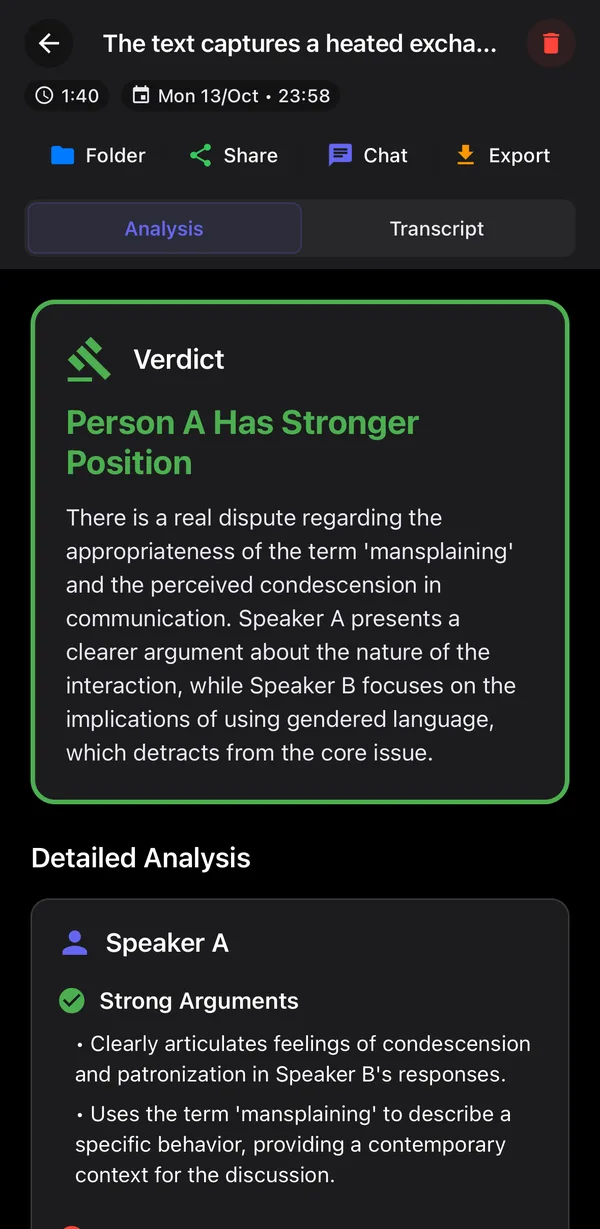
Type both sides and get a fair verdict, with the fallacies on each side. Free.
Questions people ask
Why do my knuckles crack?
Pulling or bending the joint lowers the pressure in the fluid inside it, and gas forms a bubble or cavity with a pop. Scientists still debate the exact mechanism, but it is gas, not bone.
Is it bad to crack your knuckles?
Not as far as studies can tell, as long as it does not hurt. Very forceful cracking has rarely caused dislocations or tendon and ligament injuries, so don't force a joint.
Does cracking your knuckles weaken your grip?
The evidence is mixed. A 1990 study found lower grip strength in habitual crackers, but a 2017 study using blinded exams found no difference.
Why can't I crack the same knuckle twice in a row?
The gas in the joint fluid needs time to build back up before the joint can pop again, according to Harvard Health.
When should I worry about my joints cracking?
When cracking comes with pain, swelling, or a finger that looks crooked. In those cases, see a healthcare provider.
Sources
- Harvard Health: Knuckle cracking: Annoying and harmful, or just annoying?
- Cleveland Clinic: Should You Crack Your Knuckles?
- Improbable Research: Ig Nobel Prize winners (2009 Medicine, Donald L. Unger)
- Castellanos and Axelrod, Effect of habitual knuckle cracking on hand function (Ann Rheum Dis, 1990)
- deWeber et al., Knuckle Cracking and Hand Osteoarthritis (J Am Board Fam Med, 2011)
- Boutin et al., Knuckle Cracking: Can Blinded Observers Detect Changes? (Clin Orthop Relat Res, 2017)
Keep reading
- FallaciesPost Hoc Ergo Propter HocPost hoc ergo propter hoc (Latin for 'after this, therefore because of this') is the fallacy of assuming that because one thing happened after another, the first caused the second: 'Ever since your mom visited, you've been distant.' The timing may be a clue, but coincidence, a shared cause or something else entirely could explain it.
- FallaciesAnecdotal FallacyThe anecdotal fallacy is using a personal story or an isolated example in place of solid evidence about a general claim. "My grandpa never wore a seatbelt and lived to ninety" says nothing about whether seatbelts save lives. Stories are vivid and memorable, which is exactly why they can outweigh better evidence in an argument.
- GuidesI StatementsI statements are sentences that describe your own feelings and needs instead of judging the other person, for example 'I feel overwhelmed when the dishes pile up, and I need a hand tonight' instead of 'You never help.' They raise a problem without putting the listener on trial, so it can be solved.
- DebatesDoes Cold Weather Make You Sick?Does cold weather make you sick? Not by itself. Colds and flu are caused by viruses, so cold air alone can't infect you. But winter helps those viruses: people crowd indoors, cold and dry air helps flu spread, and lab research suggests a chilled nose fights viruses less well. Both sides of this argument are partly right.
- DebatesIs It Bad to Sleep With Wet Hair?Is it bad to sleep with wet hair? Not for catching a cold; colds come from viruses. But dermatologists say it isn't great for your hair or scalp: wet hair is more fragile and can break from pillow friction, and a damp scalp can encourage yeast and bacteria. An occasional wet night is fine; a nightly habit is worth changing.
The ArgueResolver app · iPhone and Android
Record the argument. Get the verdict.
ArgueResolver listens while you talk it out, works out who said what, and gives an honest verdict on what was actually said, with compromises and steps to fix it.
Free to start · See how it works